
 On February 10, 2005, in Carson City, Nevada, my wife and I stood before the Governor of Nevada, Kenny Guinn, along with the Nevada Supreme Court and the Nevada Attorney General. After a brief discussion, they unanimously granted me a full pardon for the crime that had sent me to prison in 1988. I was elated at this incredible blessing. Having a felony conviction had hindered me from obtaining jobs, securing housing, enrolling in academic institutions, and exercising my right to own and bear arms. The full pardon removed all those restrictions. And by the grace of God, a few months later, I was further blessed when a judge in Clark County, Nevada, agreed to seal my criminal records permanently. Now, if anyone runs a criminal background check on me, it comes back entirely blank—white as snow. Praise God!
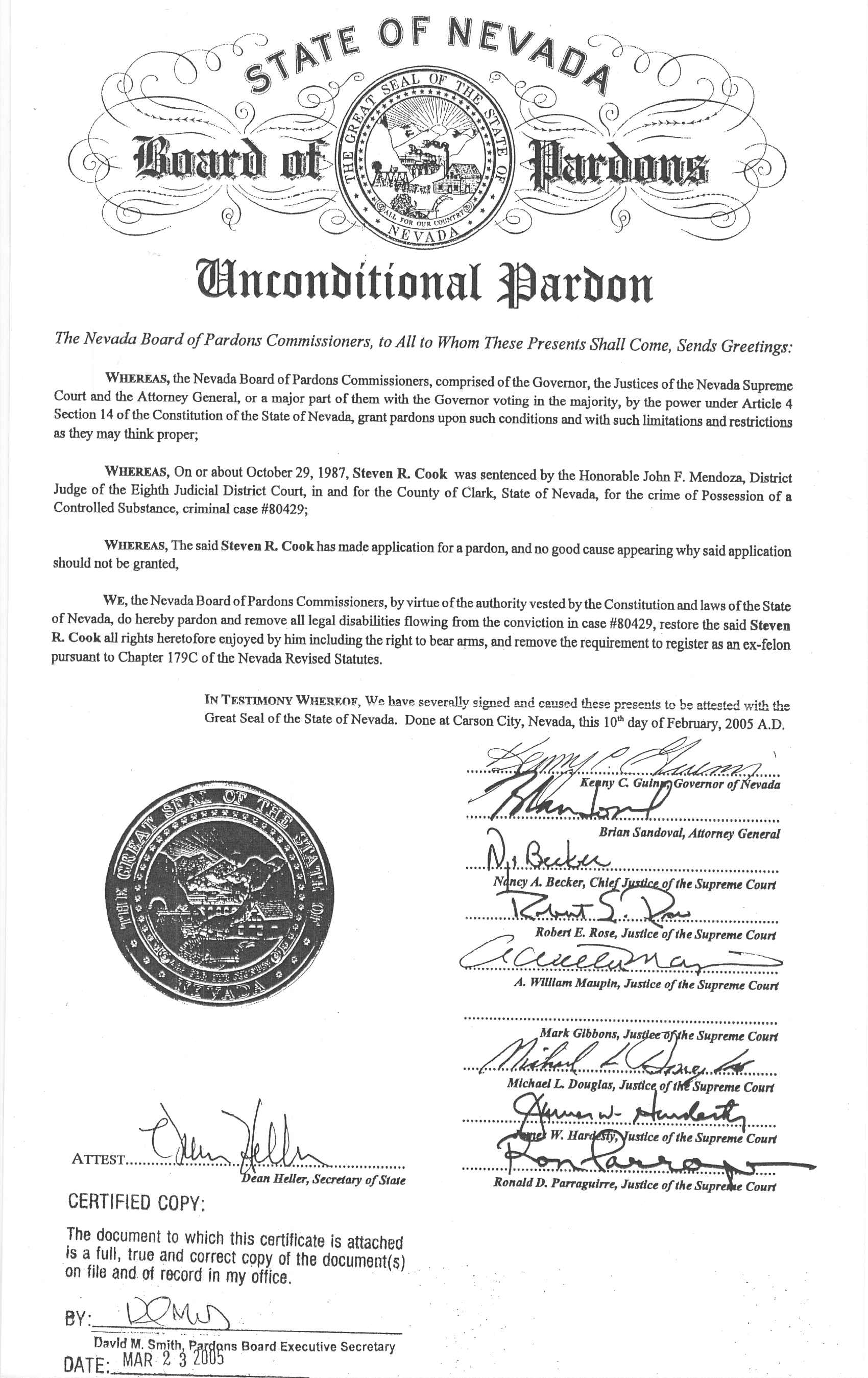 God, in His sovereignty, orchestrated the events that led to my full pardon and the sealing of my records. He opened the door and made a way for this blessing. This was an expression of His unfailing love and logistical grace. The Word of God makes it clear that God is gracious and merciful and full of compassion (Psa 103:8-12). Jeremiah wrote, “The LORD’S lovingkindnesses indeed never cease, for His compassions never fail. They are new every morning; great is Your faithfulness” (Lam 3:22-23). Oh, how I rejoice in the goodness of God, for He has reached into time and space—into my life—and sovereignly worked to remove barriers and open doors for me. I say, “Bless the LORD, O my soul, and forget none of His benefits” (Psa 103:2), for “There is no other God like You! You forgive sin and pardon the rebellion of those who remain among Your people. You do not remain angry forever, but delight in showing loyal love” (Mic 7:18).
From a governmental perspective, my case highlights the proper function of civil authority as established by God. According to Romans 13:1-4, the role of government is to administer justice, restrain evil, and uphold righteousness. When the legal system operates properly, it punishes wrongdoing but also provides a mechanism for rehabilitation and restoration. A government that grants legitimate pardons recognizes when justice has been satisfied and allows individuals who have demonstrated change to reintegrate into society. This is government functioning under divine establishment principles, upholding justice while also applying mercy where appropriate. The restoration of my rights—including my ability to work, live freely, and bear arms—underscores a critical principle: government should never place an undue burden on those who have been rehabilitated (Prov 29:4; 1 Tim 2:1-2). My duty is to be a good citizen and abide the laws of the land, knowing that if I “Do what is good…[I] will have praise from the same” (Rom 13:3).
Distinctions Between Human and Divine Pardons
As an American citizen and a Christian, I have the privilege of being pardoned both by human officials and by the God of Heaven. Of course, the latter is infinitely more valuable. Though there are similarities between human and divine pardons, there are also appreciable differences.
 Typically, a human pardon is granted based on perceived reformation, good behavior, or other justifying factors, considering whether the person has demonstrated remorse, rehabilitation, and is a low risk of reoffending. At the time of my pardon, I had gone fifteen years with steady employment, was involved in jail ministry for twelve years, and was half way through my Master’s degree. These governmental officials who granted me the pardon could see the track record of my improved behavior. In contrast, a divine pardon is granted solely by grace through faith in Christ, requiring no promise of moral improvement (Eph 2:8-9; Tit 3:5). The Bible teaches that “everyone who believes in Him receives forgiveness of sins” (Acts 10:43). Here, forgiveness is granted solely on the basis of faith in Christ. There is no mention of works, rituals, or human merit—only faith in Christ as the necessary and sufficient condition for receiving pardon. Elsewhere, it is written, “In Him we have redemption through His blood, the forgiveness of our trespasses, according to the riches of His grace” (Eph 1:7). Here, the basis of forgiveness is Christ’s sacrificial death, and the means by which it is applied to the believer is God’s grace. The phrase “according to the riches of His grace” underscores that forgiveness is entirely an unmerited gift from God, not something earned or deserved.
Furthermore, the moment a person believes in Jesus Christ as Savior, God declares that person righteous on the grounds that God’s perfect righteousness has been credited to their account (Rom 4:5-7). God gives His righteousness to one who believes in Christ as Savior. The Apostle Paul describes this as “the gift of righteousness” (Rom 5:17). It’s a free gift from God to us. This righteousness is not our own, which is relative to whatever standard we might follow, but God’s righteousness deposited in us. Paul calls it “the righteousness which comes from God on the basis of faith” (Phil 3:9). When God looks at us, as Christians, He sees His righteousness in us and declares us justified in His sight (Rom 3:24, 28; Gal 2:16). God justifies “the ungodly” the moment we believe (Rom 4:5), and we are “justified by faith apart from works of the Law” (Rom 3:28). Good works should follow our justification (Gal 6:10; Eph 2:10; Tit 2:11-14), but they are never a condition of it (John 3:16; Rom 4:1-5; Eph 2:8-9). We are justified before God, not because of any good works we do, but because of the work of Jesus on the cross and the imputed righteousness of God that is credited to our account (Rom 5:17; 2 Cor 5:21; Phil 3:9). Jesus paid our sin debt on the cross, and we are redeemed “with precious blood, as of a lamb unblemished and spotless, the blood of Christ” (1 Pet 1:19). As Christians, we are “justified by His blood” (Rom 5:9), and not by any good works we may produce before, during, or after salvation. That’s total grace!
 A human pardon restores legal rights but does not change a person’s nature or guarantee permanent standing. A divine pardon removes the penalty of sin and grants believers eternal righteousness in Christ (Rom 5:17; 2 Cor 5:21; Phil 3:9). Unlike human pardons, which apply to specific offenses, God’s pardon covers all sin—past, present, and future (Psa 103:12; Heb 10:17), removing wrath and condemnation (John 3:16; Rom 8:1; 33-34). As Christians, God pardons all our sins, so that there is nothing that separates us from Him, nor ever will. As a Christian, all my future sins are already judicially forgiven by God and there’s no danger of facing the lake of fire, for “Christ died for sins once for all, the just for the unjust, so that He might bring us to God” (1 Pet 3:18). As a Christian, I am eternally secure in my relationship with God because I have eternal life (John 10:28), which can never be lost or forfeited because of personal sin. If I turn to sinful living (which is a possibility), I can experience divine discipline in time (Heb 12:6), loss of eternal rewards (1 Cor 3:10-15), and potentially face a painful death by the hand of God (1 Cor 11:30; 1 John 5:16-17). However, I will never face the lake of fire, for “there is now no condemnation for those who are in Christ Jesus” (Rom 8:1).
 Both human and divine pardons grant release—the former from legal consequences, the latter from eternal separation from God (John 3:16; Rom 6:23). While human pardons involve acts of mercy, divine pardon is the ultimate expression of grace, freely given and freely received (Rom 6:23; Eph 2:8-9). A human pardon may restore civil rights, but only a divine pardon restores sinners to God as His children and heirs (John 1:12; Rom 8:17). The key difference is that human justice considers human behavior, while God’s justice, satisfied because of the work of Christ, grants righteousness through faith alone (2 Cor 5:21; Phil 3:9). A human pardon grants legal freedom, but only a divine pardon makes us spiritually alive and secures our eternal destiny forever with God.
Summary
 Reflecting on my journey from conviction to pardon, I see the unmistakable hand of God’s grace at work. My full pardon and the sealing of my record were not just acts of human mercy but tangible demonstrations of God’s sovereign care and faithfulness. Through it all, I am reminded that while human justice can restore my legal standing, only divine justice—satisfied in Christ—can truly cleanse me from all sin and grant me eternal life. The contrast between human and divine pardons highlights the immeasurable grace of God, who does not require proof of reformation but justifies me—the ungodly—by faith alone in Christ alone. Though my past remains a historical fact, in Christ, I stand completely forgiven, clothed in His righteousness, and free from all condemnation. Just as my legal record is now white as snow, so too has God removed my sins—all of them—as far as the east is from the west (Psa 103:12). For this, I am humbled at His mercy, knowing that His grace opens doors for a future that is free from the burdens of my past.
Dr. Steven R. Cook
Related Articles:
- The Free Gift of God is Eternal Life
- I Am Barabbas
- The Road Ahead: Developing a Plan for Success After Prison
- Victors Rather Than Victims
- Spiritual Disciplines for Christians
- Advancing to Spiritual Maturity
- Walking with God
- Enjoying the Spiritual Life
- Knowing and Doing the Will of God
- The High Calling of God’s Servant
- The Righteous Lifestyle of the Believer
- A Divided World Until Christ Returns
- The Armor of God
- The Life of Faith
- Reasons Why We Obey God
- The Righteousness of God
- Choosing Righteous Friends
- Choosing the Faithful Way
- What it Means to Follow Jesus