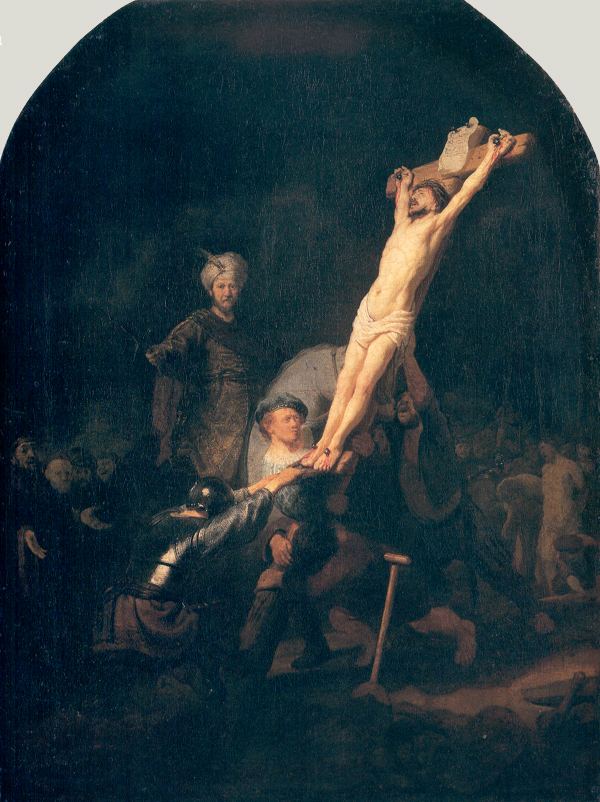
The question is sometimes raised as to who crucified Jesus? According to Chafer, “Closely related to the contrast between the divine and human sides of Christ’s death, is the question: Who put Christ to death? As already indicated, the Scriptures assign both a human and a divine responsibility for Christ’s death.”[1] According to the testimony of Scripture, Jesus’ death on the cross was the result of: 1) God the Father who sent Him, 2) Jesus who willingly went to the cross, 3), Satan who worked through others to help crucify Him, 4) unbelieving Jews, and 5) unbelieving Gentiles. The Bible verses that address the various persons involved in the crucifixion of Jesus are intermixed. That is, a passage might address God the Father and Jesus, or Jews and Gentiles, or Satan and Jews, etc. It is from these Scripture passages that the following categories as recognized.
God the Father Sent Christ to Die
Who crucified Jesus? The ultimate answer is God the Father. The Father was motivated by His love for us to save us; therefore, His plan of salvation involved sending His Son into the world to die in our place. The record of Scripture is, “But the LORD was pleased To crush Him, putting Him to grief” (Isa 53:10a), and “God so loved the world, that He gave His only begotten Son” (John 3:16a), and “this Man [Jesus], was delivered over by the predetermined plan and foreknowledge of God” (Acts 2:23a), and Peter, praying to the Father, said, “For truly in this city there were gathered together against Your holy servant Jesus, whom You anointed, both Herod and Pontius Pilate, along with the Gentiles and the peoples of Israel, to do whatever Your hand and Your purpose predestined to occur” (Acts 4:27-28), and “He who did not spare His own Son, but delivered Him over for us all” (Rom 8:32). Chafer notes, “Human hands might inflict physical suffering and death as any victim would die, but only the hand of God could make Christ a sin offering, or could lay on Him the iniquity of others (2 Cor 5:21; Isa 53:6).”[2]
Jesus Willingly Went to the Cross
 Though the Father sent Jesus into the world to be an atoning sacrifice for sin, He did not force Him onto the cross. Jesus consented to come into the world and go to the cross and die for us. He voluntarily laid down His life. The writer of Hebrews states, “Therefore, when He comes into the world, He says, ‘Sacrifice and offering You have not desired, but a body You have prepared for Me’” (Heb 10:5). Jesus, in hypostatic union, speaking from His humanity, said, “Behold, I have come (in the scroll of the book it is written of Me) to do Your will, O God” (Heb 10:7). Constable notes, “Jesus was not some dumb animal that offered its life without knowing what it was doing. He consciously, voluntarily, and deliberately offered His life in obedience to God’s will.”[3] Jesus’ voluntary death on the cross is found in several passages. Jesus said, “I lay down My life for the sheep” (John 10:15), and “no one has taken it away from Me, but I lay it down on My own initiative” (John 10:18). Paul wrote, “Christ also loved you and gave Himself up for us, an offering and a sacrifice to God as a fragrant aroma” (Eph 5:2), and “Christ also loved the church and gave Himself up for her” (Eph 5:25), and “the Son of God, who loved me and gave Himself up for me” (Gal 2:20), and “who gave Himself for us to redeem us from every lawless deed” (Tit 2:14). The writer to the Hebrews tells us that Christ “offered up Himself” (Heb 7:27; cf., Heb 9:14).
Satan Was Instrumental in Jesus’ Crucifixion
The very first prophesy related to the cross is found in Genesis, when God told Satan, “I will put enmity between you and the woman, and between your seed and her seed; He shall bruise you on the head, and you shall bruise him on the heel” (Gen 3:15). Concerning Genesis 3:15, Chafer notes, “it is implied that Satan did what he could in the exercise of his power—directly, or indirectly, through human agents—against the Savior.”[4] Satan’s seed refers to all those who reject God and Christ and are part of Satan’s kingdom of darkness.[5] Jesus said to unbelieving Jews, “You are of your father the devil” (John 8:44), and all unbelievers are “the sons of the evil one” (Matt 13:38). These were used by Satan to help in the crucifixion of Christ. On the night before Jesus’ crucifixion, John records, “During supper, the devil had already put into the heart of Judas Iscariot, the son of Simon, to betray Him” (John 13:2). During the meal, Jesus said to His disciples, “Truly, truly, I say to you, that one of you will betray Me” (John 13:21), and “After the morsel, Satan then entered into him. Therefore Jesus said to him, ‘What you do, do quickly’” (John 13:27). Here we observe a coalescence of Satanic and human activity to betray Jesus to those who would crucify Him. In this regard, Satan was the motivating force behind Judas, his willing instrument, to bring about the death of Jesus.[6]
In the Garden of Gethsemane, the chief priests, officers of the temple, and Jewish elders came to arrest Jesus (Luke 22:52a), and He said to them, “While I was with you daily in the temple, you did not lay hands on Me; but this hour and the power of darkness are yours” (Luke 22:53). Those who came physically to “lay hands” on Jesus were the Jewish authorities who conspired to kill Him. God, in His sovereignty, permitted this to happen, because it served His greater purposes to bring about salvation through the cross. But even though it was their hour to act, these men were not acting alone, as Luke’s reference to “the power of darkness” demonstrates that Satan was behind them, driving them on as his agents of lies and destruction. Later, Luke would use the term darkness as a symbol of the sphere of Satan’s authority (Acts 26:18), as would Paul (Col 1:13).
Unbelieving Jews Crucified Jesus
Though it was the Romans who actually placed Jesus on the cross and drove the nails, it was, according to Scripture, unbelieving Jews who conspired and lied about Jesus to have Him crucified (Matt 26:3-4; John 11:53). At the time of Jesus’ trial before Pilate, the Jews who were present all shouted, “Crucify Him” (Matt 27:22). God permitted Jesus’ crucifixion, both by the Jews and Romans, because it served His greater purpose. Luke recorded Peter, who said, “Men of Israel, listen to these words: Jesus the Nazarene, a man attested to you by God with miracles and wonders and signs which God performed through Him in your midst, just as you yourselves know—this Man, delivered over by the predetermined plan and foreknowledge of God, you nailed to a cross by the hands of godless men and put Him to death” (Acts 2:22-23). Clearly this address was to the “Men of Israel,” who rejected Jesus and “nailed [Him] to a cross by the hands of godless men and put Him to death” (Acts 2:23; cf. Acts 4:10; 5:30; 10:39). In Acts 4:27, Luke recorded that there were “gathered together against Your holy servant Jesus…the peoples of Israel” (Acts 4:27), to crucify Him. Paul wrote about “the Jews, who both killed the Lord Jesus and the prophets” (1 Th 2:14b-15a).
Unbelieving Gentiles Crucified Jesus
 Though many unbelieving Jews were directly responsible for collaborating in the crucifixion of Jesus, it was Gentiles who actually did the work of placing Him on the cross. That’s what Jesus foretold His disciples, saying, “Behold, we are going up to Jerusalem; and the Son of Man will be delivered to the chief priests and scribes, and they will condemn Him to death, and will hand Him over to the Gentiles to mock and scourge and crucify Him, and on the third day He will be raised up” (Matt 20:18-19). It was said of the Roman soldiers, “After they had mocked Him, they took the scarlet robe off Him and put His own garments back on Him, and led Him away to crucify Him” (Matt 27:31). Luke records in Acts, “truly in this city there were gathered together against Your holy servant Jesus, whom You anointed, both Herod and Pontius Pilate, along with the Gentiles and the peoples of Israel” (Acts 4:27).
As Christians, we must not see Christ dying at a distant time or place. We should see our own hands driving the nails that put Him there and then lifting the cross. The crucifixion was not only for us, but by us. It was our sin that necessitated His death and judgment. We must see Jesus bearing all our sin and paying the penalty of the Father’s wrath that rightfully belongs to us. In May 2006, I wrote the following poem as I thought about the role I played in placing Jesus on the cross.
Christ to the Cross
I and the Father led Christ to the cross,
Together we placed Him there;
I pushed Him forward, no care for the cost,
His Father’s wrath to bear.
Christ in the middle not wanting to die,
Knelt in the garden and prayed;
Great tears of blood the Savior did cry,
Yet His Father He humbly obeyed.
So He carried His cross down a dusty trail,
No words on His lips were found;
No cry was uttered as I drove the nails,
His arms to the cross were bound.
I lifted my Savior with arms spread wide,
He hung between heaven and earth;
I raised my spear and pierced His side,
What flowed was of infinite worth.
Like a Lamb to the altar Christ did go,
A sacrifice without blemish or spot;
A knife was raised, and life did flow,
In a basin the blood was caught.
Past the incense table and the dark black veil,
To that holy of holy places;
The blood of Christ was made to avail,
And all my sins it erases.
Now this Lamb on a cross was a demonstration
Of the Father’s love for me;
For the Savior’s death brought satisfaction,
Redeemed, and set me free.
Now I come to the Savior by faith alone,
Not trusting in works at all;
Jesus my substitute for sin did atone,
Salvation in answer to His call.
Dr. Steven R. Cook
Related Articles:
- The Gospel Explained
- Free Grace Salvation
- The Cross & Crucifixion of Jesus
- The Purposeful Suffering of Christ
- Jesus Substitutionary Atonement in Salvation
- The God-Man: Understanding the Deity and Humanity of Christ
- Defining Salvation in the Bible
- Who is the One Who Saves?
- A Look at Grace
[1] Lewis Sperry Chafer, Systematic Theology, vol. 3 (Grand Rapids, MI: Kregel Publications, 1993), 49.
[2] Ibid., 51.
[3] Tom Constable, Tom Constable’s Expository Notes on the Bible (Galaxie Software, 2003), Heb 10:5.
[4] Lewis Sperry Chafer, Systematic Theology, vol. 3, 49.
[5] The seed of Satan ultimately relates to the coming Antichrist, who will, during the time of the Tribulation, seek to destroy Israel and prevent the coming of Jesus to rule over the earth. See Arnold Fruchtenbaum’s comments on Genesis 3:15 in his book, The Book of Genesis, Ariel’s Bible Commentary.
[6] On a separate occasion, after Jesus was born, Satan wanted to kill the baby Jesus. The apostle John—operating from divine viewpoint—records that Satan, “stood before the woman who was about to give birth, so that when she gave birth, he might devour her child” (Rev 12:4). But Satan’s attack was not direct; rather, King Herod was his tool to accomplish the nefarious deed. Matthew records the account in his Gospel (Matt 2:1-23). Herod was the human agent who wanted to kill Jesus, but Satan was the motivating force behind the attack.