Israel’s story begins with God taking the first step. He brought the nation into existence and shaped it according to His plan. Scripture states, “Thus says the Lord who created you, O Jacob, and He who formed you, O Israel” (Isa. 43:1), and again, “I am the LORD… the Creator of Israel” (Isa. 43:15). Having brought Israel into being, God then bound Himself to her, declaring, “the Lord your God has chosen you to be a people for His own possession” (Deut. 7:6). This divine commitment arose from God’s promises to Abraham, Isaac, and Jacob, establishing Israel as a nation uniquely related to Him (Gen. 12:1–3; 17:7–8). The permanence of Israel’s national existence is guaranteed by God Himself, who tied her continuance to the fixed order of creation, saying, “If this fixed order departs from before Me… then the offspring of Israel also will cease from being a nation before Me forever” (Jer. 31:35–36). She was precious to the Lord, called “the apple of His eye” (Zech. 2:8), and He said to her, “I have loved you with an everlasting love; therefore, I have drawn you with lovingkindness” (Jer. 31:3). God also placed Israel at the center of His historical dealings, saying of Jerusalem, “I have set her at the center of the nations” (Ezek. 5:5). Yet Scripture is equally honest about Israel’s repeated failures through unbelief and disobedience (Ps. 106:6; Neh. 9:26). Because of her unique relationship to God, Israel also experienced unique discipline, for the Lord declared, “You only have I chosen among all the families of the earth; therefore, I will punish you for all your iniquities” (Amos 3:2). Even when God disciplines Israel, His plans for her are never canceled (Jer. 31:35–37).
Israel’s Present
In the present age, Israel exists in a state of tension. Though widely opposed and often unbelieving, she remains “beloved for the sake of the fathers” because of the irrevocable promises God made to Abraham, Isaac, and Jacob (Rom. 11:28). God’s faithfulness to Israel does not rest on Israel’s consistency but on His own unchanging covenants, which He pledged to uphold forever (Gen. 12:1–3; 2 Sam. 7:12–16; Jer. 31:35–37). Scripture explains that this present condition includes a divinely imposed hardening that is partial and temporary, for “a partial hardening has happened to Israel until the fullness of the Gentiles has come in” (Rom. 11:25). This hardening serves God’s broader redemptive purpose by opening the door of blessing to the nations, while simultaneously preserving Israel for a future restoration. During this period, Israel’s unbelief does not nullify God’s promises but confirms that salvation history is unfolding according to His timetable rather than human expectation. Israel is being kept by God until His redemptive purposes are completed, demonstrating that divine faithfulness transcends human failure.
Israel’s Future
Israel’s future is secure because it depends completely on God’s promises, not on how well Israel has done in the past or how well it is doing now. Jesus will return to the earth as the rightful King of Israel, for “when the Son of Man comes in His glory, and all the angels with Him, then He will sit on His glorious throne” (Matt. 25:31), and “His feet will stand on the Mount of Olives, which is in front of Jerusalem on the east” (Zech. 14:4), reigning in fulfillment of God’s promises (Rev. 19:16).
When Jesus returns, Israel will finally realize that He is the very One they once rejected. They will look to Him, feel deep sorrow for what they did, and put their trust in Him as their Messiah. God foretold this when He said, “They will look on Me whom they have pierced; and they will mourn for Him, as one mourns for an only son, and they will weep bitterly over Him like the bitter weeping over a firstborn” (Zech. 12:10). That grief will lead them to faith, and Paul confirms the outcome when he says, “and so all Israel will be saved” (Rom. 11:26). At that time, Jerusalem will finally welcome her true King, just as Jesus said, “You will not see Me until you say, ‘Blessed is He who comes in the name of the Lord’” (Matt. 23:39; cf. Ps. 118:26).
After His return, the Messiah will rule the world from Jerusalem. Scripture declares that “the Lord will be king over all the earth” (Zech. 14:9). He will reign as the promised Son of David, the One of whom God said, “He will be great and will be called the Son of the Most High” (Luke 1:32). God will place Him on David’s throne, fully carrying out His covenant promises, for “the Lord God will give Him the throne of His father David… and His kingdom will have no end” (Luke 1:32–33). His rule will bring lasting righteousness and peace to the entire world, because “there will be no end to the increase of His government or of peace” (Isa. 9:6–7), and “in His days the righteous will flourish, and abundance of peace” (Ps. 72:7). All opposition will be brought under control, since the Messiah will “break them with a rod of iron” (Ps. 2:9). His kingdom will never end, because “His dominion is an everlasting dominion which will not pass away” (Dan. 7:14). Israel’s future, then, clearly shows that God is faithful to His word and always brings His promises to their complete fulfillment.
The Christian Attitude Toward Israel
Because God has an unbroken past, present, and future plan for Israel, the Christian’s attitude toward Israel today should be marked by humility, respect, prayer, and confidence in God’s faithfulness. Scripture warns believers not to become arrogant toward Israel, since Gentile blessing rests on God’s promises to the patriarchs and not on Gentile merit (Rom. 11:18–20). Even in her present unbelief, Israel remains “beloved for the sake of the fathers,” because “the gifts and the calling of God are irrevocable” (Rom. 11:28–29). Christians are therefore to reject hostility or replacement thinking and instead recognize Israel’s continuing place in God’s plan (Rom. 11:1–2).
This attitude expresses itself in action. Believers are to pray for Israel, especially for her salvation, sharing Paul’s desire when he said, “my heart’s desire and my prayer to God for them is for their salvation” (Rom. 10:1), and to pray for Jerusalem, as Scripture commands, “Pray for the peace of Jerusalem” (Ps. 122:6). Christians should also lovingly share the gospel with Jewish people, knowing that faith comes through hearing the word of Christ (Rom. 10:14–17), while trusting God’s timetable, since the present hardening is partial and temporary (Rom. 11:25). When possible, believers should also support Israel in gratitude, recognizing that Gentiles have shared in Israel’s spiritual blessings (Rom. 15:27). In all of this, the Christian looks forward with confidence to the day when God’s promises are fulfilled, when Israel turns to her Messiah and “all Israel will be saved” (Rom. 11:26), and the Lord reigns as King over all the earth (Zech. 14:9).
Steven R. Cook, D.Min., M.Div.
If this article has enriched your understanding and walk with Christ, and you feel led to support my ministry, your generosity is greatly appreciated. Your gifts enable me to continue sharing the gospel of grace and providing in-depth biblical teachings. Thank you for partnering with me in this mission.
God promised to give the nation of Israel a specific territory as an everlasting possession. The Lord said to Abram, “For all the land which you see, I will give it to you and to your descendants forever” (Gen 13:15). This unconditional covenantal grant of land was reaffirmed to Isaac and Jacob (Gen 26:3; 28:13), encompassing a vast region “from the river of Egypt as far as the great river, the river Euphrates” (Gen 15:18). Historically, Israel has never possessed the full extent of this promised territory. However, many covenant theologians assert that God has already fulfilled His land promise to Israel, appealing to certain Old Testament passages as proof. They point, for example, to Joshua’s record: “So Joshua took the whole land, according to all that the Lord had spoken to Moses… Thus the land had rest from war” (Josh 11:23), and again, “the Lord gave Israel all the land which He had sworn to give to their fathers, and they possessed it and lived in it… Not one of the good promises which the Lord had made to the house of Israel failed; all came to pass” (Josh 21:43–45; cf. Josh 23:14). These verses are taken as evidence, by covenant theologians, that the Abrahamic land grant found its completion in the conquest under Joshua. Additionally, the statement that “Solomon ruled over all the kingdoms from the River to the land of the Philistines and to the border of Egypt” (1 Ki 4:21) is taken as evidence that Israel’s territory extended to the full Abrahamic boundaries (Gen 15:18). Even Nehemiah’s affirmation, “You… made a covenant with him to give the land… and You have fulfilled Your promise, for You are righteous” (Neh 9:7–8), is cited as confirmation that the divine land promise was fully realized.
However, though God fulfilled His promise in bringing Israel into the land, the narrative of Joshua makes it clear that large portions of territory remained unconquered. The Lord said to Joshua, “You are old and advanced in years, and very much of the land remains to be possessed” (Josh 13:1). Scripture further records that “the sons of Manasseh could not take possession of these cities” (Josh 17:12), that “they did not drive them out completely” (Josh 17:13), and that “they did not drive out the Canaanites who lived in Gezer” (Josh 16:10; cf. 15:63; 23:12–13). Following Joshua’s death, the book of Judges repeatedly affirms Israel’s incomplete obedience, stating that the tribes “did not drive out” the Canaanites from numerous regions (Judg 1:19, 21, 27–36). These repeated statements demonstrate that, while Israel possessed the land in principle under God’s covenant faithfulness, the full territorial boundaries promised to Abraham were not yet realized in practice. Fruchtenbaum notes, “Never in Old Testament history did Israel possess, dwell, and settle in all of the Promised Land. Nor did it ever happen in Jewish history since. However, the Palestinian Covenant guarantees that some day it will.”[1]
The conquest under Joshua and the later monarchy under Solomon cannot be regarded as the final fulfillment of the Abrahamic Covenant. Numerous prophecies anticipated Israel’s future inheritance of the land (Amos 9:14–15), and the nation never possessed the full extent of the territory promised to Abraham, which stretched eastward to the Euphrates (Gen 15:18). Israel’s occupation was neither permanent—since the Babylonian exile removed them from the land—nor complete, as Judges records that many Canaanite cities remained unconquered (Judg 1:27–34). The land described in Joshua 21 corresponded only to the Mosaic boundaries of Numbers 34, not the larger Abrahamic grant. Even in the New Testament era, Israel still awaited national restoration (Acts 1:6–8; Rom 11:25).
The book of Joshua, therefore, celebrates God’s covenant faithfulness in bringing His people into the land (Josh 21:43–45), yet it also acknowledges that their occupation was partial and temporary rather than ultimate and complete (Josh 13:1; 23:12–13). According to Phillips, “Not even during the great days of David and Solomon did Israel possess more than a tithe of the total land grant that is hers under the Abrahamic covenant.”[2] Geisler states that Israel “did not possess all the land that was promised to Abraham, namely, east of Jordan all the way to the Euphrates (Gen 15:18)… they did not possess it forever, as promised to Abraham, but were later dispossessed of it by the Babylonian captivity.”[3] Campbell adds, “This did not mean that every corner of the land was in Israel’s possession, for God Himself had told Israel they would conquer the land gradually (Deut 7:22).”[4] The conquest fulfilled God’s word to that generation, but not the full scope of the Abrahamic promise, which extends “from the river of Egypt as far as the great river, the river Euphrates” (Gen 15:18). Campbell further states, “Joshua 21:43 refers to the extent of the land as outlined in Numbers 34 and not to the ultimate extent as it will be in the messianic kingdom (Gen 15:18–21). Also, though Israel possessed the land at this time it was later dispossessed, whereas the Abrahamic Covenant promised Israel that she would possess the land forever (Gen 17:8).”[5]
Joshua 21:43 must be read in light of other passages of Scripture. It means that God fulfilled His word to that generation by granting the land they actually claimed in faith. The Lord had said, “Every place on which the sole of your foot treads, I have given it to you, just as I spoke to Moses” (Josh 1:3). God’s word to Joshua, therefore, was limited to the immediate context of conquest and distribution, not to the ultimate fulfillment of the covenant made with Abraham, Isaac, and Jacob. Regarding the remaining nations in the land, Joshua reminded Israel, “The Lord your God, He will thrust them out from before you and drive them from before you; and you will possess their land, just as the Lord your God promised you” (Josh 23:5). Yet even by the end of Joshua’s life, those nations still occupied significant portions of Canaan, a fact repeatedly acknowledged in the text (Josh 13:1–6; 23:12–13). Consequently, Joshua’s declaration that “the Lord gave Israel all the land” (21:43) should be understood through what scholars identify as representative universalism—a Hebrew idiom in which a part is spoken of as the whole. This linguistic feature is common in Scripture, where comprehensive terms convey theological completeness rather than exhaustive literal scope. Thomas Constable observes:
It was common among the Semites to regard a part of the whole as the whole (cf. Deut 26:5–10; 1 Kings 13:32; Jer 31:5; 2 Sam 5:6–10; Rev 14:1; 22:2; Rom 15:19–24). The name for this viewpoint is “representative universalism.” Some students of this passage believe that the writer was taking this view here. He was speaking in universal terms. He regarded the individual kings, towns, and areas that had been subdued as representative of the entire land of Canaan.[6]
This idiom appears elsewhere in the Old Testament. When Scripture says that “all the earth” came to Egypt to buy grain from Joseph (Gen 41:57), it does not mean every person on the globe. Similarly, “all Judea” and “all Jerusalem” going out to John the Baptist (Mark 1:5) or Solomon ruling “over all the kingdoms from the Euphrates River to the land of the Philistines and to the border of Egypt” (1 Ki 4:21) communicate general, not absolute, universality. Joshua’s use of this idiom expresses the theological truth that God had completely fulfilled what He promised to that generation. He had given them victory, possession, and rest. The remaining land would be conquered gradually, contingent upon Israel’s continued faith and obedience (Josh 23:5–13; cf. Judg 1:19, 27–36).
Therefore, the statements “the Lord gave Israel all the land” and “not one word has failed” (Josh 21:43–45; 23:14) should be understood as declarations of God’s proven covenant faithfulness within the historical framework of Joshua’s leadership. They do not mean that every geographical boundary of the Abrahamic Covenant was realized, but that God had done all He promised at that stage in redemptive history. Israel’s rest in the land (Josh 22:4; 23:1) was temporary and conditional, anticipating a greater rest that remains for the people of God (cf. Heb 4:8–9).
The Abrahamic Covenant itself remains unconditional and eternal, rooted in God’s sovereign promise and not dependent upon Israel’s obedience (Gen 12:1–3; 15:18–21; 17:7–8). Israel’s possession under Joshua was real but provisional. Their later disobedience brought discipline and dispersion, but not the cancellation of God’s covenantal oath. The full and everlasting fulfillment awaits the future Messianic Kingdom, when Israel will dwell securely in all the territory promised to Abraham, Isaac, and Jacob (Gen 15:18; Isa 11:10–16; Ezek 47:13–23; Zech 14:9–11). Thus, Joshua’s record stands as a powerful testimony to divine faithfulness—God did everything He promised in that generation, and He will yet do all He has pledged in the ages to come.
Steven R. Cook, D.Min., M.Div.
If this article has enriched your understanding and walk with Christ, and you feel led to support my ministry, your generosity is greatly appreciated. Your gifts enable me to continue sharing the gospel of grace and providing in-depth biblical teachings. Thank you for partnering with me in this mission.
God created Israel as a unique nation, set apart from all others. Scripture declares, “Thus says the Lord, your Creator, O Jacob, and He who formed you, O Israel, ‘Do not fear, for I have redeemed you; I have called you by name; you are Mine’” (Isa 43:1). Here, God is identified as Israel’s “Creator” (בָּרָא bara) and the One who “formed” (יָצַר yāṣar) them. The word bara (create) is used in Genesis 1:1 for God’s unique, sovereign act of creation. In Isaiah 43:1, it highlights God’s initiative in bringing Israel into existence as a nation, both physically and covenantally. The parallel yāṣar (“form”) adds the imagery of craftsmanship or shaping, emphasizing God’s intentional design of Israel for His purposes (cf. Isa 43:21). Radmacher states, “The use of these verbs here suggests that the Lord’s creation of Israel as a people was as decisive an act as His creation of human beings at the beginning.”[1] According to Young, “The participle creator suggests creation out of nothing. Yahweh chose the nation at Sinai, created it out of nothing, and made of it the theocracy. When He approached Israel in covenant, it was a slave people in Egypt, not even an independent nation able to stand on its own. What Israel has become, therefore, is due to the pure grace of God alone.”[2]
Israel’s existence is no accident of history but the result of God’s sovereign purpose. He chose them not for their size or virtue but because of His covenant love and oath to the patriarchs: Abraham (Gen 12:1-3), Isaac (Gen 26:3-5), and Jacob (Gen 28:13-15). Moses declared, “The LORD did not set His love on you nor choose you because you were more in number than any of the peoples, for you were the fewest of all peoples, but because the LORD loved you and kept the oath which He swore to your forefathers” (Deut 7:7-8). Craigie states. “Negatively, they were not chosen on the basis of their numerical strength; they were numerically a very small people in the context of other Near Eastern peoples and nations. Positively, they were chosen because the Lord loved them; the reason for God’s special love, though it contained within it a purpose, remains essentially a mystery.”[3]
At the heart of Israel’s identity lies the Abrahamic Covenant, in which God promised Abraham land, descendants, and blessing for all nations through him (Gen 12:1-3; 15:18-21; 17:7-8). These promises were unconditional, secured by God’s own oath (Gen 22:16-18; Heb 6:13-18). God regards Israel as “the apple of His eye” (Deut 32:10; Zech 2:8), and He loves them forever, saying, “I have loved you with an everlasting love; therefore, I have drawn you with lovingkindness” (Jer 31:3). According to Chafer, “An everlasting love includes a love from all eternity past and extends on into eternity to come. This nation is thus loved in spite of their evil and multiplied rejections of Jehovah. That everlasting love will yet prevail and this unworthy people will inherit all that Jehovah has determined.”[4]
Israel’s continued existence rests on God’s covenant faithfulness, “For the LORD will not abandon His people on account of His great name” (1Sam 12:22a), and, “the LORD will not abandon His people, nor will He forsake His inheritance” (Psa 94:14).[5] Paul states, for “to them belong the adoption as sons and the glory and the covenants and the giving of the Law and the temple service and the promises, whose are the fathers, and from whom is the Christ according to the flesh” (Rom 9:4-5). So certain is their preservation that the Lord ties their continued existence to the stability of creation itself: “Thus says the Lord, who gives the sun for light by day and the fixed order of the moon and the stars for light by night… ‘If this fixed order departs from before Me,’ declares the Lord, ‘then the offspring of Israel also will cease from being a nation before Me forever’” (Jer 31:35-36).
God originally entrusted Israel with a priestly calling, saying, “Now then, if you will indeed obey My voice and keep My covenant, then you shall be My own possession among all the peoples, for all the earth is Mine; and you shall be to Me a kingdom of priests and a holy nation” (Ex 19:5-6). Their role was not only to serve the Lord in holiness but also to be a witness to the surrounding nations, for the Lord declared of His Servant Israel, “I will also make You a light of the nations so that My salvation may reach to the end of the earth” (Isa 49:6; cf. Deut 4:6-8). Yet rather than remaining distinct, Israel often adopted the corrupt values and idolatrous practices of the nations around them, as the Lord said, “They mingled with the nations and learned their practices, and served their idols, which became a snare to them” (Psa 106:35-36; cf. 2 Kgs 17:7-12). Ross notes, “It is hard to imagine how quickly the Israelites embraced these horrible sins of idolatry and murder of the innocent in the name of religion. But they did, and as a result they defiled the land with the shedding of innocent blood.”[6] Because of Israel’s unfaithfulness, God had to discipline them, sending them into captivity and scattering them among the nations. Jeremiah wrote, “The Lord has done what He purposed; He has accomplished His word which He commanded from days of old. He has thrown down without sparing, and He has caused the enemy to rejoice over you” (Lam 2:17; cf. Judg 2:11-15; 2 Chr 36:15-17).
Tragically, Israel also rejected her Messiah when He came. The apostle John records, “He came to His own, and those who were His own did not receive Him” (John 1:11). Israel’s leaders even went so far as to accuse the Messiah of casting out demons by the power of Satan (Matt 12:24; Mark 3:22). Jesus Himself wept over Jerusalem, lamenting their stubborn unbelief, saying, “Jerusalem, Jerusalem, who kills the prophets and stones those who are sent to her! How often I wanted to gather your children together, the way a hen gathers her chicks under her wings, and you were unwilling. Behold, your house is being left to you desolate” (Matt 23:37-38). Concerning Israel’s rejection of Jesus as the Messiah, Peter states, “The stone the builders rejected has become the cornerstone” (1 Pet 2:7). The “stone” refers to Christ Himself, whom Israel rejected. Fruchtenbaum states, “The stone is Jesus the Messiah who is both elect and precious according to 1 Pet 2:4. In this case, He is not merely a stone; He is the chief corner stone.”[7] Because of this rejection, God brought judgment upon the nation, seen most vividly in the destruction of Jerusalem in A.D. 70 and their ongoing dispersion. Paul further clarifies that this rejection led to a “partial hardening” of Israel, which is temporary and will last “until the fullness of the Gentiles has come in” (Rom 11:25). This means that God has set aside Israel as a nation in the present age while He gathers a people from both Jews and Gentiles, but His covenant promises to Israel remain and will be fulfilled in the future (Rom 11:26-29).
God’s promises to Israel remain irrevocable. Paul affirms, “From the standpoint of the gospel they are enemies for your sake, but from the standpoint of God’s choice they are beloved for the sake of the fathers; for the gifts and the calling of God are irrevocable” (Rom 11:28-29). Even when under divine discipline, the Lord will not cast them off entirely, for “when they are in the land of their enemies, I will not reject them, nor will I so abhor them as to destroy them, breaking My covenant with them; for I am the Lord their God” (Lev 26:44). Israel remains the object of His covenant promises, including the coming New Covenant. God said, “Behold, days are coming… when I will make a new covenant with the house of Israel and with the house of Judah… I will put My law within them and on their heart I will write it; and I will be their God, and they shall be My people” (Jer 31:31-33). While the Church shares in spiritual blessings of this covenant (2 Cor 3:6; Heb 8:6-13), its national fulfillment awaits Israel’s future restoration.
That future will unfold when Messiah returns in glory, when “they will look on Me whom they have pierced; and they will mourn for Him, as one mourns for an only son” (Zech 12:10). In that day, “all Israel will be saved, just as it is written, ‘The Deliverer will come from Zion, He will remove ungodliness from Jacob. This is My covenant with them, when I take away their sins’” (Rom 11:26-27). Christ will reign from Jerusalem (for a thousand years), the city God has chosen, “For the Lord has chosen Zion; He has desired it for His habitation. ‘This is My resting place forever; here I will dwell, for I have desired it’” (Psa 132:13-14). The nations will stream to Jerusalem for blessing and instruction, saying, “Come, let us go up to the mountain of the Lord, to the house of the God of Jacob; that He may teach us concerning His ways and that we may walk in His paths” (Isa 2:3). Israel will at last fulfill her calling to be a light to the nations (Isa 49:6; 60:1-3), and the whole earth will be filled with the glory of God.
This unfolding plan warns the nations that how they treat Israel carries eschatological consequence, for the Lord declares, “I will gather all the nations and bring them down to the valley of Jehoshaphat. Then I will enter into judgment with them there on behalf of My people and My inheritance, Israel… and they have divided up My land” (Joel 3:2). Israel’s preservation is therefore not merely about Israel, but about the very integrity of God Himself. Paul wrote, “What then? If some did not believe, their unbelief will not nullify the faithfulness of God, will it? May it never be! Rather, let God be found true, though every man be found a liar” (Rom 3:3-4).
Christians, then, must resist the error of replacement theology, which denies Israel’s future and claims her promises for the Church. Paul warns Gentile believers, “Do not be arrogant toward the branches; but if you are arrogant, remember that it is not you who supports the root, but the root supports you” (Rom 11:18). The Church has not replaced Israel but has been graciously grafted in to share in Israel’s blessings through Christ (Rom 11:17). Therefore, Christians should love the Jewish people, resist anti-Semitism in every form, and anticipate with joy the day of their national restoration. Believers are exhorted to “pray for the peace of Jerusalem: ‘May they prosper who love you’” (Psa 122:6). This means praying for Israel’s present security, but more importantly for their ultimate peace in Messiah, the “Prince of Peace” (Isa 9:6). To pray for Israel is to align with God’s covenant purpose, anticipate Christ’s coming kingdom reign (Zech 14:16-19), and bear witness to God’s faithfulness before the world.
Steven R. Cook, D.Min., M.Div.
If this article has enriched your understanding and walk with Christ, and you feel led to support my ministry, your generosity is greatly appreciated. Your gifts enable me to continue sharing the gospel of grace and providing in-depth biblical teachings. Thank you for partnering with me in this mission.
[1] Earl D. Radmacher, Ronald Barclay Allen, and H. Wayne House, Nelson’s New Illustrated Bible Commentary (Nashville: T. Nelson Publishers, 1999), 851.
[2] Edward Young, The Book of Isaiah, Chapters 40–66, vol. 3 (Grand Rapids, MI: Wm. B. Eerdmans Publishing Co., 1972), 138.
[3] Peter C. Craigie, The Book of Deuteronomy, The New International Commentary on the Old Testament (Grand Rapids, MI: Wm. B. Eerdmans Publishing Co., 1976), 179–180.
[5] Throughout Scripture, God repeatedly acts for His name’s sake, preserving His reputation and covenant faithfulness despite the failures of His people. Moses appealed to this when interceding for Israel after the golden calf (Ex 32:12), and the prophets emphasized it in Israel’s restoration: “It is not for your sake … but for My holy name” (Ezek 36:22). The psalmists likewise prayed on this basis, asking God to pardon and guide “for Your name’s sake” (Psa 23:3; 25:11).
[6] Allen P. Ross, A Commentary on the Psalms (90–150): Commentary, vol. 3, Kregel Exegetical Library (Grand Rapids, MI: Kregel Academic, 2016), 291.
[7] Arnold G. Fruchtenbaum, The Messianic Jewish Epistles: Hebrews, James, First Peter, Second Peter, Jude, 1st ed. (Tustin, CA: Ariel Ministries, 2005), 341.
From Genesis to Revelation, the story of Israel is the story of a chosen people uniquely called and covenanted by God—not because of their merit, but because of His faithfulness. The Abrahamic Covenant (Gen 12:1-3; 15:1-21; 17:1-8) remains in effect to this day. It is an unconditional, unilateral promise in which God swore to give Abraham’s descendants a land, a nation, and a blessing, and it has never been annulled or replaced. Even though the majority of Israel remains in unbelief, they are still God’s covenant people, and “they are beloved for the sake of the fathers” (Rom 11:28). Their future restoration is not only prophesied—it is guaranteed by God’s own character.
Scripture teaches that Israel is presently under divine discipline. After centuries of rebellion, culminating in the rejection of their Messiah, Jesus declared, “Behold, your house is being left to you desolate!” (Matt 23:38). Fruchtenbaum notes, “Because of their rejection of His messiahship, in place of being gathered they are going to be scattered” (A. G. Fruchtenbaum, Israelology, 783). Yet this was not a cancellation of the covenant, as Jesus added, “For I tell you, you will not see Me again, until you say, ‘Blessed is He who comes in the name of the Lord’” (Matt 23:39). That future confession will come at His Second Coming, when the Jewish leadership will lead the nation in receiving their Messiah. Until then, Israel is undergoing “a partial hardening…until the fullness of the Gentiles has come in” (Rom 11:25), after which “all Israel will be saved” (Rom 11:26). This discipline is temporary and purposeful—God is preserving His people through chastening, preparing them for repentance and restoration. His hand has never left them.
My Love for Israel
I love Israel, because they are God’s chosen people, and set apart for a unique role in history. Scripture declares, “The Lord your God has chosen you to be a people for His own possession out of all the peoples who are on the face of the earth” (Deut 7:6). This choosing was not based on merit, but on God’s faithfulness and love: “The Lord did not set His love on you nor choose you because you were more in number than any of the peoples…but because the Lord loved you and kept the oath which He swore to your forefathers” (Deut 7:7-8). Though Israel has often stumbled, God’s love for them endures. He says, “I have loved you with an everlasting love; therefore, I have drawn you with lovingkindness” (Jer 31:3). Even now, during a time of national unbelief, Paul reminds us that “they are beloved for the sake of the fathers; for the gifts and the calling of God are irrevocable” (Rom 11:28-29). Israel remains the apple of His eye (Zech 2:8), and He will fulfill every promise He made to the patriarchs, bringing about their future restoration when they turn to the Messiah in faith (Zech 12:10; Rom 11:26).
My Prayers for Israel
Lately, when I’ve been praying for Israel, I keep thinking about Moses and how he interceded for his people during a time of deep disobedience, when they turned from the Lord to worship a golden calf (Ex 32:1-6). The Lord saw their corruption (Ex 32:7-8) and said to Moses, “I have seen this people, and behold, they are an obstinate people” (Ex 32:9). God’s anger burned against them, and He declared, “Now then let Me alone, that My anger may burn against them and that I may destroy them; and I will make of you a great nation” (Ex 32:10). Interestingly, Moses stood in the gap and prayed for Israel, appealing to God’s character and covenant promises. His intercession serves as a wonderful example for how I pray for Israel today. There are three parts to Moses prayer (Ex 32:11-13).
First, Moses reminded God that Israel belonged to Him, saying, “Why does Your anger burn against Your people whom You have brought out from the land of Egypt?” (Ex 32:11). Moses did not refer to Israel as his people, but as God’s people—chosen, delivered, and set apart by Him. To say they were God’s people was to anchor their identity, destiny, and security in His covenant faithfulness. Moses interceded not on the basis of Israel’s worthiness, but on the grounds of God’s unchanging commitment to those He had called His own (Deut 7:6-8).
Second, Moses appealed to God’s reputation, saying, “Why should the Egyptians speak, saying, ‘With evil intent He brought them out to kill them in the mountains?’” (Ex 32:12). Moses cared about how the world would perceive God’s actions. This principle still stands. When I pray for Israel, I pray not merely for their safety or national success, but for God’s name—His reputation—to be magnified in how He deals with them. The nations are watching, and Israel’s story is ultimately about God’s glory and faithfulness. Whether through judgment or mercy, His dealings must demonstrate His justice, His love, and His covenant fidelity.
Finally, Moses appealed to God’s covenant promises, saying, “Remember Abraham, Isaac, and Israel, Your servants to whom You swore by Yourself, and said to them, ‘I will multiply your descendants’” (Ex 32:13). Moses took God back to His Word—not to hold Him hostage to it, but to show that he trusted in God’s integrity. Moses knew that God keeps His promises to His people. When I pray for Israel, I echo this appeal. I’m not asking for blessing based on Israel’s righteousness, but on God’s faithfulness. (Gen 12:1-3; 15:18; 17:7-8; Psa 105:8-11; Rom 11:28-29). I ask God to act in accordance with His promises—not only because He is just, but because He delights in faithful love (Mic 7:18-20).
My Prayer for Israel:
O Lord, You are the faithful God who keeps everlasting promises to the fathers (Deut 7:9), and Israel remains Your covenant people—called by Your name, formed by Your hand, and beloved for the sake of the patriarchs (Isa 43:1, 21; Rom 11:28). I pray for the peace of Jerusalem (Psa 122:6), that Your purposes may be fulfilled and Your name glorified among the nations (Isa 66:18-20; Ezek 36:23). For the sake of Your great name, act in mercy and power; do not let the nations say that You have forsaken Your people (Jer 33:24-26). Show that You are the God who disciplines yet restores, whose wrath is just and whose mercy is abundant (Hos 11:8-9; Mic 7:18-19). You swore to bless Abraham’s descendants and make them many (Gen 12:2-3; 15:5; 22:17), and I trust You will keep that Word, for You are God and cannot lie (Num 23:19; Tit 1:2; Heb 6:18). Until Messiah returns, raise up laborers to proclaim the gospel, to pray for Your people, and to support Israel in ways that honor and glorify You and bring blessing to them. I ask this in Jesus’ name, Amen.
Steven R. Cook, D.Min., M.Div.
If this article has enriched your understanding and walk with Christ, and you feel led to support my ministry, your generosity is greatly appreciated. Your gifts enable me to continue sharing the gospel of grace and providing in-depth biblical teachings. Thank you for partnering with me in this mission.
The church refers to the body of Christ which began on the day of Pentecost in Acts chapter 2. It is comprised of Jews and Gentiles who have accepted Jesus as Savior. The church exists universally as an organism, the global presence of Christians who form the body of Christ. The church also exists locally as an organization, a nearby assembly of believers who gather together for Bible study, worship, fellowship, and the practice of the ordinances of baptism and the Lord’s Supper. The Christian church is a mystery not revealed in the Old Testament and is separate from Israel, having a different identity and purpose.
The Meaning of Ekklesia
The term church is a common translation of the Greek word ekklesia, which means called out ones, assembly, congregation, or community of Christians.[1] The New Testament writers use the word both in a general and technical sense. When used in a general sense, the word refers to any assembly, such as an assembly of residents in a city (Acts 19:32, 39, 41). It is interesting that the assembly mentioned in Acts 19 refers to pagan worshippers of the Greek goddess Artemis and does not refer to believers at all (Acts 19:34-35). The word ekklesia is also applied to Israel as a general assembly or congregation (Matt. 18:17; Acts 7:38; Heb. 2:12). In Matthew 18:15-17 Jesus addresses the subject of discipline within the fellowship of a community (ekklesia); however, the evidence of the passage favors a Jewish assembly (i.e. a synagogue) and not the Christian church.[2] In Acts 7:38 Stephen is speaking to a Jewish audience and mentions “the congregation [ekklesia] in the wilderness.”[3] Stephen’s use of the word ekklesia simply refers to the assembly of Israelites who were brought out of Egypt by Moses. In Hebrews 2:12 the writer quotes Psalm 22:22, in which the Septuagint[4] has the term ekklesia, again, used in a general way of an assembly or congregation of Jewish people.
When applied to Christians in the New Testament, ekklesia takes on a technical meaning and refers to those who have been joined to the spiritual body of Christ (1 Cor. 12:13; Eph. 1:22-23) by means of personal faith in Jesus as Savior (Acts 4:12; 1 Cor. 15:3-4; Eph. 2:8-9). The first reference to the Christian church occurs in Matthew 16:18 after Peter had confessed that Jesus is “the Christ, the Son of the living God” (Matt. 16:16), and based on the rock-solid truth of Peter’s statement, Jesus said, “I will build [future tense] My church [ekklesia]; and the gates of Hades shall not prevail against it” (Matt. 16:18). Jesus’ future tense statement reveals a church that was not in existence when He spoke. The Christian church began on the day of Pentecost, in Acts 2, when the Holy Spirit began His baptizing ministry of placing believers into the body of Christ. Concerning this work of the Holy Spirit, Paul writes, “For by one Spirit we were all baptized into one body—whether Jews or Greeks, whether slaves or free—and have all been made to drink into one Spirit” (1 Cor. 12:13; cf. Gal. 3:26-28). “The Holy Spirit of God is the primary agent who identifies the believer with other believers. Each one is a member of the body, and each member is united with the other members and with Christ (Rom. 6:1–4).”[5] The comparison of Acts 1:4-5 with Acts 2:1-4 and 11:15-17 make a compelling case for the church’s origin in Acts 2. It is mainly in the writings of Paul that the Christian church is identified as the body of Christ. Note the following Scriptures:
And He put all things under His feet, and gave Him to be head over all things to the church, which is His body, the fullness of Him who fills all in all. (Eph. 1:22-23)
For the husband is head of the wife, as also Christ is head of the church; and He is the Savior of the body. (Eph. 5:23)
And He is the head of the body, the church, who is the beginning, the firstborn from the dead, that in all things He may have the preeminence. (Col. 1:18)
I now rejoice in my sufferings for you, and fill up in my flesh what is lacking in the afflictions of Christ, for the sake of His body, which is the church. (Col. 1:24)
Several times in the New Testament Jesus is referred to as the Head of the body, the church. The Greek word soma, translated body, occurs 142 times in the New Testament and is used most often of physical bodies; however, it is used “sixteen times to refer to the church, the body of Christ (Rom. 12:5; 1 Cor. 10:17; 12:13; Eph. 1:23; 2:16; 4:4, 12, 16; 5:23, 30; Col. 1:18, 24; 2:19; 3:15). With the exception of Eph. 5:28, in Ephesians it is always used metaphorically as a reference to the body of Christ, the church.”[6] Paul first learned about this identification when he, as an unbeliever, encountered the Lord Jesus on the road to Damascus when he was persecuting Christians and putting them in prison. While on the road, the Lord Jesus appeared to him in a bright light, which caused him to fall to the ground, and then a voice said, “Saul, Saul, why are you persecuting Me?” (Act 9:4; cf. 22:7; 26:14). When Paul asked, “who are You Lord?” The reply came, “I am Jesus, whom you are persecuting” (Acts 9:5). Paul learned that an attack on Christians is an attack on the Lord Jesus Christ Himself. “The question, ‘Why do you persecute Me?’ (cf. Acts 9:5) is filled with significance for it shows the union of Christ with His church. The Lord did not ask, ‘Why do you persecute My church?’ The reference to ‘Me’ gave Saul his first glimpse into the great doctrine of Christians being in Christ.”[7] When a person believes in Jesus as Savior he/she is united to the body of Christ by means of the Holy Spirit. This is a new designation in which ethnic, social, and gender identity are all secondary to the believer’s new identity of being in Christ Jesus (Gal. 3:26-28).[8]
The Universal Church
The New Testament church is understood both in a universal and local sense. The universal church refers to the global existence of the body of Christ. This is the organic church as it exists all over the planet. Several passages in the New Testament communicate the idea of a universal church, such as when Paul said, “Give no offense, either to the Jews or to the Greeks or to the church of God” (1 Cor. 10:32), and “God has appointed these in the church: first apostles, second prophets, third teachers, after that miracles, then gifts of healings, helps, administrations, varieties of tongues” (1 Cor. 12:28), and “He put all things under His feet, and gave Him to be head over all things to the church, which is His body, the fullness of Him who fills all in all” (Eph. 1:22-23; italics added). What is noticed in these and other places in Scripture is the use of the term church without a specific location (Matt. 16:18; Acts 8:3; 9:31; 20:28; Rom. 16:16; 1 Cor. 15:9; Eph. 3:10, 21; 5:23, 32; Col. 1:18, 24). Robert Lightner comments on this:
There are a number of usages of ekklesia that do not seem to refer to a local assembly of believers. Instead, they speak of that company of believers formed on the day of Pentecost into the body of Christ, which has been growing ever since as sinners trust Christ alone as Savior and are added to it. This company of the redeemed is called the church without consideration of whether or not those who are a part of it are members of local churches.[9]
The universal church exists all over the earth. When the rapture of the church occurs, all believers, wherever they are on the planet, will be caught up to meet the Lord in the air (1 Thess. 4:13-18). That is, the church, as it exists globally, will be removed from the earth and taken to be with Christ. Also, whenever we meet another Christian, we are meeting someone who belongs to the global body of Christ, whether they belong to a local assembly or not.
The Local Church
The word church is also used to refer to a local assembly of those who regularly meet at a specific location (1 Cor. 1:2; Col. 1:2; Rev. 2-3). Luke mentions “the church which was at Jerusalem (Acts 8:1), and “the church that was at Antioch” (Acts 13:1). Paul mentions “the church in Cenchrea” (Rom. 16:1), “the church of God which is at Corinth” (1 Cor. 1:2), “the saints in Christ Jesus who are in Philippi” (Phil. 1:1), and “the saints and faithful brethren in Christ who are in Colosse” (Col. 1:2) (italics added). The apostle John wrote the book of Revelation to churches in Ephesus, Smyrna, Pergamos, Thyatira, Sardis, Philadelphia, and Laodicea (Revelation 2-3). These were all local churches that existed in ancient cities, where Christians lived and worked. However, we can narrow the local church down a little further and say that Christians met in the homes of specific church members within each city. The first church—which was Jewish—met “in the temple” in Jerusalem, as well as “from house to house” (Acts 2:46). As the church grew, and included Gentiles, the home continued as the primary meeting place for believers. Luke records Paul’s ministry to Christians in Ephesus and explained that he taught “publicly and from house to house” (Acts 20:20). Paul mentions several home churches such as the one run by Aquila and Priscilla and “the church that is in their house” (1 Cor. 16:19), and about “Nymphas and the church that is in his house” (Col. 4:15), and “to the beloved Apphia, Archippus our fellow soldier, and to the church in your house” (Phm. 1:2) (italics added).
Who were the members of these local house churches? From several writings in the New Testament we get a demographic breakdown of church members, which consisted of men and women (Eph. 5:22-23), parents and children (Eph. 6:1-4), slaves and free persons (Eph. 6:5-9), rich and poor (1 Tim. 6:17-19; Jam. 2:2-5), spiritual and carnal (1 Cor. 3:1-3; Gal. 6:1), mature and immature (1 Cor. 2:6; 1 Pet. 2:2). We can also surmise that home churches generally had few members because of the size of the homes (probably not exceeding 50 people) and the fellowship probably tended to be personal, with an emphasis on learning God’s Word and enjoying Christian fellowship. Luke gives us a snapshot of some of the values and practices of the early church in which he tells us “they continued steadfastly in the apostles’ doctrine and fellowship, in the breaking of bread, and in prayers” (Acts 2:42).
We also know the first century church had problems. Churches then, like churches now, are no better or worse than the people who make up their fellowship. Christians who were immature, carnal and selfish tended to cause trouble. Churches struggled with problems such as jealousy and strife (1 Cor. 3:1-3), fornication (1 Cor. 5:1-2), selfishness and drunkenness (1 Cor. 11:21), relationship conflicts (Phil. 4:2), and legalism (Gal. 5:1-12). But God expected all to be “filled with the Spirit” (Eph. 5:18), and to “walk by the Spirit” (Gal. 5:16), manifesting “the fruit of the Spirit”, which is “love, joy, peace, patience, kindness, goodness, faithfulness, gentleness, [and] self-control” (Gal 5:22-23). In the church, Christians were to learn Scripture (2 Tim. 2:15; 1 Pet. 2:2), grow in grace (2 Pet. 3:18), advance to spiritual maturity (Eph. 4:11-16; 2 Tim. 3:16-17), seek the interests of others over self (Phil. 2:3-4), love one another (1 Cor. 13:4-8a; 1 Thess. 3:11-12; 4:9; 1 Jo. 4:7-11), pray for one another (Jam. 5:16), encourage one another (1 Thess. 5:11), edify each other (Rom. 15:1-2; Eph. 4:29), be kind and forgiving (Eph. 4:32), serve one another (Gal. 5:13; 1 Pet. 4:10), and do good works (Eph. 2:10; Tit. 2:11-14). These Christian qualities made the church attractive and productive.
The primary purpose of the church is to glorify God. Paul states, “we who first trusted in Christ should be to the praise of His glory” (Eph. 1:12), and “to Him be glory in the church by Christ Jesus to all generations, forever and ever” (Eph. 3:21; cf. Rom. 11:36; 16:27; 1 Pet. 2:5). Other purposes of the church include evangelizing the lost (Matt. 28:18-20), edifying believers through biblical teaching so they might advance to spiritual maturity (Eph. 4:11-16), praying for one another (Jam. 5:16), and showing love (John 13:34).
A Divided Understanding of the Church
One of the dispensational distinctives is that Israel and the church are separate. The church, which is the body of Christ (Eph. 1:22-23), is a company of believers, made up of Jews and Gentiles (1 Cor. 10:32), who have been spiritually united with Christ by means of the baptism of the Holy Spirit at the moment of salvation (1 Cor. 12:13; Gal. 3:26-28). The church, as the body of Christ, was revealed to the apostles only in the New Testament (Eph. 1:22-23; 3:1-12; 5:32; Col. 1:24-27). However, covenant theologians see the church existing as one people of God, a single group of people that goes all the way back to Genesis. Covenant theologian Wayne Grudem states, “The church is the community of all true believers for all time.”[10] And John Frame comments, “Israel was the church of the old covenant; the New Testament church is the Israel of the new covenant, what Paul calls ‘the Israel of God’ (Gal. 6:16).”[11] Covenant theologians such as Charles Hodge, B. B. Warfield, Louis Berkhof, Edward Young, J. I. Packer, R. C. Sproul, John Piper, and many others argue that Israel is the church and the church is Israel; they are the same. Though I have a great love for covenant theologians and am profoundly thankful for much of their writings, I respectfully disagree with their understanding of the church.
When one reads back through the Old Testament there were basically two groups of people on the earth: Jews and Gentiles. This distinction began with the call of Abraham, when God called him into a special relationship and promised to bless the world through him (Gen. 12:1-3). Biblically, a Jew is a Jew because he/she is a biological descendant of Abraham, Isaac, and Jacob (Gen. 12:1-3; 15:5; 17:7, 19; 22:15-17; 28:13-14; Ex. 2:24-25). “The biblical basis for defining Jewishness lies in the Abrahamic Covenant which promised that a nation would descend from Abraham, Isaac, and Jacob in Genesis 12:2a; 13:16; 15:5; 17:1–2, 7; 22:17; 26:4, 24; and 28:14; from which a simple definition of Jewishness can be deduced.”[12] A Gentile is anyone who is not a Jew. And a Gentile, no matter how hard he/she tried, could never be a biological Jew. Certainly Gentiles could participate in the Jewish blessings if he/she embraced God. Rahab and Ruth believed in God, but, though saved and in the line of Christ (Matt. 1:5), they were never regarded as biological Jews. Ruth continued to be called a Moabitess, even after her conversion (Ruth 2:2, 21; 4:5, 10). The Jew and Gentile distinction continued for millennia until the formation of the Christian church. Now, in the church age, there are three groups of people: Jews, Gentiles, and the church. This is why Paul makes the comment, “Give no offense, either to the Jews or to the Greeks or to the church of God” (1 Cor. 10:32; italics added). The church is now a third group that consists of Jews and Gentiles who have trusted in Christ as their Savior and been joined to the body of Christ.[13]
Though both Israel and Christians are the people of God, the Christian church is distinct from the nation of Israel. Several observations from the New Testament provide a compelling case. First, the term Israel occurs 73 times in the New Testament (30 times in the Gospels, 21 times in the book of Acts, 19 times in the Epistles, and 3 times in the book of Revelation), and not once does it refer to the church.[14] “The term Israel is either used of the nation or the people as a whole, or of the believing remnant within. It is never used of the Church in general or of Gentile believers in particular.”[15] The fact that Israel is still called Israel, even after the church is formed, argues that Israel is not the church. Second, the word Jew occurs 186 times in the New Testament (84 times in the Gospels, 76 times in the book of Acts, 24 times in the Epistles, and 2 times in the book of Revelation), and refers to anyone who is a biological descendant of Abraham, Isaac, and Jacob. The word Jew is never used of Gentiles or the church. The fact that these distinctions continue throughout the New Testament make a compelling case that Israel and the church are separate groups of people.
The distinction between Israel and the church is verified by several facts. (1) In the New Testament natural Israel and Gentiles are contrasted after the church was clearly established (Acts 3:12; 4:8, 10; 5:21, 31, 35; 21:19). (2) Natural Israel and the church are clearly distinguished, showing that the church is not Israel (1 Cor. 10:32). The apostle’s distinction would be meaningless if Israel were the same as the church.[16]
Additional biblical distinctions reveal that Israel is a nation (Ex. 19:6), but the church is not a nation (Rom. 10:19). God’s program for Israel focuses on the land promised to Abraham (Gen. 12:1; 15:18; 17:8), whereas the church is called to go out to many lands (Matt. 28:19-20; Acts 1:8). Israel was mentioned throughout the Old Testament and recognized by other nations (Num. 14:15; Josh. 5:1), but the church was a mystery not known in the Old Testament (Eph. 3:1-6; Col. 1:26-27; cf. Rom. 16:25-26).[17] Israel was under “the Law” of Moses (John 1:17), whereas the Church is under the “Law of Christ” (1 Cor. 9:21; Gal. 6:2). Israel had a priesthood that was specific to the tribe of Levi (Num. 3:6-7), whereas all Christians are priests to God (Rev. 1:6). Israel worshipped first at the Tabernacle and later the Temple (Ex. 40:18-38; 2 Chron. 8:14-16), but for Christians, their body is the temple of the Lord and they gather locally where they want (1 Cor. 6:19-20; cf. 1 Cor. 16:19; Col. 4:15). Israel offered animal sacrifices to God (Lev. 4:1-35), but Christians offer spiritual sacrifices (1 Pet. 2:5; cf. Rom. 12:1; Heb. 13:15). Israel was required to tithe from the produce of their land (Deut. 14:22-23; 28-29; Num. 18:21), but there is no tithe required from Christians, only a joyful attitude when giving, “for God loves a cheerful giver” (2 Cor. 9:7). (See Chart Here)
In the New Testament, there are Jewish unbelievers (Acts 14:2; 19:8-9), and Jewish believers (Acts 10:45; 14:1). This is what Paul referred to when he said, “For they are not all Israel who are of Israel” (Rom. 9:6). That is, one could be a biological Jew and not belong to the remnant of saved Jews who accept Jesus as Messiah. In addition, there are Gentile unbelievers (Acts 14:2-7), and Gentile believers (Acts 13:48; 21:25). Both Jews and Gentiles are distinguished in several passages (Acts 4:27; 9:15; 14:2, 5; 21:11, 21; Rom. 3:29; 9:24), as well as Jews and Christians (Gal. 2:11-14), Gentiles and Christians (Acts 11:1), and all three at once (Acts 14:4-5; 1 Cor. 10:32). In the book of Galatians, Paul draws a distinction between Gentile and Jewish believers, where he states, “And as many as walk according to this rule, peace and mercy be upon them [Gentile Christians], and upon the Israel of God [Jewish Christians]” (Gal. 6:16). Covenant theologians commonly reference Galatians 6:16 to argue that the church and Israel are the same; but this fails to consider the language of the text. “The first group is the them, the uncircumcision, the Gentile Christians to and of whom he [Paul] had devoted most of the epistle. The second group is the Israel of God. These are the circumcision, the Jewish believers who, in contrast with the Judaizers, followed the rule of salvation by grace through faith alone.”[18] These distinctions in the New Testament make a compelling argument that Jews, Gentiles, and Christians are seen as separate groups.[19]
God’s current plan in human history is being worked out through His church. However, we should never draw the conclusion that God is finished with Israel. He is not. Israel as a nation is under divine discipline (Matt. 23:37-39; Rom. 11:25-27), but God has a future plan to restore them and to bless the world through them. God’s covenant promises to Israel are still in effect (Gen. 12:1-3; Rom. 9:1-5; 11:1-2), which promises point to a future regathering of the nation of Israel in the Promised Land (Isa. 14:1; 60:21; Jer. 30:3; Ezek. 11:17; 20:42; 37:12; Amos 9:14-15), a King and kingdom (2 Sam. 7:16; Ps. 89:3-4, 34-37; Dan. 2:44; 7:13-14; Luke 1:31-33; Matt. 6:9-10; 19:28; 25:31), and a righteous rule (Isa. 9:6-7; Jer. 23:5-6; Rev. 11:15; 19:11-16), which will last for a thousand years (Rev. 20:4-6). Jesus is the son of David, the son of Abraham, and He will inherit the throne of His father and rule on earth.
Summary
The church is distinct from Israel and Gentiles. The church, which is the body of Christ (Eph. 1:22-23), is a company of believers, from Jews and Gentiles (1 Cor. 10:32), who have been spiritually united with Christ by means of the baptism of the Holy Spirit at the moment of salvation (1 Cor. 12:13; Gal. 3:26-28). More so, the church exists both in a universal and local sense, globally as an organism and locally as an organization. Once the church is caught up to heaven at the rapture (1 Thess. 4:13-18), God will resume His plan with national Israel and fulfill all the promises made to them through the covenants (Rom. 9:1-5; 11:1-2; 25-27).
[1] Walter Bauer, A Greek-English Lexicon of the New Testament and Other Early Christian Literature, rev. and ed. Frederick W. Danker, 3rd ed. (Chicago: University of Chicago Press, 2000), 303-304.
[2] There are several reasons Matthew 18:17 does not refer to the Christian church: Firstly, the Christian church did not come into existence until after the resurrection of Jesus. To make Matthew 18:17 refer to the Christian church is to have the church in existence before the baptizing work of the Holy Spirit, which is how believers are joined to the body of Christ (1 Cor. 12:13; cf. Acts 1:5; 2:4; 11:15-16). Secondly, Jesus cites the Mosaic Law as the rule for judging the brother in Matthew 18, and this would have been expected of those living under that code (Deut. 17:6; 19:15). Currently, Christians are not living under the Mosaic Law (Rom. 6:14), but under the “Law of Christ” (Gal. 6:2; cf. Rom. 8:2; Jam. 1:25; 2:8). Thirdly, if the brother refuses to listen to the assembly, he is to be treated “as a Gentile” (Matt. 18:17), a term which would make no sense for the Christian church, since Jewish and Gentile identity is subservient to the greater identity of being united with Christ (Gal. 3:26-28).
[3] Unless otherwise stated, all Scripture quotes are taken from the New King James Version (Nashville: Thomas Nelson, 1982).
[4] The Septuagint, or LXX, refers to the Greek translation of the Hebrew Old Testament, which was translated circa 250 B.C.
[5] Robert P. Lightner, Handbook of Evangelical Theology: A Historical, Biblical, and Contemporary Survey and Review (Grand Rapids, MI: Kregel Publications, 1995), 229.
[6] Harold Hoehner, Ephesians: An Exegetical Commentary (Grand Rapids, Mich., Baker Book House, 2002), 290.
[7] Stanley D. Toussaint, “Acts,” in The Bible Knowledge Commentary: An Exposition of the Scriptures, ed. J. F. Walvoord and R. B. Zuck, vol. 2 (Wheaton, IL: Victor Books, 1985), 375–376.
[8] Prior to this transfer, every person is identified positionally as being in Adam (1 Cor. 15:21-22). However, at the moment of faith in Christ, the believer obtains a new identity and is said to be in Christ Jesus (ἐν Χριστῷ Ἰησοῦ). Paul stresses this positional identification several times in the New Testament (Rom. 8:1; 16:3; 1 Cor. 1:2, 30; Gal. 3:14, 26, 28; Eph. 1:1; 2:6, 13; 3:6).
[9] Robert P. Lightner, Handbook of Evangelical Theology: A Historical, Biblical, and Contemporary Survey and Review, 228.
[10] Wayne A. Grudem, Systematic Theology: An Introduction to Biblical Doctrine (Leicester, England; Grand Rapids, MI: Inter-Varsity Press; Zondervan Pub. House, 2004), 853.
[11] John M. Frame, Salvation Belongs to the Lord: An Introduction to Systematic Theology (Phillipsburg, NJ: P&R Publishing, 2006), 235.
[12] Arnold G. Fruchtenbaum, Israelology: The Missing Link in Systematic Theology, Rev. ed. (Tustin, CA: Ariel Ministries, 1994), 748.
[13] In one sense, Jews and Gentiles retain their ethnic and cultural identity, even after believing in Christ as Savior. However, in another sense, their new identity as a Christian, which is part of the body of Christ, supersedes whatever identity they had before (Gal. 3:26-28; Col. 3:9-11).
[14] The term Israel is used to refer to the biological descendants of Abraham, Isaac, and Jacob, both saved and lost (Matt. 2:6; 9:33; 10:6; 15:24, 31; 27:9; Mark 12:29; Luke 1:16, 54, 80; 2:25, 34; 4:25, 27; 22:30; 24:21; John 1:31; 3:10; Acts 1:6; 2:22, 36; 3:12; 4:10; 5:21, 31, 35; 7:23, 37, 42; 10:36; 13:16-17, 23-24; 21:28; 28:20; Rom. 9:4, 6, 27, 31; 10:19, 21; 11:1-2, 7, 25-26; 1 Cor. 10:18; 2 Cor. 3:7, 13; 11:22; Gal. 6:16; Eph. 2:12; Phil. 3:5; Heb. 8:8, 10; 11:22; Rev. 2:14; 7:4; 21:12), the God of Israel (Matt. 15:31; Luke 1:68), Jesus as the king of Israel (Matt. 27:42; Mark 15:32; John 1:49; 12:13), the land of Israel (Matt. 2:20-21), the cities of Israel (Matt. 10:23), and in contrast with Gentiles (Matt. 8:10; Luke 2:32; 7:9; Acts 4:27; 9:15).
[15] Arnold G. Fruchtenbaum, Israelology: The Missing Link in Systematic Theology, 699.
[16] Charles Caldwell Ryrie, Basic Theology: A Popular Systematic Guide to Understanding Biblical Truth (Chicago, IL: Moody Press, 1999), 462.
[17] A mystery (musterion) is something “which in other ages was not made known to the sons of men, as it has now been revealed by the Spirit to His holy apostles and prophets” (Eph. 3:5). Paul then states what that mystery is, “that the Gentiles should be fellow heirs, of the same body, and partakers of His promise in Christ through the gospel” (Eph. 3:6).
[18] Arnold G. Fruchtenbaum, Israelology: The Missing Link in Systematic Theology, 691.
[19] A Christian can be a spiritual descendant of Abraham by exercising faith in the same God as Abraham (Rom. 4:11; Gal. 3:29), but this should not be confused with the covenants and promises of God which are promised to national Israel (Rom. 9:1-5).
 Israel’s story begins with God taking the first step. He brought the nation into existence and shaped it according to His plan. Scripture states, “Thus says the Lord who created you, O Jacob, and He who formed you, O Israel” (Isa. 43:1), and again, “I am the LORD… the Creator of Israel” (Isa. 43:15). Having brought Israel into being, God then bound Himself to her, declaring, “the Lord your God has chosen you to be a people for His own possession” (Deut. 7:6). This divine commitment arose from God’s promises to Abraham, Isaac, and Jacob, establishing Israel as a nation uniquely related to Him (Gen. 12:1–3; 17:7–8). The permanence of Israel’s national existence is guaranteed by God Himself, who tied her continuance to the fixed order of creation, saying, “If this fixed order departs from before Me… then the offspring of Israel also will cease from being a nation before Me forever” (Jer. 31:35–36). She was precious to the Lord, called “the apple of His eye” (Zech. 2:8), and He said to her, “I have loved you with an everlasting love; therefore, I have drawn you with lovingkindness” (Jer. 31:3). God also placed Israel at the center of His historical dealings, saying of Jerusalem, “I have set her at the center of the nations” (Ezek. 5:5). Yet Scripture is equally honest about Israel’s repeated failures through unbelief and disobedience (Ps. 106:6; Neh. 9:26). Because of her unique relationship to God, Israel also experienced unique discipline, for the Lord declared, “You only have I chosen among all the families of the earth; therefore, I will punish you for all your iniquities” (Amos 3:2). Even when God disciplines Israel, His plans for her are never canceled (Jer. 31:35–37).
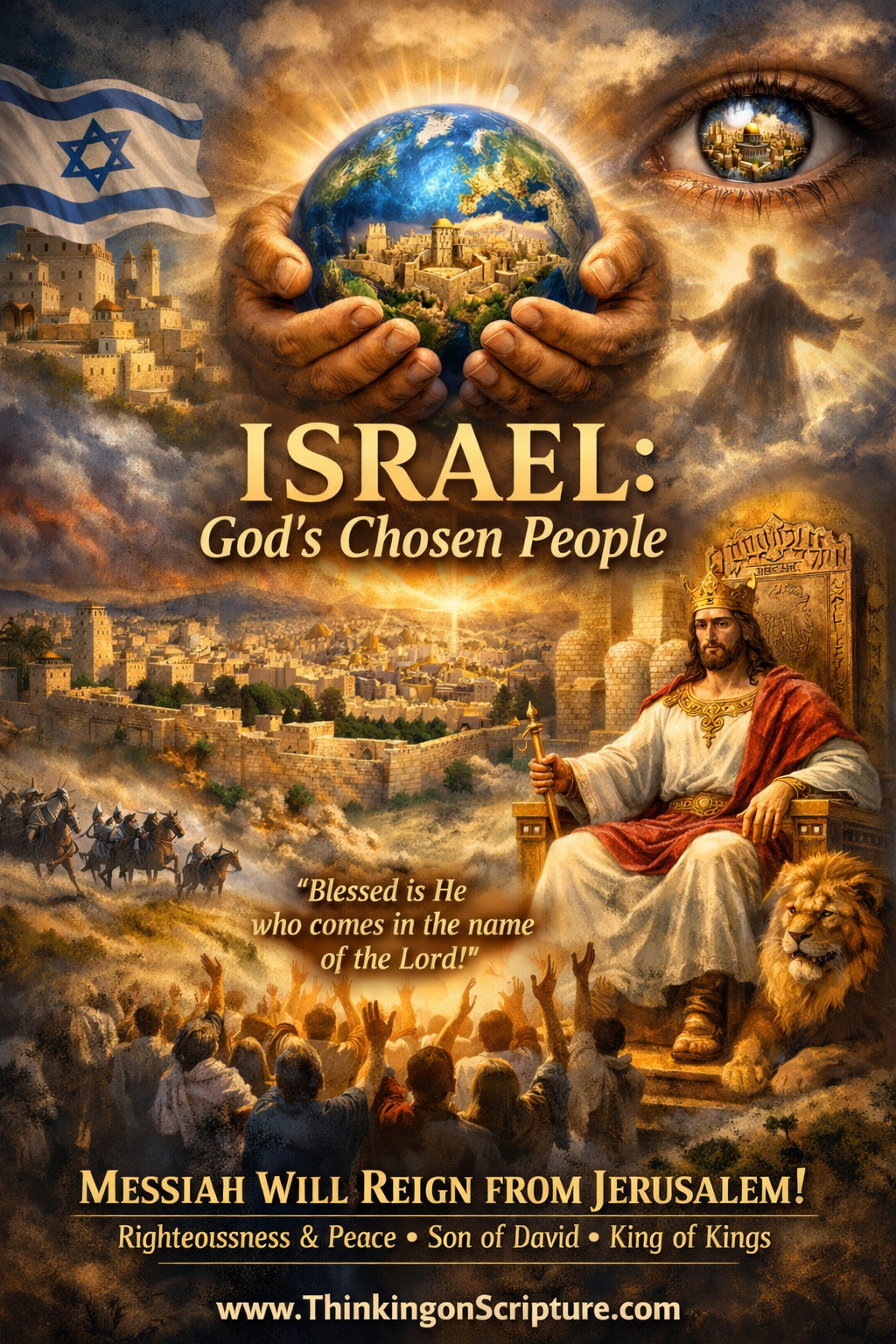 After His return, the Messiah will rule the world from Jerusalem. Scripture declares that “the Lord will be king over all the earth” (Zech. 14:9). He will reign as the promised Son of David, the One of whom God said, “He will be great and will be called the Son of the Most High” (Luke 1:32). God will place Him on David’s throne, fully carrying out His covenant promises, for “the Lord God will give Him the throne of His father David… and His kingdom will have no end” (Luke 1:32–33). His rule will bring lasting righteousness and peace to the entire world, because “there will be no end to the increase of His government or of peace” (Isa. 9:6–7), and “in His days the righteous will flourish, and abundance of peace” (Ps. 72:7). All opposition will be brought under control, since the Messiah will “break them with a rod of iron” (Ps. 2:9). His kingdom will never end, because “His dominion is an everlasting dominion which will not pass away” (Dan. 7:14). Israel’s future, then, clearly shows that God is faithful to His word and always brings His promises to their complete fulfillment.
 This attitude expresses itself in action. Believers are to pray for Israel, especially for her salvation, sharing Paul’s desire when he said, “my heart’s desire and my prayer to God for them is for their salvation” (Rom. 10:1), and to pray for Jerusalem, as Scripture commands, “Pray for the peace of Jerusalem” (Ps. 122:6). Christians should also lovingly share the gospel with Jewish people, knowing that faith comes through hearing the word of Christ (Rom. 10:14–17), while trusting God’s timetable, since the present hardening is partial and temporary (Rom. 11:25). When possible, believers should also support Israel in gratitude, recognizing that Gentiles have shared in Israel’s spiritual blessings (Rom. 15:27). In all of this, the Christian looks forward with confidence to the day when God’s promises are fulfilled, when Israel turns to her Messiah and “all Israel will be saved” (Rom. 11:26), and the Lord reigns as King over all the earth (Zech. 14:9).




 When applied to Christians in the New Testament, ekklesia takes on a technical meaning and refers to those who have been joined to the spiritual body of Christ (1 Cor. 12:13; Eph. 1:22-23) by means of personal faith in Jesus as Savior (Acts 4:12; 1 Cor. 15:3-4; Eph. 2:8-9). The first reference to the Christian church occurs in Matthew 16:18 after Peter had confessed that Jesus is “the Christ, the Son of the living God” (Matt. 16:16), and based on the rock-solid truth of Peter’s statement, Jesus said, “I will build [future tense] My church [ekklesia]; and the gates of Hades shall not prevail against it” (Matt. 16:18). Jesus’ future tense statement reveals a church that was not in existence when He spoke. The Christian church began on the day of Pentecost, in Acts 2, when the Holy Spirit began His baptizing ministry of placing believers into the body of Christ. Concerning this work of the Holy Spirit, Paul writes, “For by one Spirit we were all baptized into one body—whether Jews or Greeks, whether slaves or free—and have all been made to drink into one Spirit” (1 Cor. 12:13; cf. Gal. 3:26-28). “The Holy Spirit of God is the primary agent who identifies the believer with other believers. Each one is a member of the body, and each member is united with the other members and with Christ (Rom. 6:1–4).”
 The word church is also used to refer to a local assembly of those who regularly meet at a specific location (1 Cor. 1:2; Col. 1:2; Rev. 2-3). Luke mentions “the church which was at Jerusalem (Acts 8:1), and “the church that was at Antioch” (Acts 13:1). Paul mentions “the church in Cenchrea” (Rom. 16:1), “the church of God which is at Corinth” (1 Cor. 1:2), “the saints in Christ Jesus who are in Philippi” (Phil. 1:1), and “the saints and faithful brethren in Christ who are in Colosse” (Col. 1:2) (italics added). The apostle John wrote the book of Revelation to churches in Ephesus, Smyrna, Pergamos, Thyatira, Sardis, Philadelphia, and Laodicea (Revelation 2-3). These were all local churches that existed in ancient cities, where Christians lived and worked. However, we can narrow the local church down a little further and say that Christians met in the homes of specific church members within each city. The first church—which was Jewish—met “in the temple” in Jerusalem, as well as “from house to house” (Acts 2:46). As the church grew, and included Gentiles, the home continued as the primary meeting place for believers. Luke records Paul’s ministry to Christians in Ephesus and explained that he taught “publicly and from house to house” (Acts 20:20). Paul mentions several home churches such as the one run by Aquila and Priscilla and “the church that is in their house” (1 Cor. 16:19), and about “Nymphas and the church that is in his house” (Col. 4:15), and “to the beloved Apphia, Archippus our fellow soldier, and to the church in your house” (Phm. 1:2) (italics added).