Every believer lives under the certainty of two eschatological realities. The Lord may return for His church in the Rapture (1 Th. 4:16–17), in which case we will not taste death but will “all be changed, in a moment, in the twinkling of an eye” (1 Cor. 15:51–52). But if we are not part of the Rapture generation, then each of us will face physical death, because “it is appointed for men to die once” (Heb. 9:27). For the believer, however, death is not defeat but the final opportunity to glorify God. A life lived in obedience to the Lord can culminate in a death that honors Him, just as Paul wrote, “Christ will even now, as always, be exalted in my body, whether by life or by death” (Phil. 1:20).
 This principle appears clearly in the Lord’s post-resurrection conversation with Peter, where Jesus revealed that even the manner of Peter’s death would become an act that glorifies God. John 21:18–19 records the Lord’s final words to Peter after restoring him from his threefold denial (John 21:15–17). Jesus said, “Truly, truly, I say to you, when you were younger, you used to gird yourself and walk wherever you wished; but when you grow old, you will stretch out your hands and someone else will gird you, and bring you where you do not wish to go” (John 21:18). John then adds the inspired explanation, “Now this He said, signifying by what kind of death he would glorify God. And when He had spoken this, He said to him, ‘Follow Me!’” (John 21:19).
The contrast in John 21:18 is between Peter’s past independence and his future martyrdom. When Peter was young, he “girded” himself and went where he desired. The language reflects the ancient practice of tightening a garment to move freely. In the future, however, Peter would lose that freedom. Jesus says he will “stretch out your hands,” an expression widely understood in the early church as a reference to crucifixion. Others will “gird” him and lead him where he does not wish to go. The statement predicts that Peter would die as a martyr, which early Christian testimony affirms occurred in Rome. Thus, the Lord reveals Peter’s end from the divine vantage point. The One who knows “the end from the beginning” (Isa. 46:10) discloses the path of Peter’s life and death.
 John 21:19 explains the theological significance of that death. John writes that Jesus spoke “signifying by what kind of death he would glorify God.” Even martyrdom can become an act of worship. When a believer remains faithful under suffering, the result magnifies God’s worth and truth. Peter would eventually demonstrate this principle in his own teaching: “If anyone suffers as a Christian, he is not to be ashamed, but is to glorify God in this name” (1 Pet. 4:16). The death of the believer does not defeat God’s purpose. Rather, the believer’s endurance under trial becomes a testimony to the reality and value of Christ. In this respect Peter’s future mirrored the pattern first established by Jesus Himself. The Lord said concerning His own death, “Now is the Son of Man glorified, and God is glorified in Him” (John 13:31), and again prayed, “I glorified You on the earth, having accomplished the work which You have given Me to do” (John 17:4). Just as Christ followed the Father’s will even to the cross, so Peter would follow Christ’s will even to martyrdom, and both acts of obedience would result in the glory of God. Carson notes, “What is remarkable is that Peter lived and served three decades with this prediction hanging over him.”[1] Later church tradition claims Peter was crucified upside down because he felt unworthy to die as his Lord did, but this cannot be verified and remains uncertain.[2]
After revealing Peter’s future death, Jesus immediately returns him to the present with a simple command: “Follow Me.” The Lord discloses the destination but emphasizes the next step. The Christian life is lived one step of obedience at a time. God may know the entire course of a believer’s life, but the believer’s responsibility is to follow Christ today. The command echoes Jesus’ earlier call to discipleship: “If anyone wishes to come after Me, he must deny himself, and take up his cross and follow Me” (Matt. 16:24). Following Christ means orienting one’s will, priorities, and conduct under His authority. According to Blum, “Obedience to Jesus’ command, Follow Me, is the key issue in every Christian’s life. As Jesus followed the Father’s will, so His disciples should follow their Lord whether the path leads to a cross or to some other difficult experience.”[3]
The practical lesson is direct. The future belongs to God, but obedience belongs to us. Christians often want full knowledge of what lies ahead. Scripture rarely provides that. Instead, the Lord gives direction for the present moment. The believer advances by trusting God’s sovereignty while concentrating on present faithfulness. As Proverbs states, “Trust in the LORD with all your heart and do not lean on your own understanding. In all your ways acknowledge Him, and He will make your paths straight” (Prov. 3:5–6).
 To follow Jesus, therefore, means to live under His authority, guided by His Word, and empowered by His Spirit. It means learning His thinking through Scripture (Col. 3:16), walking by faith rather than sight (2 Cor. 5:7), and presenting oneself as an instrument of righteousness (Rom. 6:13). The believer does not need to control the entire future. He simply keeps moving behind the Shepherd who leads him. Jesus said, “My sheep hear My voice, and I know them, and they follow Me” (John 10:27). Faithful discipleship is not primarily about knowing the entire path ahead. It is about staying close to the One who already knows it.
Steven R. Cook, D.Min., M.Div.
If this article has enriched your understanding and walk with Christ, and you feel led to support my ministry, your generosity is greatly appreciated. Your gifts enable me to continue sharing the gospel of grace and providing in-depth biblical teachings. Thank you for partnering with me in this mission.
Related Articles:
- The Free Gift of God is Eternal Life
- Learning to Rest in God
- Faith from Beginning to End
- Mastering Focus as We Walk by Faith
- Trusting God in Difficult Times
- Recalibrating the Mind with Scripture
- The Christian with Integrity
- The Righteous Lifestyle of the Believer
- Walking Worthy of God’s Call to Service
- Walking in the Light
- God Uses Imperfect People
- Knowing and Doing the Will of God
- The High Calling of God’s Servant
- The Life of Faith
[1] D. A. Carson, The Gospel according to John, The Pillar New Testament Commentary (Leicester, England; Grand Rapids, MI: Inter-Varsity Press; W.B. Eerdmans, 1991), 680.
[2] The earliest reference to this idea appears in the apocryphal Acts of Peter from the late second century, and the report is later repeated by writers such as Origen and Eusebius of Caesarea. However, the tradition rests on sources removed from the events themselves and lacks contemporary historical verification. As D. A. Carson observes, “Later accounts of Peter asking to be crucified upside down, because he felt unworthy to be crucified as his Lord was, are too remote and too infected with legendary accretions to be reliable.” D. A. Carson, The Gospel according to John, Pillar New Testament Commentary (Leicester, England; Grand Rapids, MI: Inter-Varsity Press; W. B. Eerdmans, 1991), 680.
[3] Edwin A. Blum, “John,” in The Bible Knowledge Commentary: An Exposition of the Scriptures, ed. J. F. Walvoord and R. B. Zuck, vol. 2 (Wheaton, IL: Victor Books, 1985), 345.


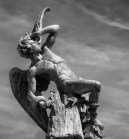 A third area where the Holy Spirit is working in the hearts of unbelievers concerns judgment, “because the ruler of this world has been judged” (John 16:11). Satan has been judged and found guilty before God. This means that Satan and his world-system is condemned. Being the ruler of this world, Satan naturally rules in the hearts of all unbelievers. Three times Jesus referred to Satan as “the ruler of this world” (John 12:31; 14:30; 16:11). Other passages of Scripture call Satan “the god of this world” (2 Cor 4:4), and “the prince of the power of the air” (Eph 2:2), informing us “that the whole world lies in the power of the evil one” (1 John 5:19). Satan rules as a tyrant who has “weakened the nations” (Isa 14:12), and currently “deceives the whole world” (Rev 12:9). Satan continues to attack God’s people today (1 Pet 5:8), practices deception (2 Cor 11:13-15), and has well developed strategies of warfare (Eph 6:10-12). Furthermore, humanity is living in an “evil age” (Gal 1:4), under “the dominion of Satan” (Acts 26:18), whose sphere of influence is called “the domain of darkness” (Col 1:13). But Satan has been judged and his punishment is pending execution. Furthermore, those who side with Satan in this life will be judged with him in eternity. According to Ryrie, “At the cross, Christ triumphed over Satan, serving notice on unbelievers of their judgment to come.”
 Barnabas’ first act on encouragement was witnessed in his willingness to give of his own resources for the benefit of others; specifically, we are told he “owned a tract of land, sold it and brought the money and laid it at the apostles’ feet” (Acts 4:37). Barnabas was a man of financial means as he owned land, perhaps on the island of Cyprus. Being a man of grace, he sold his property and gave it to the apostles to be used for ministry purposes. The sale of private property was not a common practice among Christians, which is what set Barnabas apart and made him an exceptional person. If such behavior had been practiced by all, there would have been no need to focus on Barnabas and his gracious act. It is a truth of Scripture that God’s blesses believers who are gracious in giving, for “He who supplies seed to the sower and bread for food will supply and multiply your seed for sowing and increase the harvest of your righteousness” (2 Cor 9:10). And Scripture also reveals these openhanded believers will be rewarded by the Lord in eternity (1 Cor 3:10-15).
 We also learn from other biblical passages that Barnabas was pivotal to the growth of the early church. For example, it was Barnabas who supported Paul shortly after his conversion, even though others had reservations about him (Acts 9:27). It was Barnabas who bridged the relationship between the church in Jerusalem and the church in Antioch (Acts 11:22). It was Barnabas who partnered with Paul and formed a teaching ministry in Antioch that lasted for a year (Acts 11:25-26). It was Barnabas—along with Paul—who was entrusted to deliver a financial donation to suffering Christians in Judea (Acts 11:27-30). It was Barnabas who helped launch the first significant missionary journey into the Gentile world (Acts 13:1-4). It was Barnabas who helped resolve the first major theological issue facing the church (Acts 15:1-25). It was Barnabas who supported Mark, his cousin (Col 4:10), even after Mark had failed to complete a missionary journey (Acts 15:37-38). Unfortunately, Barnabas’ support of Mark resulted in a major conflict with Paul that resulted in their breaking fellowship for a while (Acts 15:39-41). However, from later biblical passages we know that Barnabas and Paul—men who were both known for their grace and love—reconciled their differences and were reunited in fellowship and ministry (1 Cor 9:6; Gal 2:9).
