There are several believers in the Bible I admire in one way or another, but none more than Barnabas. I admire him because his life is marked by faith, grace, and because he was an encourager to other believers. Faith, grace, and encouragement. That resonates with me.
We first hear about Barnabas in the book of Acts where we learn his name was “Joseph, a Levite of Cyprian birth, who was also called Barnabas by the apostles” (Acts 4:36a). Luke informs us that Joseph was also known as Barnabas (his nickname), which means “Son of Encouragement” (Acts 4:36b).[1] To be a son of something meant that one was characterized by the quality of the word that follows. In this case, the quality is that of encouragement, which translates the Greek noun παράκλησις paraklesis, which denotes “emboldening another in belief or course of action, encouragement, exhortation…[the] lifting of another’s spirits.”[2]
No doubt, Barnabas’ life reflected what He saw and experienced in his relationship with God. In Scripture, we learn that God the Father is described as “the God of all grace” (1 Pet 5:10), Who sits upon a “throne of grace” (Heb 4:16), Who “gives grace to the afflicted” (Prov 3:34), and provides salvation “by grace” through faith in Jesus (Eph 2:8-9; cf. Acts 15:11; Rom 3:24). Jesus is said to be “full of grace and truth” (John 1:14), and the Holy Spirit is called “the Spirit of grace” (Heb 10:29). Grace (χάρις charis) is undeserved favor. It is the love, mercy, or kindness that one person freely confers upon another who deserves the opposite (Matt 5:44-45; Rom 11:6; Eph 1:6; 2:1-9; 2 Tim 1:9; Tit 3:5-7). And there is nothing more powerful or encouraging than God’s grace to warm and motivate His people to action. For what flows down from God to his children, when received with an open heart, will find natural outward expression to others, who will “encourage one another and build up one another” (1 Th 5:11a), and will “encourage one another day after day” (Heb 3:13a). I believe Barnabas was one who drank deeply from the well of God’s grace and goodness, and being blessed and encouraged by the Lord, was motivated to do the same to others.
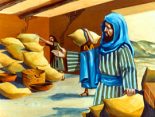
 Barnabas’ first act on encouragement was witnessed in his willingness to give of his own resources for the benefit of others; specifically, we are told he “owned a tract of land, sold it and brought the money and laid it at the apostles’ feet” (Acts 4:37). Barnabas was a man of financial means as he owned land, perhaps on the island of Cyprus. Being a man of grace, he sold his property and gave it to the apostles to be used for ministry purposes. The sale of private property was not a common practice among Christians, which is what set Barnabas apart and made him an exceptional person. If such behavior had been practiced by all, there would have been no need to focus on Barnabas and his gracious act. It is a truth of Scripture that God’s blesses believers who are gracious in giving, for “He who supplies seed to the sower and bread for food will supply and multiply your seed for sowing and increase the harvest of your righteousness” (2 Cor 9:10). And Scripture also reveals these openhanded believers will be rewarded by the Lord in eternity (1 Cor 3:10-15).
Later, in Acts, we’re told that the church at Jerusalem sent Barnabas to Antioch (Acts 11:22), and “when he arrived and witnessed the grace of God” (Acts 11:23a)—there’s that grace again!—he “rejoiced and began to encourage them all with resolute heart to remain true to the Lord” (Acts 11:23b). Here, the word encourage translates the Greek verb παρακαλέω parakaleo, which means to “call to one’s side.”[3] The picture is that of one person who comes alongside others and encourages them to accomplish a task or finish a race. In this case, it meant encouraging these Christians to press on and do God’s will. Encouraging other believers “to remain true to the Lord” is what healthy encouragement looks like.
 We also learn from other biblical passages that Barnabas was pivotal to the growth of the early church. For example, it was Barnabas who supported Paul shortly after his conversion, even though others had reservations about him (Acts 9:27). It was Barnabas who bridged the relationship between the church in Jerusalem and the church in Antioch (Acts 11:22). It was Barnabas who partnered with Paul and formed a teaching ministry in Antioch that lasted for a year (Acts 11:25-26). It was Barnabas—along with Paul—who was entrusted to deliver a financial donation to suffering Christians in Judea (Acts 11:27-30). It was Barnabas who helped launch the first significant missionary journey into the Gentile world (Acts 13:1-4). It was Barnabas who helped resolve the first major theological issue facing the church (Acts 15:1-25). It was Barnabas who supported Mark, his cousin (Col 4:10), even after Mark had failed to complete a missionary journey (Acts 15:37-38). Unfortunately, Barnabas’ support of Mark resulted in a major conflict with Paul that resulted in their breaking fellowship for a while (Acts 15:39-41). However, from later biblical passages we know that Barnabas and Paul—men who were both known for their grace and love—reconciled their differences and were reunited in fellowship and ministry (1 Cor 9:6; Gal 2:9).
Overall, Barnabas was noted as being an encourager (Acts 4:36; 11:23), who sacrificed his own resources to be a blessing to others (Acts 4:37). He was called “a good man, full of the Holy Spirit and of faith” (Acts 11:24), and one—along with Paul—who “risked” his life “for the name of our Lord Jesus Christ” (Acts 15:26). Barnabas was not without his flaws; however, he possessed the qualities one would like to see in a Christian leader, as he sought to build the Christian community by means grace, love, and solid biblical instruction. Churches and Christians need people like Barnabas, who will stand with them, give them wise counsel, and encourage them in their walk with the Lord.
Dr. Steven R. Cook
Related Articles:
- The Gospel Explained
- The Manifold Grace of God
- Biblical Encouragement
- Rejoice, Pray, and Give Thanks
- Walking with God
- The High Calling of God’s Servant
- The Life of Faith
- The Righteous Lifestyle of the Believer
- A Role Model for Believers
- Giving to Support God’s Ministers
[1] The name Barnabas, as it appears in Hebrew (ברנבו), actually means son of a prophet. The question among some Bible scholars is how this could translate as Son of Encouragement? I think Paul helps us here when he spoke to prophets at the church of Corinth, saying, “For you can all prophesy one by one, so that all may learn and all may be encouraged” (1 Cor 14:31). The idea is that a prophet of the Lord would function as one who encouraged others to walk with the Lord and remain faithful to Him.
[2] William Arndt et al., A Greek-English Lexicon of the New Testament and Other Early Christian Literature (Chicago: University of Chicago Press, 2000), 766.
[3] Ibid., 764.

 Some pastors have grievously misapplied Malachi 3:8–10 by imposing it upon the Church, using the passage as a means to coerce believers through guilt and intimidation into financial giving. In extreme cases, some have demanded access to members’ tax returns or have publicly displayed individual contributions as a method of exerting social pressure. The misuse of this Old Testament text reveals both a lack of sound hermeneutical understanding and a deficiency in spiritual maturity among church leaders. In its original context, Malachi 3:8–10 pertains to Israel under the Mosaic Law, not to the Church of Jesus Christ in the present dispensation.