 God’s kingdom program is rooted in the covenants and unfolds progressively throughout Scripture. Central to that program is the Davidic Covenant, in which God promised David an eternal dynasty, throne, kingdom, and descendant who would rule forever (2 Sam. 7:12-13; Ps. 89:3-4, 34-37). David had an earthly kingdom, and his “throne shall be established forever” (2 Sam. 7:16). Isaiah declared that the promised Son would sit “on the throne of David and over his kingdom” and that His government and peace would never end (Isa. 9:6-7). Jeremiah foretold a “righteous Branch” from David who would reign wisely and execute justice in the land (Jer. 23:5-6; 33:14-17). Ezekiel spoke of a restored Israel living securely under “My servant David” (Ezek. 34:23-24; 37:24-28). Daniel saw the Son of Man receiving an everlasting dominion that would crush all Gentile kingdoms (Dan. 2:44; 7:13-14, 27). Zechariah announced that the Lord Himself would one day be “king over all the earth” (Zech. 14:9). The New Testament opens with these promises still intact, as Gabriel told Mary that Jesus would receive “the throne of His father David” and reign forever (Luke 1:31-33). Jesus is repeatedly identified as the Son of David and rightful heir to the kingdom promises (Matt. 1:1; Rom. 1:3; Rev. 22:16). The kingdom promised in Scripture is a literal, earthly kingdom in which Christ will rule on earth, fulfilling the prayer, “Your kingdom come. Your will be done, on earth as it is in heaven” (Matt. 6:10).
Scripture also gives an extensive description of the ruler of this kingdom. The Messiah would come from the tribe of Judah and possess the scepter of rule (Gen. 49:10). He would be both human and divine, born of a virgin and called Immanuel (Isa. 7:14), “God with us” (Matt. 1:23; cf. John 1:1, 14; Col. 2:9), “Mighty God” and “Prince of Peace” (Isa. 9:6). Psalm 45 describes Him as a righteous king whose throne is eternal (Ps. 45:6-7), while Psalm 110 reveals Him as both King and Priest after the order of Melchizedek (Ps. 110:1-4). Isaiah 11 portrays Him as empowered by the Holy Spirit, ruling in righteousness and equity (Isa. 11:1-5). Micah declared that though He would be born in Bethlehem, His origins are “from the days of eternity” (Mic. 5:2). Yet before reigning in glory, the Messiah would first suffer for sin, bearing the iniquities of others (Isa. 53:1-12). The New Testament identifies Jesus as the fulfillment of these prophecies. He is the Son of David (Matt. 1:1), the King of Israel (John 1:49), and the returning conqueror who will rule the nations (Rev. 19:11-16).
At Christ’s first coming, the kingdom was genuinely offered to Israel. John the Baptist announced, “Repent, for the kingdom of heaven is at hand” (Matt. 3:1-2).[1] Jesus proclaimed the same message and traveled throughout Israel “preaching the gospel of the kingdom” (Matt. 4:17, 23; 9:35). The disciples were sent specifically to “the lost sheep of the house of Israel” with the message that “the kingdom of heaven is at hand” (Matt. 10:5-7). Christ authenticated His messianic claims through miracles that fulfilled kingdom prophecies concerning healing and restoration (Isa. 35:5-6; Matt. 11:2-6; Acts 2:22). The offer was real, the King was present, and the credentials of the kingdom were publicly displayed. According to Pentecost:
The “Gospel of the kingdom” is what was preached by both John and Jesus (Matt. 3:2, 4–17). This “Gospel” was the Good News that the kingdom was near and was a message with both a soteriological (salvation) and an eschatological (prophetic) emphasis. This Gospel directed sinners to “the Lamb of God, who takes away the sin of the world” (John 1:29) and promised the expectant ones that “the kingdom of heaven is near” (Matt. 3:2).[2]
The Kingdom Rejected
Israel’s leadership rejected the King and committed the offense that led to the removal of the kingdom offer. This climactic rejection occurred when the Pharisees attributed Christ’s miracles, performed through the power of the Holy Spirit, to Satan himself (Matt. 12:22-24; Mark 3:22-30; Luke 11:14-20). This marked a decisive turning point in Christ’s ministry. Jesus warned of judgment for this national rejection (Matt. 12:31-32) and began speaking in parables to conceal truth from hardened hearts while revealing it to responsive disciples (Matt. 13:10-17). Later, in the parable of the vineyard, Jesus declared, “the kingdom of God will be taken away from you and given to a people, producing the fruit of it” (Matt. 21:43). He lamented over Jerusalem and announced that the nation would not see Him again until it welcomed Him as Messiah (Matt. 23:37-39). John wrote, “He came to His own, and those who were His own did not receive Him” (John 1:11). The nation ultimately cried, “We have no king but Caesar” (John 19:15).
The Kingdom Postponed
Because the King was rejected, the establishment of the kingdom was postponed. Fruchtenbaum states, “When Jesus was rejected, the offer of the Messianic Kingdom was rescinded.”[3] This rejection did not cancel the covenant promises but delayed their fulfillment until Christ’s return. Jesus illustrated this postponement in the parable of the nobleman who went to a distant country to receive a kingdom and then return (Luke 19:11-27). Even after the resurrection, the disciples still expected a future earthly kingdom for Israel, asking, “Lord, is it at this time You are restoring the kingdom to Israel?” (Acts 1:6). Christ did not deny the kingdom’s future restoration but only the timing (Acts 1:7). Peter later preached that Christ remains in heaven until the “period of restoration of all things” spoken of by the prophets (Acts 3:19-21). Hebrews also states that the world has not yet been subjected to Christ in visible rule (Heb. 2:5-8). Presently, Christ sits at the Father’s right hand awaiting the time when His enemies will be made His footstool (Ps. 110:1; Acts 2:34-35).
The Millennial Kingdom
 The kingdom will finally be established at the Second Coming of Christ described in Revelation 19 and 20. Jesus will return from heaven in power and glory, destroy His enemies, and judge the rebellious nations (Rev. 19:11-21). Satan will then be bound and imprisoned for one thousand years so that he cannot deceive the nations (Rev. 20:1-3). Christ will reign on earth for a thousand years with resurrected saints who share in His rule (Rev. 20:4-6). This period of a thousand years is called the Messianic Kingdom because it will be ruled by Messiah. According to Fructenbaum, “The name Millennial Kingdom emphasizes how long this kingdom will last: one thousand years. The form of the Messianic or Millennial Kingdom is that of an earthly literal kingdom which Jesus will rule from the Throne of David.”[4] After the millennium, Satan will be released briefly, lead a final rebellion, and then be cast forever into the lake of fire (Rev. 20:7-10). This is followed by the Great White Throne Judgment and the eternal state (Rev. 20:11-15; 21:1-4).
The prophets describe the millennial kingdom as a time of worldwide righteousness, peace, prosperity, and divine rule. Christ will reign personally from Jerusalem, and the nations will stream to Zion to learn the ways of the Lord (Isa. 2:1-4; Mic. 4:1-8; Zech. 14:9, 16-21). His government will be marked by perfect justice and righteousness (Isa. 11:3-5; Jer. 23:5; Ps. 72:1-4). War will cease as weapons are transformed into tools for agriculture (Isa. 2:4; Mic. 4:3). Even the animal kingdom will experience harmony as the curse is partially lifted from creation (Isa. 11:6-9; 35:1-7). Human life spans will increase, and the earth will produce abundantly (Isa. 65:20-25; Amos 9:13-14; Joel 3:18). Israel will be spiritually restored and regathered to the land under the blessings of the new covenant (Ezek. 36:24-28; 37:21-28; Rom. 11:25-27). A millennial temple will stand in Jerusalem as described in Ezekiel 40-48, and the nations will worship the King there (Zech. 14:16-21). Above all, the kingdom will be characterized by universal knowledge of God, “for the earth will be full of the knowledge of the LORD as the waters cover the sea” (Isa. 11:9; Hab. 2:14).
The Kingdom a Reward for the Faithful
Though all believers will enter the future earthly kingdom by grace, participation in its privileges and rulership is a reward for faithfulness in this life. Scripture consistently draws this distinction. Those who suffer with Christ will also reign with Him (2 Tim. 2:12), and those who overcome in the Christian life will be granted authority to rule the nations (Rev. 2:26-27). Faithful service, spiritual maturity, and endurance under trial form the pathway to inheriting the kingdom, not in terms of salvation, which is a free gift (Rom. 6:23), but in terms of honor, responsibility, and reward (Luke 19:17; 1 Cor. 3:13-15; Rom. 8:17b). Jesus will reward His servants at the Judgment Seat of Christ, and those who have proven faithful in smaller responsibilities will be entrusted with greater authority in His coming reign (2 Cor. 5:10; Luke 19:11-19). As Paul exhorted, “Whatever you do, do your work heartily, as for the Lord rather than for men, knowing that from the Lord you will receive the reward of the inheritance. It is the Lord Christ whom you serve” (Col. 3:23-24). This eternal perspective motivates us to live with intention and integrity, not merely content to enter the kingdom, but longing to reign with Christ in it. According to Fruchtenbaum, “All believers will enter the Messianic Kingdom but only those who live an obedient spiritual lifestyle will inherit the Kingdom (Gal. 5:21). This means that only such believers will be rewarded, honored, and given crowns of authority to co-rule in the Messianic Kingdom with Messiah, the King.”[5]
Steven R. Cook, D.Min., M.Div.
If this article has enriched your understanding and walk with Christ, and you feel led to support my ministry, your generosity is greatly appreciated. Your gifts enable me to continue sharing the gospel of grace and providing in-depth biblical teachings. Thank you for partnering with me in this mission.
Related Articles:
- The Free Gift of God is Eternal Life
- The Coming Rapture of the Church
- Saved by Grace Alone, Through Faith Alone, in Christ Alone
- Overview of Future Prophetic Events
- Israel, Globalism, and the Rapture
- World Events that Imply the Rapture is Near
- God Loves Israel
- A Brief Analysis of Israel in History and Prophesy
- Jesus’ Return for His Saints
- The Judgment Seat of Christ
- The Seven Year Tribulation
- Degrees of Sin and Eternal Punishment
- The Millennial Kingdom
- The Biblical Resurrections
- How to Avoid the Lake of Fire
- A Christian View of Death
[1] In Mark 1:15, “the gospel of the kingdom” referred to the announcement that Israel’s promised Messianic King had arrived and the kingdom was being offered to the nation through repentance and faith, whereas the later gospel of grace centered on Christ’s death, burial, and resurrection (1 Cor. 15:3-4), truths the disciples did not yet understand and initially resisted when Jesus first revealed them (Matt. 16:21-22; Mark 9:31-32; Luke 18:31-34).
[2] J. Dwight Pentecost, Thy Kingdom Come: Tracing God’s Kingdom Program and Covenant Promises throughout History (Grand Rapids, MI: Kregel Publications, 1995), 251.
[3] Arnold G. Fruchtenbaum, Israelology: The Missing Link in Systematic Theology, Rev. ed. (Tustin, CA: Ariel Ministries, 1994), 624.
[4] Ibid., 611.
[5] Arnold G. Fruchtenbaum, The Messianic Jewish Epistles: Hebrews, James, First Peter, Second Peter, Jude, 1st ed. (Tustin, CA: Ariel Ministries, 2005), 244.


 A third area where the Holy Spirit is working in the hearts of unbelievers concerns judgment, “because the ruler of this world has been judged” (John 16:11). Satan has been judged and found guilty before God. This means that Satan and his world-system is condemned. Being the ruler of this world, Satan naturally rules in the hearts of all unbelievers. Three times Jesus referred to Satan as “the ruler of this world” (John 12:31; 14:30; 16:11). Other passages of Scripture call Satan “the god of this world” (2 Cor 4:4), and “the prince of the power of the air” (Eph 2:2), informing us “that the whole world lies in the power of the evil one” (1 John 5:19). Satan rules as a tyrant who has “weakened the nations” (Isa 14:12), and currently “deceives the whole world” (Rev 12:9). Satan continues to attack God’s people today (1 Pet 5:8), practices deception (2 Cor 11:13-15), and has well developed strategies of warfare (Eph 6:10-12). Furthermore, humanity is living in an “evil age” (Gal 1:4), under “the dominion of Satan” (Acts 26:18), whose sphere of influence is called “the domain of darkness” (Col 1:13). But Satan has been judged and his punishment is pending execution. Furthermore, those who side with Satan in this life will be judged with him in eternity. According to Ryrie, “At the cross, Christ triumphed over Satan, serving notice on unbelievers of their judgment to come.”
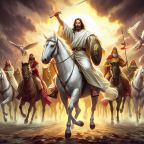 When Jesus returns to the earth after the time of the seven year Tribulation, He will establish His kingdom on earth.
 God’s greatest provision was for our eternal salvation, which came through His Son, Jesus, Who died in our place and bore the punishment that rightfully belongs to us (Rom 5:8; 1 Cor 15:3-4; 1 Pet 3:18). When we trust in Christ alone as our Savior, we receive forgiveness of sins (Eph 1:7), eternal life (John 10:28), are transferred into “the kingdom of His beloved Son” (Col 1:13), become “children of God” (John 1:12), and are blessed “with every spiritual blessing in the heavenly places in Christ” (Eph 1:3). God’s wonderful grace is amazing! And God, having done the most for us at the cross, will not do less for us after our salvation. Paul wrote, “What then shall we say to these things? If God is for us, who is against us? He who did not spare His own Son, but delivered Him over for us all, how will He not also with Him freely give us all things?” (Rom 8:31-32). Since God has already demonstrated His maximum love and generosity by giving His Son for our salvation, it only stands to reason that He will certainly provide everything else needed for our well-being, and for a life that glorifies Him and edifies others.
 By faith we trust God and rest in His promises. Failure to trust God will result in worry, fear, and an anxious heart that is never at rest. Do our hearts ever become anxious? Of course they do. And does fear ever rise up? Yes, of course it does. Well over a hundred times in the OT & NT believers are told “do no fear” and “do not be afraid” (e.g., Gen 15:1, Deut 1:21; Isa 41:10; Matt 10:28; 1 Pet 3:14). These directives would be superfluous if sinful fear was not a problem for the believer. Sometimes we become like Peter and look at the storm around us (Matt 14:30), become frightened, and sink into what we fear. But when fear rises up, faith must rise higher, always trusting God to keep His Word. When trials come (and they will), we must see them as opportunities to grow in our faith (Jam 1:2-4). The benefit of living by faith is a relaxed mental attitude as the believer focuses on the Lord and His promises. Remember, God always keeps His promises, for “God is not a man, that He should lie, nor a son of man, that He should repent; has He said, and will He not do it? Or has He spoken, and will He not make it good?” (Num 23:19). Yes, He will always keep His Word, for “the Glory of Israel will not lie or change His mind; for He is not a man that He should change His mind” (1 Sam 15:29), for “it is impossible for God to lie” (Heb 6:18). God has integrity and keeps His Word, and “is able to do far more abundantly beyond all that we ask or think” (Eph 3:20a).
 God will provide. The challenge for us, as His children, is to accept His Word as true and apply it to our lives on a regular basis. The walk of faith requires us to have discipline of mind and will, to learn and live God’s Word, and to stay focused on Him and His promises. As God’s children, we are to “walk by faith and not by sight” (2 Cor 5:7). The walk of faith is what He wants, for He says, “My righteous one shall live by faith” (Heb 10:38), and “faith is the assurance of things hoped for, the conviction of things not seen” (Heb 11:1). The life of faith is what Pleases God, “without faith it is impossible to please Him, for he who comes to God must believe that He is and that He is a rewarder of those who seek Him” (Heb 11:6). Will there be failure on our part? Yes, more often than most of us would like to admit. But that’s why daily confession is important (1 John 1:9), as we acknowledge our sins to God, trust that He forgives, and then move back into a walk of faith. Let us continually learn and live God’s Word, always trusting the Lord will provide and that He will keep His promises to us. This way of living will glorify God, edify others, and result in a relaxed mental attitude for us as we lean on the Lord.