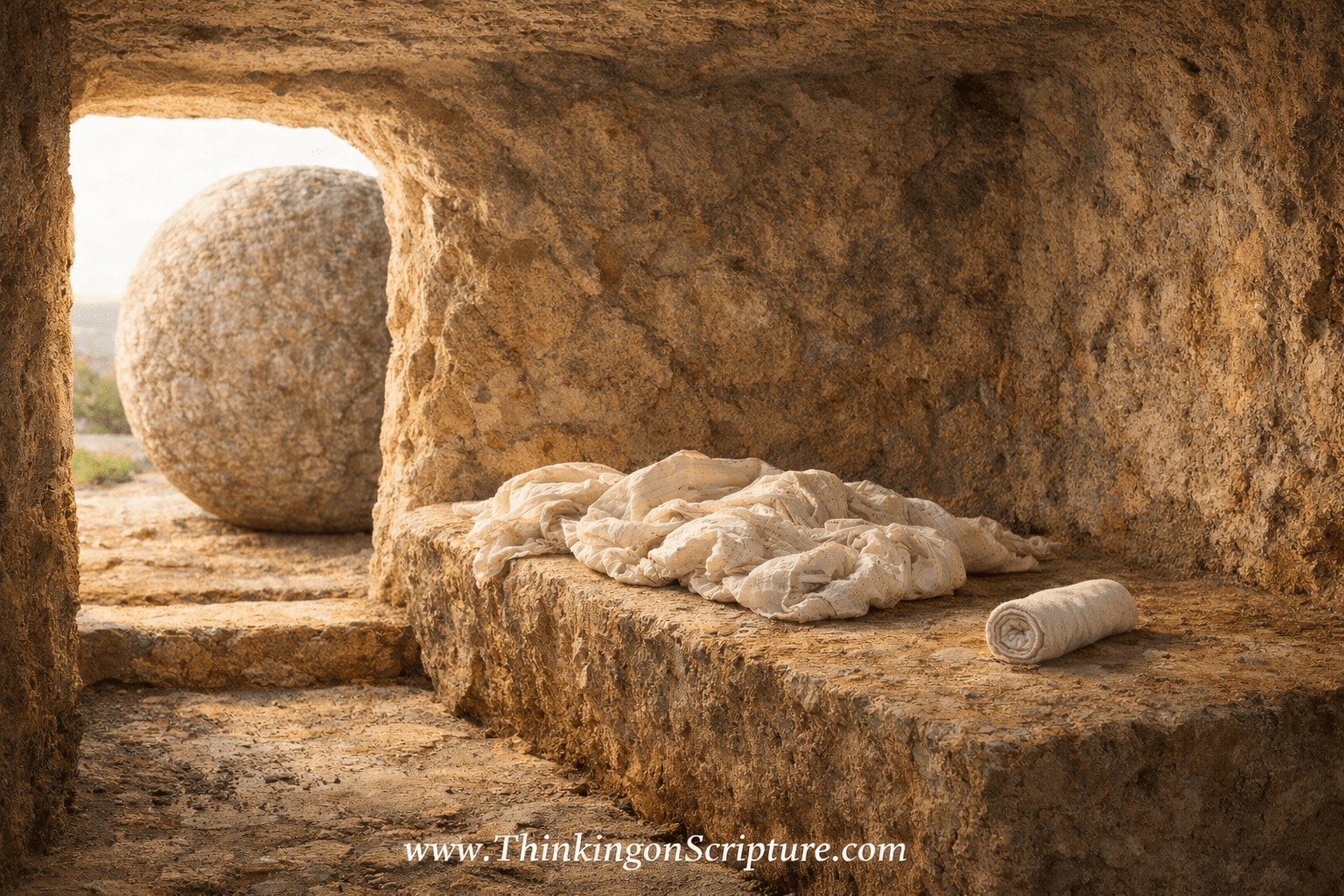
 The resurrection of Jesus Christ stands as an essential element of the gospel: that Christ died for our sins, was buried, and was raised on the third day (1 Cor. 15:3–4). Yet some denied the resurrection (1 Cor. 15:12). Paul answered them directly, “if Christ has not been raised, your faith is worthless; you are still in your sins” (1 Cor. 15:17). At the cross, Jesus paid the penalty for sin, and the resurrection is God’s public declaration that the payment was accepted and that righteousness has been secured. Scripture states, “He was handed over to die because of our sins, and he was raised to life to make us right with God” (Rom. 4:25). The cross removes the penalty of sin and secures righteousness, while the resurrection validates and publicly declares that the saving work of Christ has been fully accepted.
Christ bore our sins in His body on the cross, dying as our substitute, “the just for the unjust, so that He might bring us to God” (1 Pet. 3:18; cf. Isa. 53:6; 2 Cor. 5:21). During the hours of darkness, He endured judgment for sin, and then He died physically (Matt. 27:45–50). Death is the consequence of sin (Rom. 5:12; 6:23), and Jesus entered that realm fully. The resurrection demonstrates His victory over sin and death, proving that the penalty was completely satisfied and that death could not hold Him (Acts 2:24).
 The post-resurrection appearances provide cumulative, verifiable evidence that Jesus rose bodily. These are not visions or impressions but encounters with the same physical body that was crucified, now glorified (Luke 24:39; John 20:27). Jesus appeared to numerous eyewitnesses. He appeared to Mary Magdalene (John 20:11–18), to other women returning from the tomb (Matt. 28:8–10), to Peter (Luke 24:34; 1 Cor. 15:5), to two disciples on the road to Emmaus (Luke 24:13–35), to the apostles without Thomas (John 20:19–25), to the apostles with Thomas (John 20:26–29), to seven disciples by the Sea of Galilee (John 21:1–14), to more than five hundred brethren at one time (1 Cor. 15:6), to James (1 Cor. 15:7), to all the apostles (Luke 24:50–51; 1 Cor. 15:7), and later to Paul as one “untimely born” (1 Cor. 15:8; Acts 9:3–6). These appearances occurred over forty days, “presenting Himself alive… by many convincing proofs” (Acts 1:3). The four Gospels function as converging eyewitness testimony, supplemented by apostolic witness in Acts and the Epistles (Luke 1:1–4; John 21:24; Acts 2:32).
A distinction must be made between resuscitation and resurrection. Prior to Christ, individuals such as the widow’s son (1 Kings 17:17–24), the Shunammite’s son (2 Kings 4:32–35), Jairus’s daughter (Mark 5:35–43), the widow’s son at Nain (Luke 7:11–15), and Lazarus (John 11:43–44) were restored to mortal life, only to die again. Christ’s resurrection is categorically different. He rose in a glorified, immortal body, never to die again, becoming “the first fruits of those who are asleep” (1 Cor. 15:20, 23).
The resurrection of Christ guarantees the future resurrection of all who belong to Him. For the Church, this occurs at the Rapture, when “the dead in Christ will rise first… then we who are alive and remain will be caught up together with them… to meet the Lord in the air” (1 Th. 4:16–17), and “we will all be changed… for this perishable must put on the imperishable, and this mortal must put on immortality” (1 Cor. 15:51–53). Old Testament and Tribulation saints will be raised at the end of the Tribulation (Dan. 12:2; Rev. 20:4–6). These resurrections result in glorified bodies fit for eternal life in God’s presence (Phil. 3:20–21).
Unbelievers will also be resurrected, but for judgment, not blessing. At the Great White Throne, they will be raised and judged, then cast into the lake of fire (John 5:28–29; Rev. 20:11–15). The resurrection of Christ does not benefit them because they reject the provision secured by His work (John 3:18, 36). Unbelievers who receive resurrection bodies “will go away into eternal punishment” (Matt. 25:46), spending eternity in the lake of fire, forever separated from God, suffering eternal torment with no hope of relief. The lake of fire is avoidable.
How Can I Be Saved?
The answer is simple: “Believe in the Lord Jesus, and you will be saved” (Acts 16:31). Jesus Christ is the eternal Son who became man (John 1:1, 14), lived sinlessly (1 John 3:5), died in your place (Rom. 5:8), and rose again on the third day (1 Cor. 15:3–4). He accomplished everything necessary for your salvation. Scripture declares, “For God so loved the world, that He gave His only begotten Son, that whoever believes in Him shall not perish, but have eternal life” and “He who believes in the Son has eternal life” (John 3:16; 36a). The issue is not what you do for God, but whether you will accept His free offer of salvation purchased by Christ on the cross.
Eternal life is a free gift from God, offered because He is gracious and not because we are deserving, “for there are none righteous, not even one… for all have sinned and fall short of the glory of God” (Rom. 3:10, 23). But God, because of His great love and grace toward us (Eph. 2:4–5), offers total forgiveness (Acts 10:43), reconciliation (2 Cor. 5:18–19), and eternal salvation through faith alone in Christ alone (Eph. 2:8–9). Scripture states, “the free gift of God is eternal life in Christ Jesus our Lord” (Rom. 6:23). A gift requires no payment before, during, or after. Eternal salvation was purchased by Jesus and is offered as a free gift to all.
 You receive God’s free gift of eternal life the moment you place your faith in Jesus as your Savior. Believing in Jesus means you trust Him to accomplish what you cannot: to make you righteous before God by removing your sins (Col. 2:13–14), crediting you with His righteousness (2 Cor. 5:21), and giving you eternal life (John 10:28). This great gift of salvation was very costly to Jesus (1 Pet. 1:18–19), but it is totally free to you, if you will believe in Jesus as your Savior. If you have not trusted in Him, you can do so now. The matter is simple: “Believe in the Lord Jesus, and you will be saved” (Acts 16:31). Once you believe in Jesus, you are forever part of His family (John 1:12; Gal. 3:26), and will never face the lake of fire (John 5:24; Rom. 8:1). Heaven is secure from that point onward (John 10:28–29; 1 Pet. 1:4–5), and you can rest in Him and what He accomplished for you.
Steven R. Cook, D.Min., M.Div.
If this article has enriched your understanding and walk with Christ, and you feel led to support my ministry, your generosity is greatly appreciated. Your gifts enable me to continue sharing the gospel of grace and providing in-depth biblical teachings. Thank you for partnering with me in this mission.
Related Articles:
- The Free Gift of God is Eternal Life
- Salvation if Free, Discipleship is Costly
- The Gospel of Grace
- Eternal Life
- Assurance of Salvation
- Total Depravity, Faith in Christ, and Regeneration
- Saved by Grace Alone, Through Faith Alone, in Christ Alone
- Not of Works
- When a Christian Turns to a Sinful Lifestyle
- God Uses Imperfect People
- The Righteous Lifestyle of the Believer
- Walking Worthy of God’s Call to Service
- God’s Gift of Righteousness
- The Cross & Crucifixion of Jesus
- Defining Salvation in the Bible
- Who is the One Who Saves?