
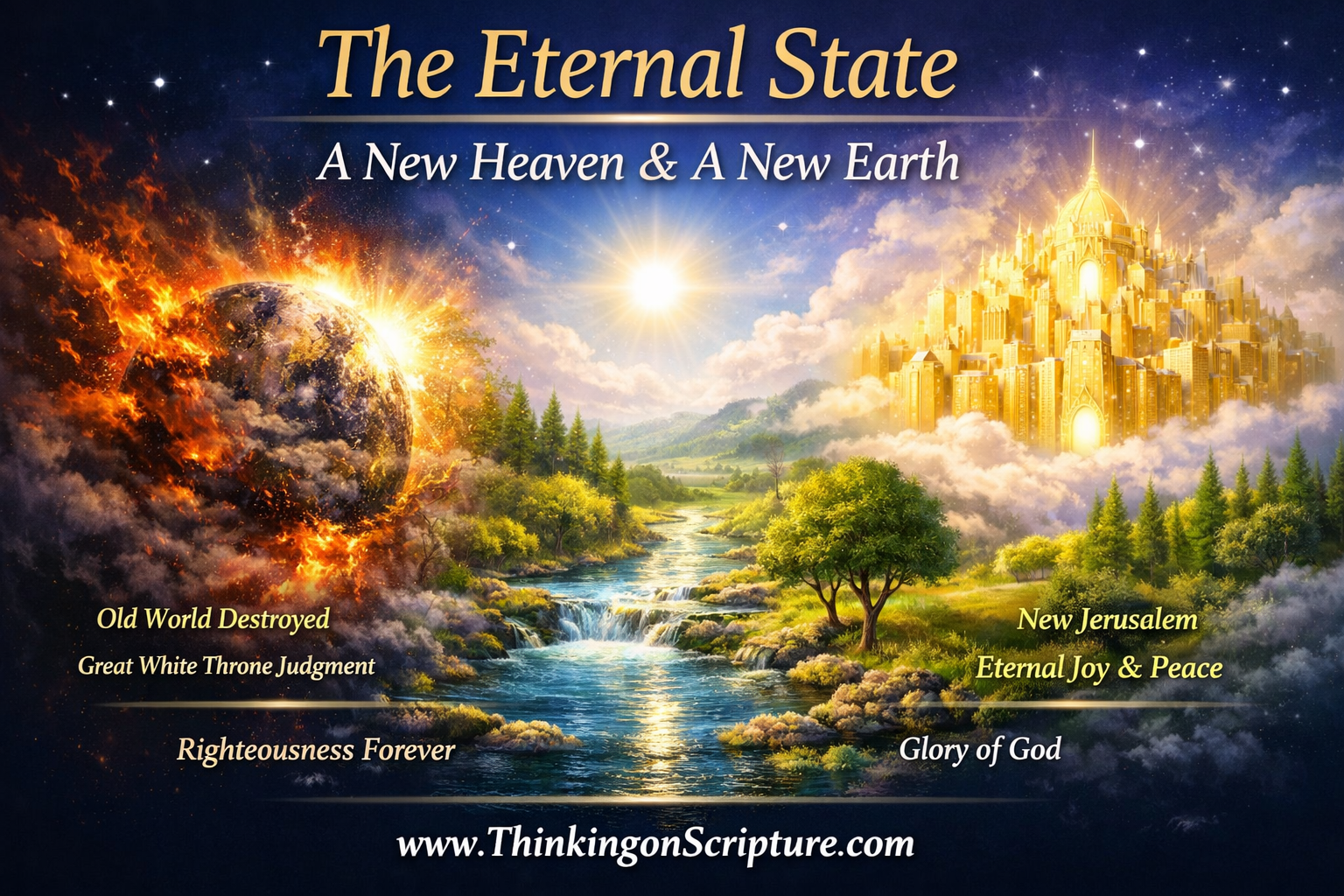
 The eternal state is the final, permanent condition of creation after the present heavens and earth are dissolved and replaced by a new order directly created by God. Scripture places it after the Millennium, the final rebellion, and the Great White Throne judgment. John writes, “Then I saw a new heaven and a new earth; for the first heaven and the first earth passed away” (Rev. 21:1). Bailey states, “The new heavens and earth will come into existence after the Millennium and the Great White Throne judgment.”[1] Peter explains that the present cosmos will be destroyed by intense heat, making way for what God has promised: “new heavens and a new earth, in which righteousness dwells” (2 Pet. 3:10–13). This “is a totally new heaven and a new earth, and not the present heaven and earth renovated.”[2] The curse is removed, sin is absent, and history as we know it is complete. Pentecost states, “By a definite act of creation God calls into being a new heaven and a new earth. As God created the present heavens and earth to be the scene of His theocratic display, so God will create the new heavens and earth to be the scene of the eternal theocratic kingdom of God.”[3]
In the eternal state, God dwells openly and permanently with redeemed humanity. John states, “Behold, the tabernacle of God is among men, and He will dwell among them, and they shall be His people, and God Himself will be among them” (Rev. 21:3). Kreider states, “In the eternal state, the righteous will live on the new earth and the wicked will be sent to the lake of fire (Rev. 20:14–21:5).”[4] Fellowship with God is immediate and unhindered. There is no temple because God Himself is the dwelling place. John wrote, “I saw no temple in it, for the Lord God the Almighty and the Lamb are its temple” (Rev. 21:22). Mediation gives way to direct presence. Faith gives way to sight. Pentecost adds:
“It has already been demonstrated from passages such as Revelation 21:3 that the Lord Jesus Christ will be dwelling with men on the new earth in the eternal kingdom. Since Scripture reveals that the church will be with Christ, it is concluded that the eternal abode of the church will likewise be in the new earth, in that heavenly city, New Jerusalem, that has been especially prepared by God for the saints. Such a relationship would be the answer to the Lord’s prayer for those God had given Him: “Father, I will that they also, whom thou hast given me, be with me where I am; that they may behold my glory, which thou hast given me” (John 17:24).”[5]
Isaiah anticipates the eternal state when he records the Lord’s promise of a new creation. God declares, “For behold, I create new heavens and a new earth; and the former things will not be remembered or come to mind” (Isa. 65:17; cf. Ps. 102:25-26; Isa. 66:22). Chafer notes, “Isaiah declares regarding the new heaven and the new earth that they will be of such exalted character that the former creation will not be brought to mind.”[6] Joy and blessing characterize this new creation, as God says, “Be glad and rejoice forever in what I create” (Isa. 65:18). Isaiah’s prophecy provides the Old Testament foundation that John later expands in Revelation 21–22. According to Thomas:
“The reason assigned for the appearance of the new heaven and earth is the disappearance of the first heaven and earth. The entrance of sin and death spoiled the earlier creation and made it a place of rebellion and alienation, an enemy-occupied territory. Its replacement with a whole new order of life without death, mourning, crying, and pain is a necessity.”[7]
The central feature of the eternal state is the holy city, the New Jerusalem, which descends from heaven. It is described as radiant, massive, orderly, and perfectly secure, reflecting God’s glory and precision. Its foundations bear the names of the apostles, and its gates bear the names of the tribes of Israel, showing continuity with God’s redemptive work across history (Rev. 21:12–14). The city’s gates are never closed, and nothing unclean enters it (Rev. 21:25–27). God’s glory provides the light, and the Lamb is its lamp. There is no night, no fear, and no threat.
All effects of the fall are permanently removed. John revealed, “He will wipe away every tear from their eyes; and there will no longer be any death; there will no longer be any mourning, or crying, or pain” (Rev. 21:4). Paul anticipated this reality when he wrote, “The last enemy that will be abolished is death” (1 Cor. 15:26). Death is abolished. Sorrow is finished. Pain is gone because the sin nature and its consequences no longer exist. The former things associated with a fallen world have passed away.
Life in the eternal state is marked by righteousness, service, and joy. Revelation 22 describes the river of the water of life flowing from the throne of God and of the Lamb, and the tree of life bearing fruit every month, with leaves that communicate blessing rather than healing, since there is no sickness to cure (Rev. 22:1–2). In this new state, “There will no longer be any curse” (Rev. 22:3). God’s bond servants serve Him willingly and intelligently, and “They will see His face, and His name will be on their foreheads” (Rev. 22:4). Authority and responsibility continue, as believers “will reign forever and ever” (Rev. 22:5), but without frustration or failure.
The eternal state is everlasting and unchanging. There is no further testing, rebellion, or transition. Evil has been judged and removed, and only righteousness remains. God declares, “Behold, I am making all things new” and adds, “These words are faithful and true” (Rev. 21:5). The plan of God reaches its final expression. Creation continues in perfect and permanent righteousness. The redeemed enjoy unbroken life, purposeful service, and full fellowship with God forever, and the glory of God fills all things without interruption or end.
Steven R. Cook, D.Min., M.Div.
If this article has enriched your understanding and walk with Christ, and you feel led to support my ministry, your generosity is greatly appreciated. Your gifts enable me to continue sharing the gospel of grace and providing in-depth biblical teachings. Thank you for partnering with me in this mission.
Related Articles:
- The Free Gift of God is Eternal Life
- Overview of Future Prophetic Events
- World Events that Imply the Rapture is Near
- Israel, Globalism, and the Rapture of the Church
- Pray for Israel, God’s Chosen People
- God Loves Israel
- A Brief Analysis of Israel in History and Prophesy
- The Rapture of the Church
- Jesus’ Return for His Saints
- The Judgment Seat of Christ
- The Seven Year Tribulation
- Degrees of Sin and Eternal Punishment
- The Millennial Kingdom
- The Biblical Resurrections
- How to Avoid the Lake of Fire
- A Christian View of Death
[1] Mark Bailey et al., Nelson’s New Testament Survey: Discover the Background, Theology and Meaning of Every Book in the New Testament (Nashville: Word, 1999), 654–655.
[2] John F. Walvoord, “Revelation,” in The Bible Knowledge Commentary: An Exposition of the Scriptures, ed. J. F. Walvoord and R. B. Zuck, vol. 2 (Wheaton, IL: Victor Books, 1985), 983.
[3] J. Dwight Pentecost, Things to Come: A Study in Biblical Eschatology (Grand Rapids, MI: Zondervan, 1958), 561.
[4] Glenn R. Kreider, “Eschatology,” in The Harvest Handbook of Bible Prophecy, ed. Ed Hindson, Mark Hitchcock, and Tim LaHaye (Eugene, OR: Harvest House Publishers, 2020), 110.
[5] J. Dwight Pentecost, Things to Come, 562.
[6] Lewis Sperry Chafer, Systematic Theology, vol. 5 (Grand Rapids, MI: Kregel Publications, 1993), 365.
[7] Robert L. Thomas, Revelation 8-22: An Exegetical Commentary (Chicago: Moody Publishers, 1995), 439.