The New Heavens and New Earth

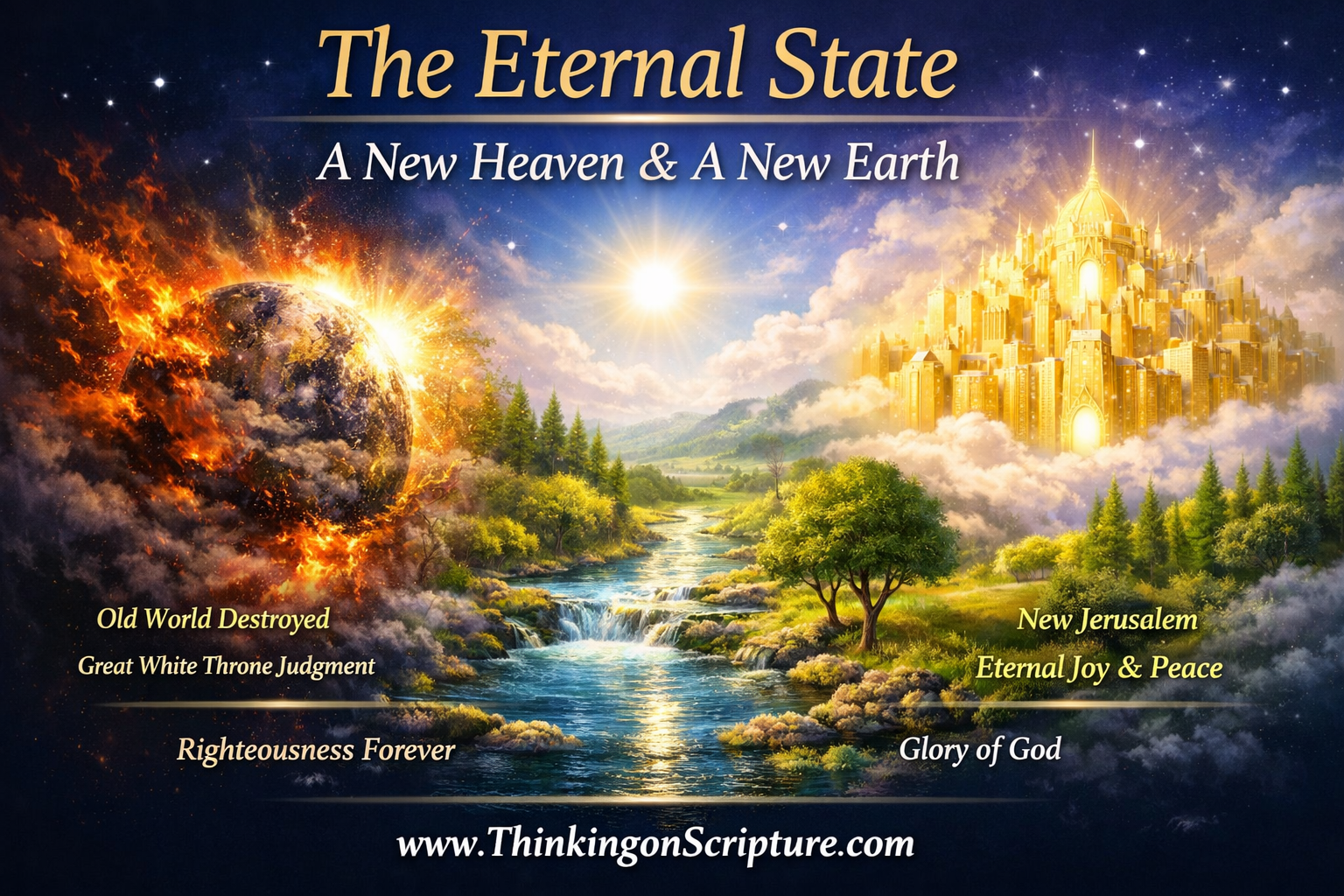
The eternal state is the final, permanent condition of creation after the present heavens and earth are dissolved and replaced by a new order directly created by God. Scripture places it after the Millennium, the final rebellion, and the Great White Throne judgment. John writes, “Then I saw a new heaven and a new earth; for the first heaven and the first earth passed away” (Rev. 21:1). Bailey states, “The new heavens and earth will come into existence after the Millennium and the Great White Throne judgment.”[1] Peter explains that the present cosmos will be destroyed by intense heat, making way for what God has promised: “new heavens and a new earth, in which righteousness dwells” (2 Pet. 3:10–13). This “is a totally new heaven and a new earth, and not the present heaven and earth renovated.”[2] The curse is removed, sin is absent, and history as we know it is complete. Pentecost states, “By a definite act of creation God calls into being a new heaven and a new earth. As God created the present heavens and earth to be the scene of His theocratic display, so God will create the new heavens and earth to be the scene of the eternal theocratic kingdom of God.”[3]

In the eternal state, God dwells openly and permanently with redeemed humanity. John states, “Behold, the tabernacle of God is among men, and He will dwell among them, and they shall be His people, and God Himself will be among them” (Rev. 21:3). Kreider states, “In the eternal state, the righteous will live on the new earth and the wicked will be sent to the lake of fire (Rev. 20:14–21:5).”[4] Fellowship with God is immediate and unhindered. There is no temple because God Himself is the dwelling place. John wrote, “I saw no temple in it, for the Lord God the Almighty and the Lamb are its temple” (Rev. 21:22). Mediation gives way to direct presence. Faith gives way to sight. Pentecost adds:

“It has already been demonstrated from passages such as Revelation 21:3 that the Lord Jesus Christ will be dwelling with men on the new earth in the eternal kingdom. Since Scripture reveals that the church will be with Christ, it is concluded that the eternal abode of the church will likewise be in the new earth, in that heavenly city, New Jerusalem, that has been especially prepared by God for the saints. Such a relationship would be the answer to the Lord’s prayer for those God had given Him: “Father, I will that they also, whom thou hast given me, be with me where I am; that they may behold my glory, which thou hast given me” (John 17:24).”[5]

Isaiah anticipates the eternal state when he records the Lord’s promise of a new creation. God declares, “For behold, I create new heavens and a new earth; and the former things will not be remembered or come to mind” (Isa. 65:17; cf. Ps. 102:25-26; Isa. 66:22). Chafer notes, “Isaiah declares regarding the new heaven and the new earth that they will be of such exalted character that the former creation will not be brought to mind.”[6] Joy and blessing characterize this new creation, as God says, “Be glad and rejoice forever in what I create” (Isa. 65:18). Isaiah’s prophecy provides the Old Testament foundation that John later expands in Revelation 21–22. According to Thomas:

“The reason assigned for the appearance of the new heaven and earth is the disappearance of the first heaven and earth. The entrance of sin and death spoiled the earlier creation and made it a place of rebellion and alienation, an enemy-occupied territory. Its replacement with a whole new order of life without death, mourning, crying, and pain is a necessity.”[7]

The central feature of the eternal state is the holy city, the New Jerusalem, which descends from heaven. It is described as radiant, massive, orderly, and perfectly secure, reflecting God’s glory and precision. Its foundations bear the names of the apostles, and its gates bear the names of the tribes of Israel, showing continuity with God’s redemptive work across history (Rev. 21:12–14). The city’s gates are never closed, and nothing unclean enters it (Rev. 21:25–27). God’s glory provides the light, and the Lamb is its lamp. There is no night, no fear, and no threat.

All effects of the fall are permanently removed. John revealed, “He will wipe away every tear from their eyes; and there will no longer be any death; there will no longer be any mourning, or crying, or pain” (Rev. 21:4). Paul anticipated this reality when he wrote, “The last enemy that will be abolished is death” (1 Cor. 15:26). Death is abolished. Sorrow is finished. Pain is gone because the sin nature and its consequences no longer exist. The former things associated with a fallen world have passed away.

Life in the eternal state is marked by righteousness, service, and joy. Revelation 22 describes the river of the water of life flowing from the throne of God and of the Lamb, and the tree of life bearing fruit every month, with leaves that communicate blessing rather than healing, since there is no sickness to cure (Rev. 22:1–2). In this new state, “There will no longer be any curse” (Rev. 22:3). God’s bond servants serve Him willingly and intelligently, and “They will see His face, and His name will be on their foreheads” (Rev. 22:4). Authority and responsibility continue, as believers “will reign forever and ever” (Rev. 22:5), but without frustration or failure.

The eternal state is everlasting and unchanging. There is no further testing, rebellion, or transition. Evil has been judged and removed, and only righteousness remains. God declares, “Behold, I am making all things new” and adds, “These words are faithful and true” (Rev. 21:5). The plan of God reaches its final expression. Creation continues in perfect and permanent righteousness. The redeemed enjoy unbroken life, purposeful service, and full fellowship with God forever, and the glory of God fills all things without interruption or end.

Steven R. Cook, D.Min., M.Div.

If this article has enriched your understanding and walk with Christ, and you feel led to support my ministry, your generosity is greatly appreciated. Your gifts enable me to continue sharing the gospel of grace and providing in-depth biblical teachings. Thank you for partnering with me in this mission.

Related Articles:


[1] Mark Bailey et al., Nelson’s New Testament Survey: Discover the Background, Theology and Meaning of Every Book in the New Testament (Nashville: Word, 1999), 654–655.

[2] John F. Walvoord, “Revelation,” in The Bible Knowledge Commentary: An Exposition of the Scriptures, ed. J. F. Walvoord and R. B. Zuck, vol. 2 (Wheaton, IL: Victor Books, 1985), 983.

[3] J. Dwight Pentecost, Things to Come: A Study in Biblical Eschatology (Grand Rapids, MI: Zondervan, 1958), 561.

[4] Glenn R. Kreider, “Eschatology,” in The Harvest Handbook of Bible Prophecy, ed. Ed Hindson, Mark Hitchcock, and Tim LaHaye (Eugene, OR: Harvest House Publishers, 2020), 110.

[5] J. Dwight Pentecost, Things to Come, 562.

[6] Lewis Sperry Chafer, Systematic Theology, vol. 5 (Grand Rapids, MI: Kregel Publications, 1993), 365.

[7] Robert L. Thomas, Revelation 8-22: An Exegetical Commentary (Chicago: Moody Publishers, 1995), 439.

Overview of Future Prophetic Events

What follows is an overview of future prophetic events as revealed in Scripture. It is not a comprehensive or technical analysis, but a panoramic survey designed to provide clarity and structure for understanding God’s prophetic program. This presentation moves sequentially—from the Rapture of the Church to the eternal state—outlining the major movements of eschatology as understood from a literal, historical, grammatical interpretation of Scripture. Each section is grounded in key biblical passages and reflects a traditional dispensational perspective, affirming the distinctiveness of Israel and the Church and the unfolding of God’s sovereign plan through both time and eternity. Readers should note that this is a bird’s-eye view, intended to give the big picture. Deeper exegetical and theological treatments of these subjects are available elsewhere—but for now, we take our place as students of prophecy, watching history move steadily toward its divine consummation.

Prophetic Overview

The next great event in God’s prophetic program is the Rapture of the Church (John 14:1-3), which is the sudden, bodily, and upward catching away of all Church-age believers—both living and dead—to meet Christ in the air (1 Th 4:13-18; 1 Cor 15:51-53). The word Rapture—though not found in English Bibles—comes from the Latin rapturo, which translates the Greek harpazō (“to snatch away”) in 1 Thessalonians 4:17, and accurately describes the sudden catching away of believers to meet Christ in the air. This event is imminent, meaning it could occur at any moment, with no signs preceding it. It is distinct from the Second Coming and is exclusively for the Church, the body and bride of Christ (Eph 5:25-27). At the Rapture, deceased believers will be resurrected, and living believers will be instantly transformed. This marks the end of the Church Age—a mystery age not revealed in the Old Testament—and removes believers from the earth before God pours out His wrath in the Tribulation (1 Th 1:10; 5:9). The Church is promised deliverance, not participation, in the Day of the Lord (Rev 3:10). According to Fruchtenbaum:

“The Church is composed of all true believers from Pentecost in Acts two until the Rapture of the Church. The Rapture excludes the Old Testament saints. It also excludes the Tribulation saints. The only saints who will be raptured are the Church saints. The Rapture passages clearly state that only those who are in Christ will partake of the Rapture.”[1]

After the Rapture and while the Tribulation unfolds on earth, believers in heaven will appear before the judgment seat of Christ—also called the Bema seat—for evaluation and reward (2 Cor 5:10; Rom 14:10-12). According to Pentecost, “The believer’s works are brought into judgment, called ‘the things done in his body’ (2 Cor. 5:10), in order that it may be determined whether they are good or bad.”[2] This is not a judgment for sin, as all sins were fully paid for by Christ on the cross (Rom 8:1; Heb 10:14), and believers are already justified by faith (Rom 3:28; 5:1; Gal 2:16). Rather, the Bema is a judgment of the believer’s service, motives, and faithfulness in the Christian life. Paul describes this as a testing of each person’s work—whether it was built with gold, silver, and precious stones, or with wood, hay, and straw (1 Cor 3:12-15). Those works of eternal value, done in alignment with God’s Word, empowered by the Spirit, and offered for the glory of God, will endure the fire of divine evaluation and be rewarded. Unfruitful or self-centered efforts will be burned up, resulting in loss of reward—but not loss of salvation. The Bema seat thus underscores the seriousness of our stewardship in this life and highlights the grace of God, who not only saves but also rewards His people for their faithfulness. It is here that crowns are awarded (2 Tim 4:8; 1 Pet 5:4; Jam 1:12), and the Church is made ready as the adorned bride of Christ (Rev 19:7-8).

Following the Rapture, the Tribulation period begins, a seven-year timeframe marked by divine judgment and escalating global chaos (Dan 9:27; Matt 24:4-28). According to Thomas Ice, “In this discourse [Matt 24:4-28], Jesus describes for the disciples the tribulation period. In verses 4-14, He speaks about the first half of the tribulation, and in verses 15-28, He describes the second half leading up to the second coming.”[3] The Tribulation begins with the signing of a covenant between the coming world ruler—the Antichrist—and Israel (Dan 9:27). This covenant allows Israel to resume temple worship, likely including animal sacrifices. The first half of the Tribulation (three and a half years) is marked by political deception, regional wars, famine, and limited divine judgments (Rev 6:1-8). Though catastrophic, these judgments are restrained, giving the world time to repent. Two notable events during this time include the ministry of the 144,000 sealed Jewish evangelists (Rev 7:1-8) and the rise of global religious syncretism symbolized by the harlot of Revelation 17.

Midway through the Tribulation, the Antichrist breaks his covenant with Israel, halts temple sacrifices, and sets up the abomination of desolation in the rebuilt Jewish temple, proclaiming himself to be God (Dan 9:27; Matt 24:15; 2 Th 2:3-4). This initiates the Great Tribulation, the second and more intense half of the seven-year period (Matt 24:21-22). During this time, Satan is cast down to earth with great fury (Rev 12:7-12), and the Antichrist is empowered to wage war against the saints, particularly the believing Jewish remnant and Gentile converts who refuse to worship him (Rev 13:7-10). The False Prophet promotes this global idolatry and enforces the mark of the beast (Rev 13:11-18). Despite escalating evil, God continues to offer grace through angelic proclamations (Rev 14:6-7) and the faithful witness of believers, many of whom are martyred.

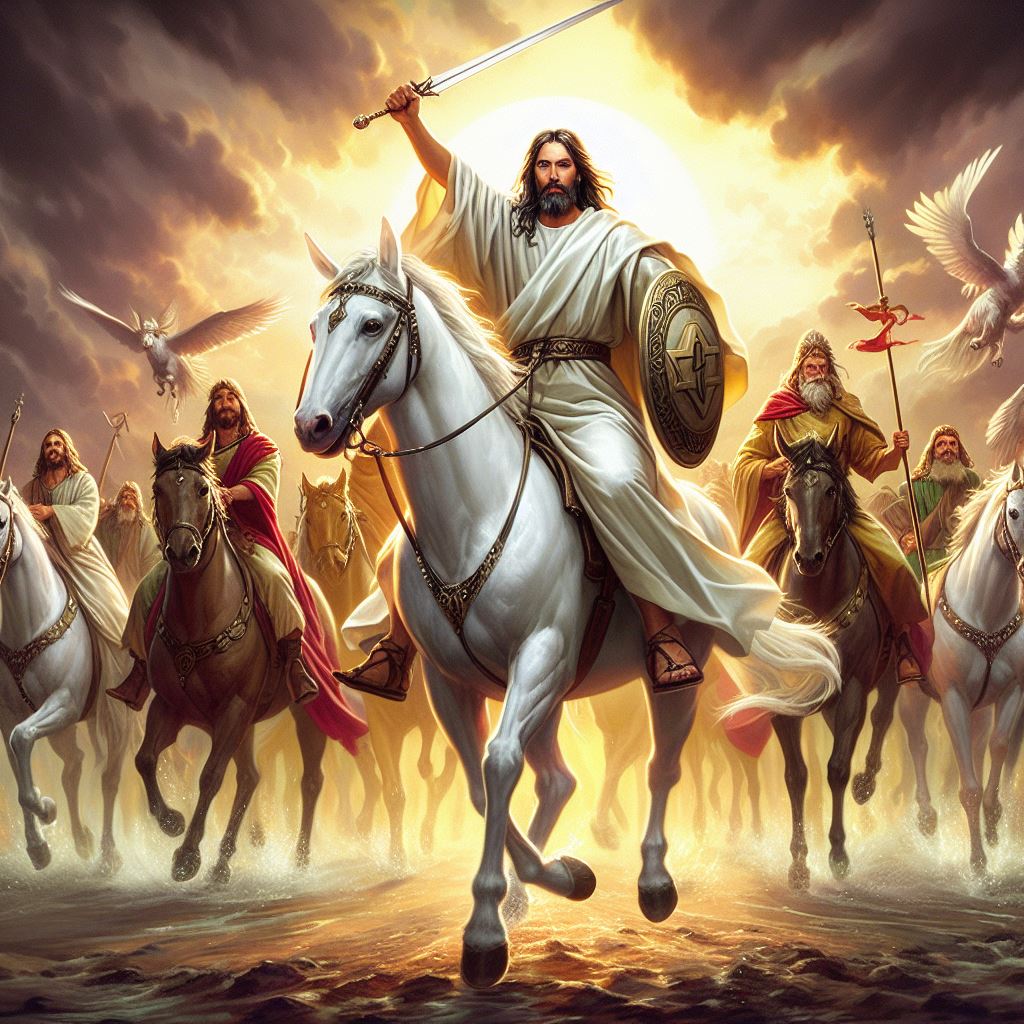
As the Tribulation nears its end, a series of cataclysmic judgments intensify God’s wrath: trumpet and bowl judgments devastate the environment, economy, and world population (Rev 8-9; 16). Political alliances form against Israel, setting the stage for the Battle of Armageddon. The kings of the earth, stirred by demonic influence, gather in the valley of Megiddo to destroy Jerusalem and annihilate the Jewish people (Zech 12:2-3; Rev 16:13-16). But just as it seems all hope is lost, the heavens open, and Christ returns in glory with His holy angels and glorified saints (Zech 14:1-11; Rev 19:11-16). According to Ryrie, “the second coming of Christ will occur prior to the Millennium, which will see the establishment of Christ’s kingdom on this earth for a literal one thousand years.”[4] This Second Coming is visible, dramatic, and earth-shaking. Christ will personally destroy the Antichrist and the False Prophet, casting them into the lake of fire (Rev 19:19-20), and He will bind Satan in the abyss for 1,000 years (Rev 20:1-3).

At the return of Christ, the Millennial Kingdom will be established—a literal 1,000-year reign of Jesus Christ on earth, centered in Jerusalem (Rev 20:4-6). Fruchtenbaum states, “The Millennium will not begin the day immediately following the last day of the Great Tribulation because there will be a seventy-five day interval.”[5] The 75-day interval serves to cleanse and prepare the earth for Christ’s Millennial reign by judging the nations, restoring order, and inaugurating millennial blessings (Dan 12:11-12; Matt 25:31-46). After that, Christ will establish His kingdom on earth. He will fulfill all Old Testament covenants with Israel, including the Abrahamic (Gen 12:1-3), Davidic (2 Sam 7:16; Psa 89:35-37; Luke 1:31-33), and New Covenants (Jer 31:31-34). Israel will be regathered, restored, and exalted among the nations (Isa 2:2-4; Zech 14:16-21). The curse on nature will be partially lifted, and peace, righteousness, and justice will characterize Christ’s reign (Isa 11:1-10). Temple worship will resume, though modified, with sacrifices serving as memorials of Christ’s once-for-all sacrifice (Ezek 40–48). Though Satan is bound, human beings born during the Millennium—descendants of Tribulation survivors—will still have sin natures and need salvation.

At the end of the thousand years, Satan is released for a final rebellion (Rev 20:7-9). He will deceive a vast number of people, proving that even in a perfect environment, man’s sin nature still inclines him to rebel against God. Fire from heaven will consume the rebellious forces, and Satan will be cast into the lake of fire forever (Rev 20:10). Then comes the Great White Throne Judgment, where all unbelievers throughout history are resurrected, judged according to their works, and condemned to eternal separation from God in the lake of fire (Rev 20:11-15). This is not a judgment to determine salvation, but to reveal the just grounds for condemnation due to their rejection of God’s provision of grace. There is no mention of the Church here, as believers were already judged at the Bema Seat following the Rapture (2 Cor 5:10; Rom 14:10).

After the final judgment, God creates a new heaven and a new earth where righteousness dwells (2 Pet 3:13; Rev 21:1). The eternal state begins, free from sin, death, pain, and sorrow. The New Jerusalem descends from heaven, adorned like a bride, and becomes the dwelling place of the redeemed (Rev 21:2-4). God’s people from all ages will dwell in perfect fellowship with Him forever, enjoying His presence, His glory, and His goodness without end. There will be no temple in the New Jerusalem, for the Lord God and the Lamb are its temple (Rev 21:22). The curse is gone (Rev 22:3), the water of life flows freely, and the leaves of the tree are for the healing of the nations. Eternity will be a time of unbroken peace, joy, service, and worship. The former things will have passed away, and the redeemed will enjoy their inheritance in the presence of their Savior forever.

Summary

The prophetic Word of God unveils a majestic and ordered panorama of future events, from the imminent Rapture of the Church to the eternal state in the new heavens and new earth. Each stage—whether the Tribulation, Christ’s return, the Millennial Kingdom, or the final judgment—demonstrates God’s sovereign control over history and His faithfulness to fulfill every covenant and promise. For the Church, prophecy is about prediction and preparation. It reminds us that history is moving steadily toward divine consummation, and that our hope is anchored not in the shifting sands of this world, but in the unshakable promises of our returning Savior. As we await that blessed hope, we do so with confidence, vigilance, and joy, knowing that the same God who keeps His Word about the future is the same God who sustains us in the present. Come, Lord Jesus (Rev 22:20).

Steven R. Cook, D.Min., M.Div.

If this article has enriched your understanding and walk with Christ, and you feel led to support my ministry, your generosity is greatly appreciated. Your gifts enable me to continue sharing the gospel of grace and providing in-depth biblical teachings. Thank you for partnering with me in this mission.

Related Articles:


[1] Arnold G. Fruchtenbaum, The Footsteps of the Messiah: A Study of the Sequence of Prophetic Events, Rev. ed. (Tustin, CA: Ariel Ministries, 2003), 142.

[2] J. Dwight Pentecost, Things to Come: A Study in Biblical Eschatology (Grand Rapids, MI: Zondervan, 1958), 223.

[3] Timothy J. Demy and Thomas Ice, Answers to Common Questions about the End Times (Grand Rapids, MI: Kregel Publications, 2011), 64.

[4] Charles C. Ryrie, Basic Theology: A Popular Systematic Guide to Understanding Biblical Truth (Chicago, IL: Moody Press, 1999), 522.

[5] Arnold G. Fruchtenbaum, The Footsteps of the Messiah, 361.

God, History, Time and Eternity

Before the mountains were born or You gave birth to the earth and the world, even from everlasting to everlasting, You are God. (Ps. 90:2)

     The Bible is a record of what matters most to us.  It gives us insights into realities we could never know except that God has revealed them to us in understandable terms.  God has not revealed everything to us, but what He has revealed is perfectly true.  Scripture gives us insight into things eternal and temporal, heavenly and earthly, angelic and human, good and evil, and above all, the thoughts, character, and actions of the Triune God.  We live in time-space history, which is driven by divine choices, angelic choices, human choices, and natural causes.  God’s choices are always supreme, all creatures being subordinate, influenced and controlled.  The Lord allows fallen angels and humans to produce sin and evil, but never beyond or against His sovereign will (Job 1:1-21; Ps. 105:12-15; 1 Kings 22:19-23; 2 Cor. 12:7-10).  God’s providential control over creation guarantees there are no accidents in history, but that all is within His sovereign plan.  “Whatever the LORD pleases, He does, in heaven and in earth, in the seas and in all deeps” (Ps. 135:6).  There is no one who can comprehend all His ways, or who can stand against Him when He acts.  “All the inhabitants of the earth are accounted as nothing, but He does according to His will in the host of heaven and among the inhabitants of earth; and no one can ward off His hand or say to Him, ‘What have You done?’” (Dan 4:35).

     Most of us think about history in time and space, which began when “God created the heavens and the earth” (Gen. 1:1).  However, according to Scripture, history moves backward and forward beyond time and space and touches things heavenly as well as earthly.  The heavens and earth in Genesis 1:1 refers to material heavens and planet earth.  The Hebrew word translated heavens is plural (שָׁמַיִם shamayim) and refers to:

  1. The atmosphere around the earth (where birds fly; Gen. 1:20).
  2. The stellar heaven which is the universe beyond the earth (Gen. 1:14; 15:5).

Paul mentions a third heaven (2 Cor. 12:2), which is the heaven beyond the universe, and is the place where God rules all things (Dan. 2:44).  Most Christians think of heaven as the place where God rules from His throne.  “Scripture implies the existence of three heavens. The first is the atmosphere above us, that is, the blue sky. The second is the stellar heaven. The third is the highest heaven where the throne of God is.”[1] 

     It is important to be aware of these distinctions because there is both an earthly history and a heavenly history (i.e. the third heaven).  These are connected and touch each other, for things which occur in heaven have direct impact on the earth (Job 1:1-20; 2:1-7; 2 Chron. 18:18-22; Luke 22:31-32), and things which occur on the earth impact things heavenly (Matt. 18:10; Luke 15:10).  The fall of Satan first occurred in heaven (Isa. 14:12-14; Ezek. 28:11-18), and afterward he came to earth and influenced the fall of Adam and Eve (Gen. 3:1-7; Rom. 5:12; 1 Tim. 2:13-14).  On the other hand, God the Son came to earth and became a man (John 1:1, 14; Gal. 4:4), lived a righteous life (2 Cor. 5:21; 1 John 3:5), died a substitutionary death on a cross (Mark 10:45; Rom. 5:6-11; 1 Pet. 3:18), was buried in a grave, and rose again to life on the third day after His crucifixion (Matt. 20:18-19; 1 Cor. 15:3-4).  In His resurrection body, Jesus bore the wounds of the cross (John 20:24-28) and carried those wounds with Him when He ascended into heaven (Acts 1:9-11).  All this reveals that heaven touches earth and the earth touches heaven.

     In the Bible, God occasionally pulls back the curtain of time and space and gives us glimpses into things eternal, revealing a history before time, before the creation of the world.  We learn that God Himself is eternal, for “Before the mountains were born or You gave birth to the earth and the world, even from everlasting to everlasting, You are God” (Ps. 90:2; cf. Deut. 33:27; Ps. 93:2; Isa. 40:28; Jer. 10:10).  From eternity past there was a loving and glorious relationship among the members of the Trinity, who exist as three distinct Persons (Matt. 28:19; 2 Cor. 13:14; 1 Pet. 1:2): God the Father (Gal. 1:1; Eph. 6:23; Phil. 2:11), God the Son (John 1:1, 14, 18; 8:58; 20:28; Col. 1:17; 2:9; Heb. 1:8; 1 Pet. 1:20), and God the Holy Spirit (John 14:16-17; Acts 5:3-4; 1 Cor. 2:11-12; 2 Cor. 13:14; Heb. 9:14).  All three Persons are co-equal, co-infinite, co-eternal, and worthy of all praise and service.  The Persons of the Trinity communicated with each other, loved each other, and made decisions and promises which impacted the world and entire course of history.  There was forethought and intentionality to the creation of the heavens and earth, to mankind, to permit the fall of Adam and Eve, and to provide a monergistic solution that righteously judges sin and saves lost sinners.  To deal with sin, the Father designed and prepared a body for Jesus, and this decision was made in heaven, for “when He [God the Son] comes into the world [time and space], He says, ‘Sacrifice and offering You have not desired, but a body You have prepared for Me’” (Heb. 10:5).  God the Holy Spirit created Jesus’ body in the womb of the Virgin Mary (Isa. 7:14; Matt. 1:23; Luke 1:26-38), for an angel from heaven told her, “The Holy Spirit will come upon you, and the power of the Most High will overshadow you; and for that reason the holy Child shall be called the Son of God” (Luke 1:35).  During His time on earth, Jesus lived a sinless life and walked in perfect obedience to God the Father (2 Cor. 5:21; Phil. 2:8-11; 1 John 3:5).  Jesus offered a prayer just a few hours before going to the cross, a prayer spoken among His friends, a prayer in which He mentions a glory and love He enjoyed with the Father before the world existed.  Jesus said, “Father, glorify Me together with Yourself, with the glory which I had with You before the world was” (John 17:5), “for You loved Me before the foundation of the world” (John 17:24).  This prayer reveals a wonderful relationship that existed from eternity past, which relationship broke into time and space for our benefit, and resumed its full expression when Jesus returned to heaven.  It was also from their relationship in eternity past that God “chose us in Him before the foundation of the world” (Eph. 1:4), which choosing was secured by means of the cross.  From His eternal choice, God promised us eternal life, which speaks both of a current relationship with the Father (John 17:3), as well as an eternal destiny forever in heaven (John 3:16). 

     Our current experiences are connected with our eternal destiny which is assured to us who are in Christ.  Throughout our earthly life, God works through His Word, through others, and through circumstances to grow us spiritually in order to form the character of Christ in us.  All of God’s work in us is intentional, designed to prepare us for the life we will come to know when we leave this world and enter into His eternal presence.  Life on earth—in time and space—becomes more meaningful when we live beyond ourselves, beyond our struggles, beyond our circumstances and see everything within the context of eternity to which we belong right now.  I say we belong to eternity “right now” because as Christians we possess eternal life from the moment we believed in Christ as our Savior (John 10:28).  Eternal life is not what we can have, but what we have from the moment of salvation onward.  Our eternal life is the forever-life that finds its greatest experiential expression when we leave this world and enter into the presence of God in heaven.  At death, the flow of time ceases and all worldly experience comes to an end when we pass into eternity.  Until then, we enjoy eternal life here and now with God who has saved us and adopted us as His own.

Steven R. Cook, D.Min.

Related Articles:

[1] William MacDonald, Believer’s Bible Commentary: Old and New Testaments, ed. Arthur Farstad (Nashville: Thomas Nelson, 1995), 1865.