The Coming Rapture of the Church

The Rapture of the church is the future event in which Christ will descend from heaven to gather His bride, the church, to Himself. Paul describes it as a mystery previously unrevealed but now made known, declaring, “Behold, I tell you a mystery; we will not all sleep, but we will all be changed, in a moment, in the twinkling of an eye, at the last trumpet; for the trumpet will sound, and the dead will be raised imperishable, and we will be changed” (1 Cor 15:51-52). The term rapture comes from the Latin rapio, a translation of the Greek harpazō, meaning to seize or snatch away, as found in Paul’s statement that believers will be “caught up together with them in the clouds to meet the Lord in the air” (1 Th 4:17). This supernatural catching away involves the bodily resurrection of deceased believers, the transformation of living saints into their glorified bodies, and the collective meeting of the entire church with Christ in the air. According to Ryrie, “At the rapture some mortals (living) will only need to put on immortality, while those whose bodies have seen corruption (dead) will need to put on incorruption through resurrection. Both routes to heaven involve change—the living need to be translated and the dead raised. The last generation of Christians will not experience death.” (Charles Ryrie, A Survey of Bible Doctrine, p. 166). Unlike the Second Coming, where Christ visibly descends to the earth in judgment and to establish His earthly kingdom (Rev 19:11-16; Zech 14:4), the Rapture is Christ’s coming for His saints and constitutes the blessed hope of the church (Tit 2:13).

The comfort of the Rapture lies in the believer’s assurance of eternal union with Christ and deliverance from divine wrath. Paul emphasizes this comfort by saying, “For the Lord Himself will descend from heaven with a shout, with the voice of the archangel and with the trumpet of God, and the dead in Christ will rise first. Then we who are alive and remain will be caught up together with them in the clouds to meet the Lord in the air, and so we shall always be with the Lord. Therefore comfort one another with these words” (1 Th 4:16-18). This event is imminent, meaning it could occur at any moment, without warning signs, in keeping with Jesus’ promise: “I go and prepare a place for you. If I go and prepare a place for you, I will come again and receive you to Myself, that where I am, there you may be also” (John 14:2-3). The Rapture of the church is the believer’s hope not only of escaping the coming wrath (1 Th 1:10; 5:9) but also of entering into the joyful presence of Christ, where death and sorrow will forever be abolished (Rev 21:4). The Rapture thus motivates holy living, strengthens faith amidst trials, and orients the believer’s heart toward eternal realities. Fruchtenbaum states, “As each day ends, it brings the believer one day closer to the time when the Rapture may occur. Because of this imminency, it is time for believers to awaken out of sleep and to live a life consistent with the position of being sons of light.” (Arnold G. Fruchtenbaum, The Footsteps of the Messiah, p. 154).

In God’s sovereign plan, the removal of the church through the Rapture may serve as a divine reset upon the world stage, preparing the way for the rise of global events prophesied for the Tribulation period. With the restraining influence of the church and the indwelling Holy Spirit’s unique ministry through it removed (2 Th 2:6-7), the world will be positioned for the ascent of the man of lawlessness (2 Th 2:8) and the formation of a one-world system of government, economy, and religion (Dan 7:23-25; Rev 13:1-18; 17:1-18). Current movements toward globalism, international financial consolidation, ecumenical religious cooperation, and increasing hostility toward Israel may be viewed as preparatory shadows of what will unfold in full after the Rapture. God, who “changes the times and the epochs; He removes kings and establishes kings” (Dan 2:21), will sovereignly direct history toward its appointed climax. Thus, while the church eagerly waits for Christ from heaven, the world is unknowingly being set in motion toward the fulfillment of the very events Scripture foretells, events which will ultimately display both God’s judgment on rebellious humanity and His faithfulness to Israel and His covenant promises.

To be ready for the Rapture and the events that follow, a person must first belong to Christ, and this happens only through faith in Him, for “whoever believes in Him shall not perish, but have eternal life” (John 3:16). Jesus is the eternal Son of God (John 1:1; Heb 1:8), who became truly human while never ceasing to be divine (John 1:14; Col 2:9). He lived a perfectly sinless life, for “in Him there is no sin” (1 John 3:5), and at the cross He died in our place, bearing the penalty for our sins as the just for the unjust (Mark 10:45; 1 Pet 3:18). He was buried, and on the third day He rose again according to the Scriptures, conquering sin and death (1 Cor 15:3-4). Because of His finished work, He now offers eternal life as a free gift to all who believe in Him, for “the wages of sin is death, but the free gift of God is eternal life in Christ Jesus our Lord” (Rom 6:23). Becoming a Christian does not come through works, rituals, or self-effort, but through trusting in Christ alone for salvation. The matter is simple: “Believe in the Lord Jesus, and you will be saved” (Acts 16:31). Those who place their faith in Him are forgiven all their sins, declared righteous, and delivered from “the wrath to come” (1 Th 1:10). Jesus Himself assures, “I give eternal life to them, and they will never perish; and no one will snatch them out of My hand” (John 10:28). This is the simple yet profound promise of the gospel—eternal life through faith in Christ alone (John 3:16; Acts 4:12).

Steven R. Cook, D.Min., M.Div.

If this article has enriched your understanding and walk with Christ, and you feel led to support my ministry, your generosity is greatly appreciated. Your gifts enable me to continue sharing the gospel of grace and providing in-depth biblical teachings. Thank you for partnering with me in this mission.

Related Articles:

Overview of Future Prophetic Events

What follows is an overview of future prophetic events as revealed in Scripture. It is not a comprehensive or technical analysis, but a panoramic survey designed to provide clarity and structure for understanding God’s prophetic program. This presentation moves sequentially—from the Rapture of the Church to the eternal state—outlining the major movements of eschatology as understood from a literal, historical, grammatical interpretation of Scripture. Each section is grounded in key biblical passages and reflects a traditional dispensational perspective, affirming the distinctiveness of Israel and the Church and the unfolding of God’s sovereign plan through both time and eternity. Readers should note that this is a bird’s-eye view, intended to give the big picture. Deeper exegetical and theological treatments of these subjects are available elsewhere—but for now, we take our place as students of prophecy, watching history move steadily toward its divine consummation.

Prophetic Overview

The next great event in God’s prophetic program is the Rapture of the Church (John 14:1-3), which is the sudden, bodily, and upward catching away of all Church-age believers—both living and dead—to meet Christ in the air (1 Th 4:13-18; 1 Cor 15:51-53). The word Rapture—though not found in English Bibles—comes from the Latin rapturo, which translates the Greek harpazō (“to snatch away”) in 1 Thessalonians 4:17, and accurately describes the sudden catching away of believers to meet Christ in the air. This event is imminent, meaning it could occur at any moment, with no signs preceding it. It is distinct from the Second Coming and is exclusively for the Church, the body and bride of Christ (Eph 5:25-27). At the Rapture, deceased believers will be resurrected, and living believers will be instantly transformed. This marks the end of the Church Age—a mystery age not revealed in the Old Testament—and removes believers from the earth before God pours out His wrath in the Tribulation (1 Th 1:10; 5:9). The Church is promised deliverance, not participation, in the Day of the Lord (Rev 3:10). According to Fruchtenbaum:

“The Church is composed of all true believers from Pentecost in Acts two until the Rapture of the Church. The Rapture excludes the Old Testament saints. It also excludes the Tribulation saints. The only saints who will be raptured are the Church saints. The Rapture passages clearly state that only those who are in Christ will partake of the Rapture.”[1]

After the Rapture and while the Tribulation unfolds on earth, believers in heaven will appear before the judgment seat of Christ—also called the Bema seat—for evaluation and reward (2 Cor 5:10; Rom 14:10-12). According to Pentecost, “The believer’s works are brought into judgment, called ‘the things done in his body’ (2 Cor. 5:10), in order that it may be determined whether they are good or bad.”[2] This is not a judgment for sin, as all sins were fully paid for by Christ on the cross (Rom 8:1; Heb 10:14), and believers are already justified by faith (Rom 3:28; 5:1; Gal 2:16). Rather, the Bema is a judgment of the believer’s service, motives, and faithfulness in the Christian life. Paul describes this as a testing of each person’s work—whether it was built with gold, silver, and precious stones, or with wood, hay, and straw (1 Cor 3:12-15). Those works of eternal value, done in alignment with God’s Word, empowered by the Spirit, and offered for the glory of God, will endure the fire of divine evaluation and be rewarded. Unfruitful or self-centered efforts will be burned up, resulting in loss of reward—but not loss of salvation. The Bema seat thus underscores the seriousness of our stewardship in this life and highlights the grace of God, who not only saves but also rewards His people for their faithfulness. It is here that crowns are awarded (2 Tim 4:8; 1 Pet 5:4; Jam 1:12), and the Church is made ready as the adorned bride of Christ (Rev 19:7-8).

Following the Rapture, the Tribulation period begins, a seven-year timeframe marked by divine judgment and escalating global chaos (Dan 9:27; Matt 24:4-28). According to Thomas Ice, “In this discourse [Matt 24:4-28], Jesus describes for the disciples the tribulation period. In verses 4-14, He speaks about the first half of the tribulation, and in verses 15-28, He describes the second half leading up to the second coming.”[3] The Tribulation begins with the signing of a covenant between the coming world ruler—the Antichrist—and Israel (Dan 9:27). This covenant allows Israel to resume temple worship, likely including animal sacrifices. The first half of the Tribulation (three and a half years) is marked by political deception, regional wars, famine, and limited divine judgments (Rev 6:1-8). Though catastrophic, these judgments are restrained, giving the world time to repent. Two notable events during this time include the ministry of the 144,000 sealed Jewish evangelists (Rev 7:1-8) and the rise of global religious syncretism symbolized by the harlot of Revelation 17.

Midway through the Tribulation, the Antichrist breaks his covenant with Israel, halts temple sacrifices, and sets up the abomination of desolation in the rebuilt Jewish temple, proclaiming himself to be God (Dan 9:27; Matt 24:15; 2 Th 2:3-4). This initiates the Great Tribulation, the second and more intense half of the seven-year period (Matt 24:21-22). During this time, Satan is cast down to earth with great fury (Rev 12:7-12), and the Antichrist is empowered to wage war against the saints, particularly the believing Jewish remnant and Gentile converts who refuse to worship him (Rev 13:7-10). The False Prophet promotes this global idolatry and enforces the mark of the beast (Rev 13:11-18). Despite escalating evil, God continues to offer grace through angelic proclamations (Rev 14:6-7) and the faithful witness of believers, many of whom are martyred.

As the Tribulation nears its end, a series of cataclysmic judgments intensify God’s wrath: trumpet and bowl judgments devastate the environment, economy, and world population (Rev 8-9; 16). Political alliances form against Israel, setting the stage for the Battle of Armageddon. The kings of the earth, stirred by demonic influence, gather in the valley of Megiddo to destroy Jerusalem and annihilate the Jewish people (Zech 12:2-3; Rev 16:13-16). But just as it seems all hope is lost, the heavens open, and Christ returns in glory with His holy angels and glorified saints (Zech 14:1-11; Rev 19:11-16). According to Ryrie, “the second coming of Christ will occur prior to the Millennium, which will see the establishment of Christ’s kingdom on this earth for a literal one thousand years.”[4] This Second Coming is visible, dramatic, and earth-shaking. Christ will personally destroy the Antichrist and the False Prophet, casting them into the lake of fire (Rev 19:19-20), and He will bind Satan in the abyss for 1,000 years (Rev 20:1-3).

At the return of Christ, the Millennial Kingdom will be established—a literal 1,000-year reign of Jesus Christ on earth, centered in Jerusalem (Rev 20:4-6). Fruchtenbaum states, “The Millennium will not begin the day immediately following the last day of the Great Tribulation because there will be a seventy-five day interval.”[5] The 75-day interval serves to cleanse and prepare the earth for Christ’s Millennial reign by judging the nations, restoring order, and inaugurating millennial blessings (Dan 12:11-12; Matt 25:31-46). After that, Christ will establish His kingdom on earth. He will fulfill all Old Testament covenants with Israel, including the Abrahamic (Gen 12:1-3), Davidic (2 Sam 7:16; Psa 89:35-37; Luke 1:31-33), and New Covenants (Jer 31:31-34). Israel will be regathered, restored, and exalted among the nations (Isa 2:2-4; Zech 14:16-21). The curse on nature will be partially lifted, and peace, righteousness, and justice will characterize Christ’s reign (Isa 11:1-10). Temple worship will resume, though modified, with sacrifices serving as memorials of Christ’s once-for-all sacrifice (Ezek 40–48). Though Satan is bound, human beings born during the Millennium—descendants of Tribulation survivors—will still have sin natures and need salvation.

At the end of the thousand years, Satan is released for a final rebellion (Rev 20:7-9). He will deceive a vast number of people, proving that even in a perfect environment, man’s sin nature still inclines him to rebel against God. Fire from heaven will consume the rebellious forces, and Satan will be cast into the lake of fire forever (Rev 20:10). Then comes the Great White Throne Judgment, where all unbelievers throughout history are resurrected, judged according to their works, and condemned to eternal separation from God in the lake of fire (Rev 20:11-15). This is not a judgment to determine salvation, but to reveal the just grounds for condemnation due to their rejection of God’s provision of grace. There is no mention of the Church here, as believers were already judged at the Bema Seat following the Rapture (2 Cor 5:10; Rom 14:10).

After the final judgment, God creates a new heaven and a new earth where righteousness dwells (2 Pet 3:13; Rev 21:1). The eternal state begins, free from sin, death, pain, and sorrow. The New Jerusalem descends from heaven, adorned like a bride, and becomes the dwelling place of the redeemed (Rev 21:2-4). God’s people from all ages will dwell in perfect fellowship with Him forever, enjoying His presence, His glory, and His goodness without end. There will be no temple in the New Jerusalem, for the Lord God and the Lamb are its temple (Rev 21:22). The curse is gone (Rev 22:3), the water of life flows freely, and the leaves of the tree are for the healing of the nations. Eternity will be a time of unbroken peace, joy, service, and worship. The former things will have passed away, and the redeemed will enjoy their inheritance in the presence of their Savior forever.

Summary

The prophetic Word of God unveils a majestic and ordered panorama of future events, from the imminent Rapture of the Church to the eternal state in the new heavens and new earth. Each stage—whether the Tribulation, Christ’s return, the Millennial Kingdom, or the final judgment—demonstrates God’s sovereign control over history and His faithfulness to fulfill every covenant and promise. For the Church, prophecy is about prediction and preparation. It reminds us that history is moving steadily toward divine consummation, and that our hope is anchored not in the shifting sands of this world, but in the unshakable promises of our returning Savior. As we await that blessed hope, we do so with confidence, vigilance, and joy, knowing that the same God who keeps His Word about the future is the same God who sustains us in the present. Come, Lord Jesus (Rev 22:20).

Steven R. Cook, D.Min., M.Div.

If this article has enriched your understanding and walk with Christ, and you feel led to support my ministry, your generosity is greatly appreciated. Your gifts enable me to continue sharing the gospel of grace and providing in-depth biblical teachings. Thank you for partnering with me in this mission.

Related Articles:


[1] Arnold G. Fruchtenbaum, The Footsteps of the Messiah: A Study of the Sequence of Prophetic Events, Rev. ed. (Tustin, CA: Ariel Ministries, 2003), 142.

[2] J. Dwight Pentecost, Things to Come: A Study in Biblical Eschatology (Grand Rapids, MI: Zondervan, 1958), 223.

[3] Timothy J. Demy and Thomas Ice, Answers to Common Questions about the End Times (Grand Rapids, MI: Kregel Publications, 2011), 64.

[4] Charles C. Ryrie, Basic Theology: A Popular Systematic Guide to Understanding Biblical Truth (Chicago, IL: Moody Press, 1999), 522.

[5] Arnold G. Fruchtenbaum, The Footsteps of the Messiah, 361.

Jesus’ Return with His Saints

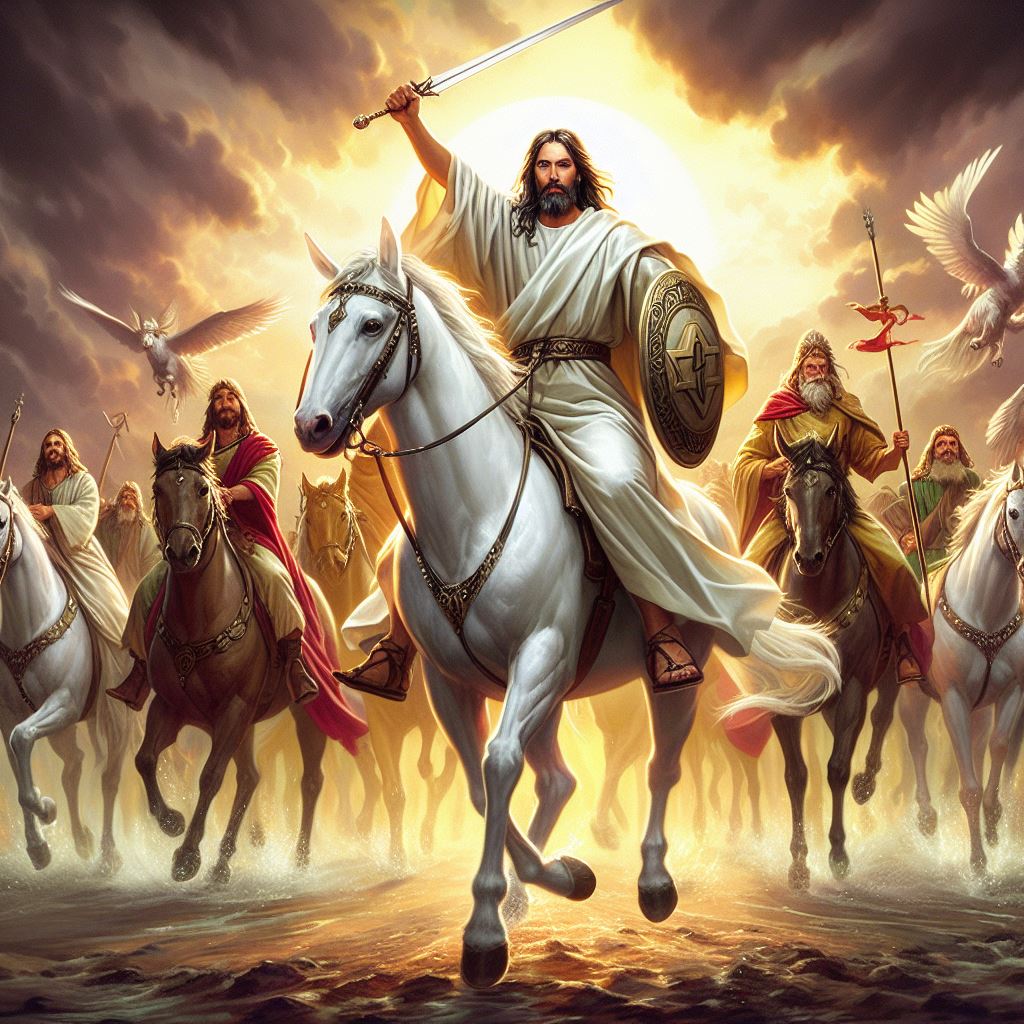
Jesus Coming with His SaintsWhen Jesus returns to the earth after the time of the seven year Tribulation, He will establish His kingdom on earth.[1] This is a time when humanity will be saved from the tyranny of Satan who currently rules over the earth.[2] At His Second Coming, it is written, “And the armies which are in heaven, clothed in fine linen, white and clean, were following Him on white horses” (Rev 19:14). Concerning this passage, Radmacher states, “The armies in heaven may be angelic hosts (Rev 5:11; Matt 26:53), but Revelation 17:14 speaks of those with the Lord at His coming as being ‘called, chosen, and faithful,’ all terms for believers (Rom 1:7; Eph 1:1; 1 Pet 2:9).”[3] Wiersbe adds, “Certainly the angels are a part of this army (Matt 25:31; 2 Th 1:7); but so are the saints (1 Th 3:13; 2 Th 1:10).”[4] Norman Geisler states:

“Before the Tribulation, Christ comes for His bride (1 Th 4:16–17; John 14:3); then, at the end of the Tribulation, He will return with all His saints. Jude wrote, “See, the Lord is coming with thousands upon thousands of his holy ones” (Jude 1:14; cf., Matt 24:29–31). He cannot come with them until He has first come for them; we have identified the time interval between these events as seven years.”[5]

Wayne House comments:

“It is important to remember that when we say “the second coming” of Christ, we are not talking about the rapture that occurs prior to the second coming. The rapture is most clearly presented in 1 Thessalonians 4:13–18. It is characterized in the Bible as a “translation coming” (1 Cor 15:51–52; 1 Th 4:15–17) in which Christ comes for His church. The second advent is Christ returning with His saints, descending from heaven to establish His earthly kingdom (Zech 14:4–5; Matt 24:27–31).”[6]

At His Second Coming, Jesus will put down all rebellion, both human and satanic. The two main leaders of the world, the Antichrist and his false prophet, will be defeated and “thrown alive into the lake of fire which burns with brimstone” (Rev 19:20). Furthermore, those people who followed Antichrist “were killed with the sword which came from the mouth of Him who sat on the horse, and all the birds were filled with their flesh” (Rev 19:21). Afterwards, the Lord will send one of His angels to arrest and imprison Satan (Rev 20:1-3). John wrote about this angel, saying, “And he laid hold of the dragon, the serpent of old, who is the devil and Satan, and bound him for a thousand years; and he threw him into the abyss, and shut it and sealed it over him, so that he would not deceive the nations any longer” (Rev 20:2-3a). This will be a time of global deliverance from evil as Messiah reigns over all the earth in perfect righteousness.

Dr. Steven R. Cook

Related Articles:

[1] The subject of Messiah’s earthly kingdom is found throughout the OT (Dan 2:44; 7:13-14; 2 Sam 7:16; Psa 89:3-4, 34-37; Isa 9:6-7; Jer 23:5-6) and the NT (Matt 6:9-10; 19:28; 25:31; Luke 1:31-33; Rev 19:11-16; Rev 20:4-6).

[2] Three times Jesus referred to Satan as “the ruler of this world” (John 12:31; 14:30; 16:11). Other passages of Scripture call Satan “the god of this world” (2 Cor 4:4), and “the prince of the power of the air” (Eph 2:2), informing us “that the whole world lies in the power of the evil one” (1 John 5:19). Satan rules as a tyrant who has “weakened the nations” (Isa 14:12), and currently “deceives the whole world” (Rev 12:9). Satan continues to attack God’s people today (1 Pet 5:8), practices deception (2 Cor 11:13-15), and has well developed strategies of warfare (Eph 6:10-12). Furthermore, humanity is living in an “evil age” (Gal 1:4), under “the dominion of Satan” (Acts 26:18), whose sphere of influence is called “the domain of darkness” (Col 1:13).

[3] Earl D. Radmacher, Ronald Barclay Allen, and H. Wayne House, Nelson’s New Illustrated Bible Commentary (Nashville: T. Nelson Publishers, 1999), 1762.

[4] Warren W. Wiersbe, The Bible Exposition Commentary, vol. 2 (Wheaton, IL: Victor Books, 1996), 618.

[5] Norman L. Geisler, Systematic Theology, Volume Four: Church, Last Things (Minneapolis, MN: Bethany House Publishers, 2005), 618–619.

[6] H. Wayne House and Timothy J. Demy, Answers to Common Questions about Jesus (Grand Rapids, MI: Kregel Publications, 2011), 75–76.

Jesus’ Return for His Saints

Jesus Coming for His SaintsThe eschatological subject of the Rapture of the church can be related the study of Soteriology because it is regarded as a form of deliverance. When Messiah returns at the end of the church age, He will deliver His church from an evil world and a coming judgment that will last for seven years (Read Revelation chapters 6-18). A distinction is here drawn between Jesus coming for His saints at the Rapture, and Jesus coming with His saints at His Second Coming (Dan 7:13-14; Matt 19:28; 25:31; Rev 19:11-21). Jesus is now in heaven preparing a place for believers to be with Him there (John 14:1-3). Paul revealed Jesus will return for His church and that all Christians will be “caught up” to meet the Lord in the air (1 Th 4:13-18).

The doctrine of the Rapture was first presented by the Lord Jesus when He provided new information to His apostles on the night before His crucifixion. After speaking of His soon departure (John 13:33), Jesus comforted them, saying, “Let not your heart be troubled; believe in God, believe also in Me. In My Father’s house are many dwelling places; if it were not so, I would have told you; for I go to prepare a place for you.  And if I go and prepare a place for you, I will come again, and receive you to Myself; that where I am, there you may be also” (John 14:1-3). The place where Jesus was going was heaven. The purpose of His going was to prepare a place for them. And, at some unspecified time, Jesus promised He would come again to receive them to Himself, that they may be with Him.

Paul described this as a time when “we shall all be changed, in a moment, in the twinkling of an eye, at the last trumpet; for the trumpet will sound, and the dead will be raised imperishable, and we shall be changed.  For this perishable must put on the imperishable, and this mortal must put on immortality” (1 Cor 15:51-53). And, when writing to the church at Thessalonica, Paul  explained, “the dead in Christ shall rise first. Then we who are alive and remain shall be caught up together with them in the clouds to meet the Lord in the air, and thus we shall always be with the Lord” (1 Th 4:16b-17). According to BDAG, the meaning of caught up (ἁρπάζω) is “to grab or seize suddenly so as to remove or gain control, snatch/take away.”[1] John Walvoord states, “The important point is that the verse says Christ will come for believers and take them from the earth to heaven, where they will be in His presence till they return with Him to the earth to reign. The Rapture will mean that all believers ‘will be with the Lord forever,’ enjoying Him and His presence for all eternity.”[2]

As Christians, we are “looking for the blessed hope and the appearing of the glory of our great God and Savior, Christ Jesus” (Tit 2:13). This Rapture is immanent, meaning it may occur at any time and without prior notice. All Christians who are alive at the time of the Rapture will be caught up to meet the Lord in the air, will go with Him to heaven, and be saved from the wrath to be poured out during the seven-year Tribulation. Our future is not one of judgment; rather, we are assured we will be saved from God’s future wrath, both in time and eternity (Rom 5:9; 1 Thess 1:10; 5:9; Rev 3:10).

Dr. Steven R. Cook

Related Articles:

[1] William Arndt et al., A Greek-English Lexicon of the New Testament and Other Early Christian Literature (Chicago: University of Chicago Press, 2000), 134.

[2] John Walvoord, eds. Charles R. Swindoll and Roy B. Zuck, Understanding Christian Theology (Nashville, TN: Thomas Nelson Publishers, 2003), 1265.

Jesus’ Ascension and Session

Jesus Ascending into HeavenAfter Jesus’ resurrection, He appeared to many on several occasions. His final appearance was to His apostles. Luke wrote, “And He led them out as far as Bethany, and He lifted up His hands and blessed them. While He was blessing them, He parted from them and was carried up into heaven” (Luke 24:50-51). And in Acts we’re told, “He was lifted up while they were looking on, and a cloud received Him out of their sight” (Acts 1:9). It’s important to note that Jesus ascended bodily into heaven, and that He will return the same way. Jesus’ ascension into heaven was the beginning of His session at the right hand of God. Concerning Jesus’s session, R. B. Thieme Jr. notes, “At His session, the humanity of Christ was ‘crowned with glory and honor’ and exalted to a position far higher than the angels (Heb 2:9). The Father put all powers and authorities in subjection to His Son and confirmed the ultimate subjugation of all who oppose Him.”[1] Jesus is, right now, “at the right hand of God, having gone into heaven, after angels and authorities and powers had been subjected to Him” (1 Pet 3:22; cf., Eph 1:20), and He was “crowned with glory and honor” (Heb 2:9), and holds the title of “King of kings and Lord of lords” (Rev 19:16). According to Werner Foerster, “Session at the right hand of God means joint rule. It thus implies divine dignity, as does the very fact of sitting in God’s presence.”[2] And Ryrie notes, “By His resurrection and ascension our Lord was positioned in the place of honor at the right hand of the Father to be Head over the church, His body (Eph 1:20–23).”[3] Walvoord notes:

In the ascension of the incarnate Christ to heaven, not only was the divine nature restored to its previous place of infinite glory, but the human nature was also exalted. It is now as the God-Man that He is at the right hand of God the Father. This demonstrates that infinite glory and humanity are compatible as illustrated in the person of Christ and assures the saint that though he is a sinner saved by grace he may anticipate the glory of God in eternity.[4]

Ryrie states, “The Ascension marked the end of the period of Christ’s humiliation and His entrance into the state of exaltation…The Ascension having taken place, Christ then was ready to begin other ministries in behalf of His own and of the world.”[5] Lewis Chafer notes seven aspects of Jesus’ current ministry in heaven.

Seven aspects of His present ministry are to be recognized, namely: (1) exercise of universal authority. He said of Himself, “All power is given unto me in heaven and in earth” (Matt 28:18); (2) Headship over all things to the Church (Eph 1:22–23); (3) bestowment and direction of the exercise of gifts (Rom 12:3–8; 1 Cor 12:4–31; Eph 4:7–11); (4) intercession, in which ministry Christ contemplates the weakness and immaturity of His own who are in the world (Psa 23:1; Rom 8:34; Heb 7:25); (5) advocacy, by which ministry He appears in defense of His own before the Father’s throne when they sin (Rom 8:34; Heb 9:24; 1 John 2:1); (6) building of the place He has gone to prepare (John 14:1-3); and (7) “expecting” or waiting until the moment when by the Father’s decree the kingdoms of this world shall become the kingdom of the Messiah—not by human agencies but by the resistless, crushing power of the returning King (Heb 10:13).[6]

Dr. Steven R. Cook

Related Articles:

[1] Robert B. Thieme, Jr. “Session of Jesus Christ”, Thieme’s Bible Doctrine Dictionary, (Houston, TX., R. B. Thieme, Jr., Bible Ministries, 2022), 238.

[2] Werner Foerster and Gottfried Quell, “Κύριος, Κυρία, Κυριακός, Κυριότης, Κυριεύω, Κατακυριεύω,” ed. Gerhard Kittel, Geoffrey W. Bromiley, and Gerhard Friedrich, Theological Dictionary of the New Testament (Grand Rapids, MI: Eerdmans, 1964–), 1089.

[3] Charles Caldwell Ryrie, Basic Theology, 313.

[4] John F. Walvoord, Jesus Christ Our Lord (Galaxie Software, 2008), 121–122.

[5] Charles Caldwell Ryrie, Basic Theology, 312.

[6] Lewis Sperry Chafer, Systematic Theology, Vol. 7 (Grand Rapids, MI: Kregel Publications, 1993), 82.