I spent two years studying Classical Greek at Texas Tech University before attending seminary in Fort Worth, Texas. My Greek professor, a Church of Christ minister, spent two semesters trying to convince me that water baptism was necessary for eternal salvation. We met several times outside the classroom—usually at Denny’s over coffee—and discussed nearly every New Testament passage on baptism. Of course, Acts 2:38 came up several times in our discussions. I am not a Greek scholar, but with four years of Greek study and a knowledge of how to use lexicons and grammar resources, I feel competent to analyze Acts 2:38 and provide an accurate interpretation.
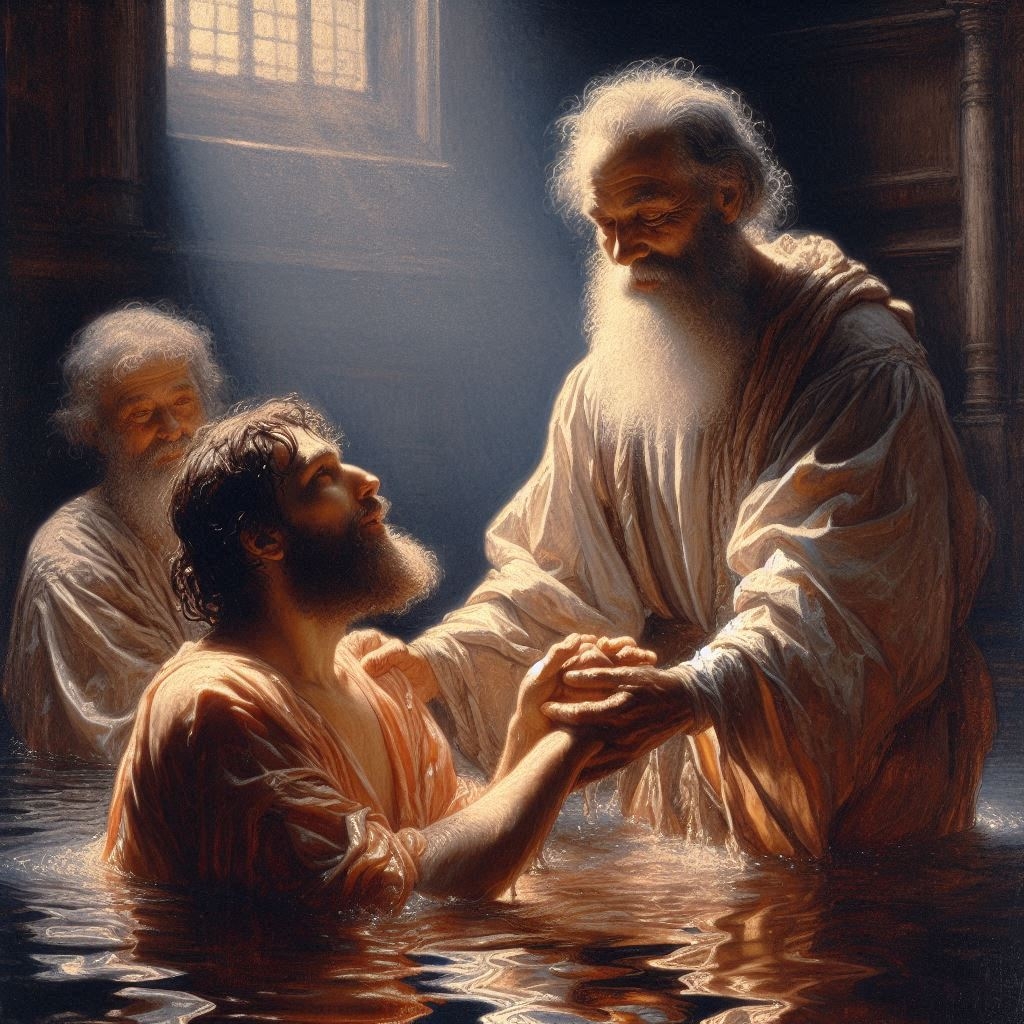
Acts 2:38 is often mentioned in debates about salvation, baptism, and repentance. The verse states, “Peter said to them, ‘Repent, and each of you be baptized in the name of Jesus Christ for the forgiveness of your sins; and you will receive the gift of the Holy Spirit’” (Acts 2:38 NASB). In context, Peter is addressing a Jewish audience on the Day of Pentecost after the Holy Spirit has descended, fulfilling Jesus’ promise (Acts 1:8). He has just finished preaching that Jesus is the Messiah whom they had rejected and crucified (Acts 2:23-24). The Jews, realizing their grave error, are “pierced to the heart” and ask, “Brethren, what shall we do?” (Acts 2:37). They were asking, “What should we do now in light of this realization?” Peter’s response in Acts 2:38 addresses both their justification (repentance leading to faith in Christ) and their public identification with Him (water baptism).
The word “repent” (metanoeō) means “to change one’s mind.” In this context, it does not mean turning from sin as a prerequisite for salvation but rather a change of mind about Jesus—acknowledging Him as the Messiah. Toussaint notes, “The Jews had rejected Jesus; now they were to trust in Him. Repentance was repeatedly part of the apostles’ message in Acts (Acts 2:38; 3:19; 5:31; 8:22; 11:18; 13:24; 17:30; 19:4; 20:21; 26:20).”[1] According to Fruchtenbaum, “If these Jewish individuals would repent, that is, change their minds about Yeshua, they would be saved spiritually.”[2] Faith alone in Christ alone is all that’s necessary for salvation (John 3:16; Rom 3:28; Acts 4:12; Eph 2:8-9).
The command to “be baptized” (baptisthētō) is in the aorist passive imperative, indicating an individual response that follows repentance. This differs from the verb “repent” (metanoēsate), which is a second-person plural imperative, indicating a general call to the group. The phrase “for the forgiveness of your sins” (eis aphesin tōn hamartiōn) contains the preposition eis, which can mean “for,” “unto,” or “because of.” (see A.T. Robertson, Word Pictures in the New Testament, Acts 2:38). Black notes, “The interpretation turns on the proper meaning of the Greek preposition eis, translated as ‘for.’ The usage in Acts 2:38 can be compared to the usage in Matthew 3:11, where baptism in water is a sign of repentance and not the basis or cause of repentance.”[3] Given the consistent biblical teaching that salvation is by grace alone through faith alone (John 3:16; Acts 16:31; Eph 2:8-9), eis is best understood as “because of” rather than “in order to receive.” Fruchtenbaum states, “The Greek word translated in the verse as ‘unto’ is eis. It can also simply mean ‘on the basis of’ or ‘because of,’ as it does in Matthew 10:41 and 12:41. Just as the Ninevites repented because of the preaching of Jonah, these must now be baptized because of the remission of their sins—not in order to have their sins remitted, but because they have already had their sins remitted by repentance.”[4] Ryrie notes:
This baptism was “for the remission of sins” (Acts 2:38). This does not mean in order that sins might be remitted, for everywhere in the New Testament sins are forgiven as a result of faith in Christ, not as a result of baptism. It means be baptized because of the remission of sins. The Greek preposition eis, for, has this meaning “because of” not only here but also in such a passage as Matthew 12:41 where the meaning can only be “they repented because of (not in order to) the preaching of Jonah.[5]
Water baptism is not a requirement for forgiveness but is performed because sins have already been forgiven through faith in Christ. Radmacher states, “Believers are baptized in view of God’s work of forgiveness, not in order to receive that forgiveness. God’s forgiveness in Christ gives baptism its significance. Baptism is a public declaration that a person’s sins have been forgiven because of Christ’s work on the Cross.”[6] Wallace notes, “Water baptism is not a cause of salvation, but a picture; and as such it serves both as a public acknowledgment (by those present) and a public confession (by the convert) that one has been Spirit-baptized.”[7] Additionally, the phrase, “you will receive” (lēmpsesthe) is in the future active indicative, meaning the Holy Spirit is received after repentance, not necessarily after baptism.
It is important to recognize that Acts is a transitional book. The events in Acts 2 mark the beginning of the Church Age, shifting from Israel under the Old Covenant to the body of Christ. Peter’s audience consists of Jews who were under the Mosaic Law and now must transition to the new dispensation. Because salvation is by faith alone (Rom 4:5; Eph 2:8-9), and baptism is a work, it cannot be a requirement for salvation. Peter’s call to repentance is a call to faith in Christ, while baptism is an outward identification with that faith.
Many misinterpret Acts 2:38 as teaching baptismal regeneration, the false doctrine that baptism is necessary for salvation. However, the broader New Testament contradicts this view. Scripture consistently teaches salvation by faith alone (John 3:16; Acts 16:31; Rom 3:28; 4:4-5; Gal 2:16; Eph 2:8-9). The thief on the cross was saved without baptism (Luke 23:42-43). In Acts 10:44-48, Cornelius and other Gentiles receive the Holy Spirit before being baptized, proving that baptism is not required for receiving the Spirit or for salvation.
Paul wrote, “For Christ did not send me to baptize, but to preach the gospel” (1 Cor 1:17). Here, Paul draws a clear distinction between the gospel message and the act of water baptism. The gospel, by its very nature, is the power of God for salvation to everyone who believes (Rom 1:16). If water baptism were a necessary component of the gospel, Paul’s statement would be incoherent. Instead, he deliberately separates water baptism from the gospel. Water baptism, while an important act of obedience and public identification with Christ (Matt 28:19; Acts 8:36-38), is not a prerequisite for salvation. To incorporate baptism as a requirement would be to adulterate the gospel by introducing a works-based element, which contradicts the doctrine of justification by faith alone (Rom 3:28; Gal 2:16). Therefore, water baptism follows salvation but is not part of the gospel itself, nor does it contribute in any way to eternal life.
In conclusion, Acts 2:38 does not teach baptismal regeneration but must be understood in its dispensational and linguistic context. Peter calls his Jewish listeners to change their minds about Jesus and to be baptized as a public testimony of their faith. The passage, when properly interpreted, harmonizes with the broader biblical doctrine of salvation by grace alone through faith alone.
Steven R. Cook, D.Min., M.Div.
If this article has enriched your understanding and walk with Christ, and you feel led to support my ministry, your generosity is greatly appreciated. Your gifts enable me to continue sharing the gospel of grace and providing in-depth biblical teachings. Thank you for partnering with me in this mission.
[1] Stanley D. Toussaint, “Acts,” in The Bible Knowledge Commentary: An Exposition of the Scriptures, vol. 2 (Wheaton, IL: Victor Books, 1985), 359.
[2] Arnold G. Fruchtenbaum, The Book of Acts, ed. Christiane K. Jurik, First Edition, Ariel’s Bible Commentary (San Antonio, TX: Ariel Ministries, 2020), 79.
[3] Thomas D. Lea and David Alan Black, The New Testament: Its Background and Message, 2nd ed. (Nashville, TN: Broadman & Holman Publishers, 2003), 292.
[4] Arnold G. Fruchtenbaum, The Book of Acts, 79–80.
[5] Charles C. Ryrie, Acts of the Apostles, Everyman’s Bible Commentary (Chicago: Moody Press, 1961), 24.
[6] Earl D. Radmacher, Ronald Barclay Allen, and H. Wayne House, Nelson’s New Illustrated Bible Commentary (Nashville: T. Nelson Publishers, 1999), 1370.
[7] Daniel B. Wallace, Greek Grammar Beyond the Basics – Exegetical Syntax of the New Testament (Zondervan Publishing House and Galaxie Software, 1996), 371.
The church refers to the body of Christ which began on the day of Pentecost in Acts chapter 2. It is comprised of Jews and Gentiles who have accepted Jesus as Savior. The church exists universally as an organism, the global presence of Christians who form the body of Christ. The church also exists locally as an organization, a nearby assembly of believers who gather together for Bible study, worship, fellowship, and the practice of the ordinances of baptism and the Lord’s Supper. The Christian church is a mystery not revealed in the Old Testament and is separate from Israel, having a different identity and purpose.
The Meaning of Ekklesia
The term church is a common translation of the Greek word ekklesia, which means called out ones, assembly, congregation, or community of Christians.[1] The New Testament writers use the word both in a general and technical sense. When used in a general sense, the word refers to any assembly, such as an assembly of residents in a city (Acts 19:32, 39, 41). It is interesting that the assembly mentioned in Acts 19 refers to pagan worshippers of the Greek goddess Artemis and does not refer to believers at all (Acts 19:34-35). The word ekklesia is also applied to Israel as a general assembly or congregation (Matt. 18:17; Acts 7:38; Heb. 2:12). In Matthew 18:15-17 Jesus addresses the subject of discipline within the fellowship of a community (ekklesia); however, the evidence of the passage favors a Jewish assembly (i.e. a synagogue) and not the Christian church.[2] In Acts 7:38 Stephen is speaking to a Jewish audience and mentions “the congregation [ekklesia] in the wilderness.”[3] Stephen’s use of the word ekklesia simply refers to the assembly of Israelites who were brought out of Egypt by Moses. In Hebrews 2:12 the writer quotes Psalm 22:22, in which the Septuagint[4] has the term ekklesia, again, used in a general way of an assembly or congregation of Jewish people.
When applied to Christians in the New Testament, ekklesia takes on a technical meaning and refers to those who have been joined to the spiritual body of Christ (1 Cor. 12:13; Eph. 1:22-23) by means of personal faith in Jesus as Savior (Acts 4:12; 1 Cor. 15:3-4; Eph. 2:8-9). The first reference to the Christian church occurs in Matthew 16:18 after Peter had confessed that Jesus is “the Christ, the Son of the living God” (Matt. 16:16), and based on the rock-solid truth of Peter’s statement, Jesus said, “I will build [future tense] My church [ekklesia]; and the gates of Hades shall not prevail against it” (Matt. 16:18). Jesus’ future tense statement reveals a church that was not in existence when He spoke. The Christian church began on the day of Pentecost, in Acts 2, when the Holy Spirit began His baptizing ministry of placing believers into the body of Christ. Concerning this work of the Holy Spirit, Paul writes, “For by one Spirit we were all baptized into one body—whether Jews or Greeks, whether slaves or free—and have all been made to drink into one Spirit” (1 Cor. 12:13; cf. Gal. 3:26-28). “The Holy Spirit of God is the primary agent who identifies the believer with other believers. Each one is a member of the body, and each member is united with the other members and with Christ (Rom. 6:1–4).”[5] The comparison of Acts 1:4-5 with Acts 2:1-4 and 11:15-17 make a compelling case for the church’s origin in Acts 2. It is mainly in the writings of Paul that the Christian church is identified as the body of Christ. Note the following Scriptures:
And He put all things under His feet, and gave Him to be head over all things to the church, which is His body, the fullness of Him who fills all in all. (Eph. 1:22-23)
For the husband is head of the wife, as also Christ is head of the church; and He is the Savior of the body. (Eph. 5:23)
And He is the head of the body, the church, who is the beginning, the firstborn from the dead, that in all things He may have the preeminence. (Col. 1:18)
I now rejoice in my sufferings for you, and fill up in my flesh what is lacking in the afflictions of Christ, for the sake of His body, which is the church. (Col. 1:24)
Several times in the New Testament Jesus is referred to as the Head of the body, the church. The Greek word soma, translated body, occurs 142 times in the New Testament and is used most often of physical bodies; however, it is used “sixteen times to refer to the church, the body of Christ (Rom. 12:5; 1 Cor. 10:17; 12:13; Eph. 1:23; 2:16; 4:4, 12, 16; 5:23, 30; Col. 1:18, 24; 2:19; 3:15). With the exception of Eph. 5:28, in Ephesians it is always used metaphorically as a reference to the body of Christ, the church.”[6] Paul first learned about this identification when he, as an unbeliever, encountered the Lord Jesus on the road to Damascus when he was persecuting Christians and putting them in prison. While on the road, the Lord Jesus appeared to him in a bright light, which caused him to fall to the ground, and then a voice said, “Saul, Saul, why are you persecuting Me?” (Act 9:4; cf. 22:7; 26:14). When Paul asked, “who are You Lord?” The reply came, “I am Jesus, whom you are persecuting” (Acts 9:5). Paul learned that an attack on Christians is an attack on the Lord Jesus Christ Himself. “The question, ‘Why do you persecute Me?’ (cf. Acts 9:5) is filled with significance for it shows the union of Christ with His church. The Lord did not ask, ‘Why do you persecute My church?’ The reference to ‘Me’ gave Saul his first glimpse into the great doctrine of Christians being in Christ.”[7] When a person believes in Jesus as Savior he/she is united to the body of Christ by means of the Holy Spirit. This is a new designation in which ethnic, social, and gender identity are all secondary to the believer’s new identity of being in Christ Jesus (Gal. 3:26-28).[8]
The Universal Church
The New Testament church is understood both in a universal and local sense. The universal church refers to the global existence of the body of Christ. This is the organic church as it exists all over the planet. Several passages in the New Testament communicate the idea of a universal church, such as when Paul said, “Give no offense, either to the Jews or to the Greeks or to the church of God” (1 Cor. 10:32), and “God has appointed these in the church: first apostles, second prophets, third teachers, after that miracles, then gifts of healings, helps, administrations, varieties of tongues” (1 Cor. 12:28), and “He put all things under His feet, and gave Him to be head over all things to the church, which is His body, the fullness of Him who fills all in all” (Eph. 1:22-23; italics added). What is noticed in these and other places in Scripture is the use of the term church without a specific location (Matt. 16:18; Acts 8:3; 9:31; 20:28; Rom. 16:16; 1 Cor. 15:9; Eph. 3:10, 21; 5:23, 32; Col. 1:18, 24). Robert Lightner comments on this:
There are a number of usages of ekklesia that do not seem to refer to a local assembly of believers. Instead, they speak of that company of believers formed on the day of Pentecost into the body of Christ, which has been growing ever since as sinners trust Christ alone as Savior and are added to it. This company of the redeemed is called the church without consideration of whether or not those who are a part of it are members of local churches.[9]
The universal church exists all over the earth. When the rapture of the church occurs, all believers, wherever they are on the planet, will be caught up to meet the Lord in the air (1 Thess. 4:13-18). That is, the church, as it exists globally, will be removed from the earth and taken to be with Christ. Also, whenever we meet another Christian, we are meeting someone who belongs to the global body of Christ, whether they belong to a local assembly or not.
The Local Church
The word church is also used to refer to a local assembly of those who regularly meet at a specific location (1 Cor. 1:2; Col. 1:2; Rev. 2-3). Luke mentions “the church which was at Jerusalem (Acts 8:1), and “the church that was at Antioch” (Acts 13:1). Paul mentions “the church in Cenchrea” (Rom. 16:1), “the church of God which is at Corinth” (1 Cor. 1:2), “the saints in Christ Jesus who are in Philippi” (Phil. 1:1), and “the saints and faithful brethren in Christ who are in Colosse” (Col. 1:2) (italics added). The apostle John wrote the book of Revelation to churches in Ephesus, Smyrna, Pergamos, Thyatira, Sardis, Philadelphia, and Laodicea (Revelation 2-3). These were all local churches that existed in ancient cities, where Christians lived and worked. However, we can narrow the local church down a little further and say that Christians met in the homes of specific church members within each city. The first church—which was Jewish—met “in the temple” in Jerusalem, as well as “from house to house” (Acts 2:46). As the church grew, and included Gentiles, the home continued as the primary meeting place for believers. Luke records Paul’s ministry to Christians in Ephesus and explained that he taught “publicly and from house to house” (Acts 20:20). Paul mentions several home churches such as the one run by Aquila and Priscilla and “the church that is in their house” (1 Cor. 16:19), and about “Nymphas and the church that is in his house” (Col. 4:15), and “to the beloved Apphia, Archippus our fellow soldier, and to the church in your house” (Phm. 1:2) (italics added).
Who were the members of these local house churches? From several writings in the New Testament we get a demographic breakdown of church members, which consisted of men and women (Eph. 5:22-23), parents and children (Eph. 6:1-4), slaves and free persons (Eph. 6:5-9), rich and poor (1 Tim. 6:17-19; Jam. 2:2-5), spiritual and carnal (1 Cor. 3:1-3; Gal. 6:1), mature and immature (1 Cor. 2:6; 1 Pet. 2:2). We can also surmise that home churches generally had few members because of the size of the homes (probably not exceeding 50 people) and the fellowship probably tended to be personal, with an emphasis on learning God’s Word and enjoying Christian fellowship. Luke gives us a snapshot of some of the values and practices of the early church in which he tells us “they continued steadfastly in the apostles’ doctrine and fellowship, in the breaking of bread, and in prayers” (Acts 2:42).
We also know the first century church had problems. Churches then, like churches now, are no better or worse than the people who make up their fellowship. Christians who were immature, carnal and selfish tended to cause trouble. Churches struggled with problems such as jealousy and strife (1 Cor. 3:1-3), fornication (1 Cor. 5:1-2), selfishness and drunkenness (1 Cor. 11:21), relationship conflicts (Phil. 4:2), and legalism (Gal. 5:1-12). But God expected all to be “filled with the Spirit” (Eph. 5:18), and to “walk by the Spirit” (Gal. 5:16), manifesting “the fruit of the Spirit”, which is “love, joy, peace, patience, kindness, goodness, faithfulness, gentleness, [and] self-control” (Gal 5:22-23). In the church, Christians were to learn Scripture (2 Tim. 2:15; 1 Pet. 2:2), grow in grace (2 Pet. 3:18), advance to spiritual maturity (Eph. 4:11-16; 2 Tim. 3:16-17), seek the interests of others over self (Phil. 2:3-4), love one another (1 Cor. 13:4-8a; 1 Thess. 3:11-12; 4:9; 1 Jo. 4:7-11), pray for one another (Jam. 5:16), encourage one another (1 Thess. 5:11), edify each other (Rom. 15:1-2; Eph. 4:29), be kind and forgiving (Eph. 4:32), serve one another (Gal. 5:13; 1 Pet. 4:10), and do good works (Eph. 2:10; Tit. 2:11-14). These Christian qualities made the church attractive and productive.
The primary purpose of the church is to glorify God. Paul states, “we who first trusted in Christ should be to the praise of His glory” (Eph. 1:12), and “to Him be glory in the church by Christ Jesus to all generations, forever and ever” (Eph. 3:21; cf. Rom. 11:36; 16:27; 1 Pet. 2:5). Other purposes of the church include evangelizing the lost (Matt. 28:18-20), edifying believers through biblical teaching so they might advance to spiritual maturity (Eph. 4:11-16), praying for one another (Jam. 5:16), and showing love (John 13:34).
A Divided Understanding of the Church
One of the dispensational distinctives is that Israel and the church are separate. The church, which is the body of Christ (Eph. 1:22-23), is a company of believers, made up of Jews and Gentiles (1 Cor. 10:32), who have been spiritually united with Christ by means of the baptism of the Holy Spirit at the moment of salvation (1 Cor. 12:13; Gal. 3:26-28). The church, as the body of Christ, was revealed to the apostles only in the New Testament (Eph. 1:22-23; 3:1-12; 5:32; Col. 1:24-27). However, covenant theologians see the church existing as one people of God, a single group of people that goes all the way back to Genesis. Covenant theologian Wayne Grudem states, “The church is the community of all true believers for all time.”[10] And John Frame comments, “Israel was the church of the old covenant; the New Testament church is the Israel of the new covenant, what Paul calls ‘the Israel of God’ (Gal. 6:16).”[11] Covenant theologians such as Charles Hodge, B. B. Warfield, Louis Berkhof, Edward Young, J. I. Packer, R. C. Sproul, John Piper, and many others argue that Israel is the church and the church is Israel; they are the same. Though I have a great love for covenant theologians and am profoundly thankful for much of their writings, I respectfully disagree with their understanding of the church.
When one reads back through the Old Testament there were basically two groups of people on the earth: Jews and Gentiles. This distinction began with the call of Abraham, when God called him into a special relationship and promised to bless the world through him (Gen. 12:1-3). Biblically, a Jew is a Jew because he/she is a biological descendant of Abraham, Isaac, and Jacob (Gen. 12:1-3; 15:5; 17:7, 19; 22:15-17; 28:13-14; Ex. 2:24-25). “The biblical basis for defining Jewishness lies in the Abrahamic Covenant which promised that a nation would descend from Abraham, Isaac, and Jacob in Genesis 12:2a; 13:16; 15:5; 17:1–2, 7; 22:17; 26:4, 24; and 28:14; from which a simple definition of Jewishness can be deduced.”[12] A Gentile is anyone who is not a Jew. And a Gentile, no matter how hard he/she tried, could never be a biological Jew. Certainly Gentiles could participate in the Jewish blessings if he/she embraced God. Rahab and Ruth believed in God, but, though saved and in the line of Christ (Matt. 1:5), they were never regarded as biological Jews. Ruth continued to be called a Moabitess, even after her conversion (Ruth 2:2, 21; 4:5, 10). The Jew and Gentile distinction continued for millennia until the formation of the Christian church. Now, in the church age, there are three groups of people: Jews, Gentiles, and the church. This is why Paul makes the comment, “Give no offense, either to the Jews or to the Greeks or to the church of God” (1 Cor. 10:32; italics added). The church is now a third group that consists of Jews and Gentiles who have trusted in Christ as their Savior and been joined to the body of Christ.[13]
Though both Israel and Christians are the people of God, the Christian church is distinct from the nation of Israel. Several observations from the New Testament provide a compelling case. First, the term Israel occurs 73 times in the New Testament (30 times in the Gospels, 21 times in the book of Acts, 19 times in the Epistles, and 3 times in the book of Revelation), and not once does it refer to the church.[14] “The term Israel is either used of the nation or the people as a whole, or of the believing remnant within. It is never used of the Church in general or of Gentile believers in particular.”[15] The fact that Israel is still called Israel, even after the church is formed, argues that Israel is not the church. Second, the word Jew occurs 186 times in the New Testament (84 times in the Gospels, 76 times in the book of Acts, 24 times in the Epistles, and 2 times in the book of Revelation), and refers to anyone who is a biological descendant of Abraham, Isaac, and Jacob. The word Jew is never used of Gentiles or the church. The fact that these distinctions continue throughout the New Testament make a compelling case that Israel and the church are separate groups of people.
The distinction between Israel and the church is verified by several facts. (1) In the New Testament natural Israel and Gentiles are contrasted after the church was clearly established (Acts 3:12; 4:8, 10; 5:21, 31, 35; 21:19). (2) Natural Israel and the church are clearly distinguished, showing that the church is not Israel (1 Cor. 10:32). The apostle’s distinction would be meaningless if Israel were the same as the church.[16]
Additional biblical distinctions reveal that Israel is a nation (Ex. 19:6), but the church is not a nation (Rom. 10:19). God’s program for Israel focuses on the land promised to Abraham (Gen. 12:1; 15:18; 17:8), whereas the church is called to go out to many lands (Matt. 28:19-20; Acts 1:8). Israel was mentioned throughout the Old Testament and recognized by other nations (Num. 14:15; Josh. 5:1), but the church was a mystery not known in the Old Testament (Eph. 3:1-6; Col. 1:26-27; cf. Rom. 16:25-26).[17] Israel was under “the Law” of Moses (John 1:17), whereas the Church is under the “Law of Christ” (1 Cor. 9:21; Gal. 6:2). Israel had a priesthood that was specific to the tribe of Levi (Num. 3:6-7), whereas all Christians are priests to God (Rev. 1:6). Israel worshipped first at the Tabernacle and later the Temple (Ex. 40:18-38; 2 Chron. 8:14-16), but for Christians, their body is the temple of the Lord and they gather locally where they want (1 Cor. 6:19-20; cf. 1 Cor. 16:19; Col. 4:15). Israel offered animal sacrifices to God (Lev. 4:1-35), but Christians offer spiritual sacrifices (1 Pet. 2:5; cf. Rom. 12:1; Heb. 13:15). Israel was required to tithe from the produce of their land (Deut. 14:22-23; 28-29; Num. 18:21), but there is no tithe required from Christians, only a joyful attitude when giving, “for God loves a cheerful giver” (2 Cor. 9:7). (See Chart Here)
In the New Testament, there are Jewish unbelievers (Acts 14:2; 19:8-9), and Jewish believers (Acts 10:45; 14:1). This is what Paul referred to when he said, “For they are not all Israel who are of Israel” (Rom. 9:6). That is, one could be a biological Jew and not belong to the remnant of saved Jews who accept Jesus as Messiah. In addition, there are Gentile unbelievers (Acts 14:2-7), and Gentile believers (Acts 13:48; 21:25). Both Jews and Gentiles are distinguished in several passages (Acts 4:27; 9:15; 14:2, 5; 21:11, 21; Rom. 3:29; 9:24), as well as Jews and Christians (Gal. 2:11-14), Gentiles and Christians (Acts 11:1), and all three at once (Acts 14:4-5; 1 Cor. 10:32). In the book of Galatians, Paul draws a distinction between Gentile and Jewish believers, where he states, “And as many as walk according to this rule, peace and mercy be upon them [Gentile Christians], and upon the Israel of God [Jewish Christians]” (Gal. 6:16). Covenant theologians commonly reference Galatians 6:16 to argue that the church and Israel are the same; but this fails to consider the language of the text. “The first group is the them, the uncircumcision, the Gentile Christians to and of whom he [Paul] had devoted most of the epistle. The second group is the Israel of God. These are the circumcision, the Jewish believers who, in contrast with the Judaizers, followed the rule of salvation by grace through faith alone.”[18] These distinctions in the New Testament make a compelling argument that Jews, Gentiles, and Christians are seen as separate groups.[19]
God’s current plan in human history is being worked out through His church. However, we should never draw the conclusion that God is finished with Israel. He is not. Israel as a nation is under divine discipline (Matt. 23:37-39; Rom. 11:25-27), but God has a future plan to restore them and to bless the world through them. God’s covenant promises to Israel are still in effect (Gen. 12:1-3; Rom. 9:1-5; 11:1-2), which promises point to a future regathering of the nation of Israel in the Promised Land (Isa. 14:1; 60:21; Jer. 30:3; Ezek. 11:17; 20:42; 37:12; Amos 9:14-15), a King and kingdom (2 Sam. 7:16; Ps. 89:3-4, 34-37; Dan. 2:44; 7:13-14; Luke 1:31-33; Matt. 6:9-10; 19:28; 25:31), and a righteous rule (Isa. 9:6-7; Jer. 23:5-6; Rev. 11:15; 19:11-16), which will last for a thousand years (Rev. 20:4-6). Jesus is the son of David, the son of Abraham, and He will inherit the throne of His father and rule on earth.
Summary
The church is distinct from Israel and Gentiles. The church, which is the body of Christ (Eph. 1:22-23), is a company of believers, from Jews and Gentiles (1 Cor. 10:32), who have been spiritually united with Christ by means of the baptism of the Holy Spirit at the moment of salvation (1 Cor. 12:13; Gal. 3:26-28). More so, the church exists both in a universal and local sense, globally as an organism and locally as an organization. Once the church is caught up to heaven at the rapture (1 Thess. 4:13-18), God will resume His plan with national Israel and fulfill all the promises made to them through the covenants (Rom. 9:1-5; 11:1-2; 25-27).
[1] Walter Bauer, A Greek-English Lexicon of the New Testament and Other Early Christian Literature, rev. and ed. Frederick W. Danker, 3rd ed. (Chicago: University of Chicago Press, 2000), 303-304.
[2] There are several reasons Matthew 18:17 does not refer to the Christian church: Firstly, the Christian church did not come into existence until after the resurrection of Jesus. To make Matthew 18:17 refer to the Christian church is to have the church in existence before the baptizing work of the Holy Spirit, which is how believers are joined to the body of Christ (1 Cor. 12:13; cf. Acts 1:5; 2:4; 11:15-16). Secondly, Jesus cites the Mosaic Law as the rule for judging the brother in Matthew 18, and this would have been expected of those living under that code (Deut. 17:6; 19:15). Currently, Christians are not living under the Mosaic Law (Rom. 6:14), but under the “Law of Christ” (Gal. 6:2; cf. Rom. 8:2; Jam. 1:25; 2:8). Thirdly, if the brother refuses to listen to the assembly, he is to be treated “as a Gentile” (Matt. 18:17), a term which would make no sense for the Christian church, since Jewish and Gentile identity is subservient to the greater identity of being united with Christ (Gal. 3:26-28).
[3] Unless otherwise stated, all Scripture quotes are taken from the New King James Version (Nashville: Thomas Nelson, 1982).
[4] The Septuagint, or LXX, refers to the Greek translation of the Hebrew Old Testament, which was translated circa 250 B.C.
[5] Robert P. Lightner, Handbook of Evangelical Theology: A Historical, Biblical, and Contemporary Survey and Review (Grand Rapids, MI: Kregel Publications, 1995), 229.
[6] Harold Hoehner, Ephesians: An Exegetical Commentary (Grand Rapids, Mich., Baker Book House, 2002), 290.
[7] Stanley D. Toussaint, “Acts,” in The Bible Knowledge Commentary: An Exposition of the Scriptures, ed. J. F. Walvoord and R. B. Zuck, vol. 2 (Wheaton, IL: Victor Books, 1985), 375–376.
[8] Prior to this transfer, every person is identified positionally as being in Adam (1 Cor. 15:21-22). However, at the moment of faith in Christ, the believer obtains a new identity and is said to be in Christ Jesus (ἐν Χριστῷ Ἰησοῦ). Paul stresses this positional identification several times in the New Testament (Rom. 8:1; 16:3; 1 Cor. 1:2, 30; Gal. 3:14, 26, 28; Eph. 1:1; 2:6, 13; 3:6).
[9] Robert P. Lightner, Handbook of Evangelical Theology: A Historical, Biblical, and Contemporary Survey and Review, 228.
[10] Wayne A. Grudem, Systematic Theology: An Introduction to Biblical Doctrine (Leicester, England; Grand Rapids, MI: Inter-Varsity Press; Zondervan Pub. House, 2004), 853.
[11] John M. Frame, Salvation Belongs to the Lord: An Introduction to Systematic Theology (Phillipsburg, NJ: P&R Publishing, 2006), 235.
[12] Arnold G. Fruchtenbaum, Israelology: The Missing Link in Systematic Theology, Rev. ed. (Tustin, CA: Ariel Ministries, 1994), 748.
[13] In one sense, Jews and Gentiles retain their ethnic and cultural identity, even after believing in Christ as Savior. However, in another sense, their new identity as a Christian, which is part of the body of Christ, supersedes whatever identity they had before (Gal. 3:26-28; Col. 3:9-11).
[14] The term Israel is used to refer to the biological descendants of Abraham, Isaac, and Jacob, both saved and lost (Matt. 2:6; 9:33; 10:6; 15:24, 31; 27:9; Mark 12:29; Luke 1:16, 54, 80; 2:25, 34; 4:25, 27; 22:30; 24:21; John 1:31; 3:10; Acts 1:6; 2:22, 36; 3:12; 4:10; 5:21, 31, 35; 7:23, 37, 42; 10:36; 13:16-17, 23-24; 21:28; 28:20; Rom. 9:4, 6, 27, 31; 10:19, 21; 11:1-2, 7, 25-26; 1 Cor. 10:18; 2 Cor. 3:7, 13; 11:22; Gal. 6:16; Eph. 2:12; Phil. 3:5; Heb. 8:8, 10; 11:22; Rev. 2:14; 7:4; 21:12), the God of Israel (Matt. 15:31; Luke 1:68), Jesus as the king of Israel (Matt. 27:42; Mark 15:32; John 1:49; 12:13), the land of Israel (Matt. 2:20-21), the cities of Israel (Matt. 10:23), and in contrast with Gentiles (Matt. 8:10; Luke 2:32; 7:9; Acts 4:27; 9:15).
[15] Arnold G. Fruchtenbaum, Israelology: The Missing Link in Systematic Theology, 699.
[16] Charles Caldwell Ryrie, Basic Theology: A Popular Systematic Guide to Understanding Biblical Truth (Chicago, IL: Moody Press, 1999), 462.
[17] A mystery (musterion) is something “which in other ages was not made known to the sons of men, as it has now been revealed by the Spirit to His holy apostles and prophets” (Eph. 3:5). Paul then states what that mystery is, “that the Gentiles should be fellow heirs, of the same body, and partakers of His promise in Christ through the gospel” (Eph. 3:6).
[18] Arnold G. Fruchtenbaum, Israelology: The Missing Link in Systematic Theology, 691.
[19] A Christian can be a spiritual descendant of Abraham by exercising faith in the same God as Abraham (Rom. 4:11; Gal. 3:29), but this should not be confused with the covenants and promises of God which are promised to national Israel (Rom. 9:1-5).
 I spent two years studying Classical Greek at Texas Tech University before attending seminary in Fort Worth, Texas. My Greek professor, a Church of Christ minister, spent two semesters trying to convince me that water baptism was necessary for eternal salvation. We met several times outside the classroom—usually at Denny’s over coffee—and discussed nearly every New Testament passage on baptism. Of course, Acts 2:38 came up several times in our discussions. I am not a Greek scholar, but with four years of Greek study and a knowledge of how to use lexicons and grammar resources, I feel competent to analyze Acts 2:38 and provide an accurate interpretation.
 The command to “be baptized” (baptisthētō) is in the aorist passive imperative, indicating an individual response that follows repentance. This differs from the verb “repent” (metanoēsate), which is a second-person plural imperative, indicating a general call to the group. The phrase “for the forgiveness of your sins” (eis aphesin tōn hamartiōn) contains the preposition eis, which can mean “for,” “unto,” or “because of.” (see A.T. Robertson, Word Pictures in the New Testament, Acts 2:38). Black notes, “The interpretation turns on the proper meaning of the Greek preposition eis, translated as ‘for.’ The usage in Acts 2:38 can be compared to the usage in Matthew 3:11, where baptism in water is a sign of repentance and not the basis or cause of repentance.”[3] Given the consistent biblical teaching that salvation is by grace alone through faith alone (John 3:16; Acts 16:31; Eph 2:8-9), eis is best understood as “because of” rather than “in order to receive.” Fruchtenbaum states, “The Greek word translated in the verse as ‘unto’ is eis. It can also simply mean ‘on the basis of’ or ‘because of,’ as it does in Matthew 10:41 and 12:41. Just as the Ninevites repented because of the preaching of Jonah, these must now be baptized because of the remission of their sins—not in order to have their sins remitted, but because they have already had their sins remitted by repentance.”[4] Ryrie notes:
 Water baptism is not a requirement for forgiveness but is performed because sins have already been forgiven through faith in Christ. Radmacher states, “Believers are baptized in view of God’s work of forgiveness, not in order to receive that forgiveness. God’s forgiveness in Christ gives baptism its significance. Baptism is a public declaration that a person’s sins have been forgiven because of Christ’s work on the Cross.”[6] Wallace notes, “Water baptism is not a cause of salvation, but a picture; and as such it serves both as a public acknowledgment (by those present) and a public confession (by the convert) that one has been Spirit-baptized.”[7] Additionally, the phrase, “you will receive” (lēmpsesthe) is in the future active indicative, meaning the Holy Spirit is received after repentance, not necessarily after baptism.
 Paul wrote, “For Christ did not send me to baptize, but to preach the gospel” (1 Cor 1:17). Here, Paul draws a clear distinction between the gospel message and the act of water baptism. The gospel, by its very nature, is the power of God for salvation to everyone who believes (Rom 1:16). If water baptism were a necessary component of the gospel, Paul’s statement would be incoherent. Instead, he deliberately separates water baptism from the gospel. Water baptism, while an important act of obedience and public identification with Christ (Matt 28:19; Acts 8:36-38), is not a prerequisite for salvation. To incorporate baptism as a requirement would be to adulterate the gospel by introducing a works-based element, which contradicts the doctrine of justification by faith alone (Rom 3:28; Gal 2:16). Therefore, water baptism follows salvation but is not part of the gospel itself, nor does it contribute in any way to eternal life.
 When applied to Christians in the New Testament, ekklesia takes on a technical meaning and refers to those who have been joined to the spiritual body of Christ (1 Cor. 12:13; Eph. 1:22-23) by means of personal faith in Jesus as Savior (Acts 4:12; 1 Cor. 15:3-4; Eph. 2:8-9). The first reference to the Christian church occurs in Matthew 16:18 after Peter had confessed that Jesus is “the Christ, the Son of the living God” (Matt. 16:16), and based on the rock-solid truth of Peter’s statement, Jesus said, “I will build [future tense] My church [ekklesia]; and the gates of Hades shall not prevail against it” (Matt. 16:18). Jesus’ future tense statement reveals a church that was not in existence when He spoke. The Christian church began on the day of Pentecost, in Acts 2, when the Holy Spirit began His baptizing ministry of placing believers into the body of Christ. Concerning this work of the Holy Spirit, Paul writes, “For by one Spirit we were all baptized into one body—whether Jews or Greeks, whether slaves or free—and have all been made to drink into one Spirit” (1 Cor. 12:13; cf. Gal. 3:26-28). “The Holy Spirit of God is the primary agent who identifies the believer with other believers. Each one is a member of the body, and each member is united with the other members and with Christ (Rom. 6:1–4).”
 The word church is also used to refer to a local assembly of those who regularly meet at a specific location (1 Cor. 1:2; Col. 1:2; Rev. 2-3). Luke mentions “the church which was at Jerusalem (Acts 8:1), and “the church that was at Antioch” (Acts 13:1). Paul mentions “the church in Cenchrea” (Rom. 16:1), “the church of God which is at Corinth” (1 Cor. 1:2), “the saints in Christ Jesus who are in Philippi” (Phil. 1:1), and “the saints and faithful brethren in Christ who are in Colosse” (Col. 1:2) (italics added). The apostle John wrote the book of Revelation to churches in Ephesus, Smyrna, Pergamos, Thyatira, Sardis, Philadelphia, and Laodicea (Revelation 2-3). These were all local churches that existed in ancient cities, where Christians lived and worked. However, we can narrow the local church down a little further and say that Christians met in the homes of specific church members within each city. The first church—which was Jewish—met “in the temple” in Jerusalem, as well as “from house to house” (Acts 2:46). As the church grew, and included Gentiles, the home continued as the primary meeting place for believers. Luke records Paul’s ministry to Christians in Ephesus and explained that he taught “publicly and from house to house” (Acts 20:20). Paul mentions several home churches such as the one run by Aquila and Priscilla and “the church that is in their house” (1 Cor. 16:19), and about “Nymphas and the church that is in his house” (Col. 4:15), and “to the beloved Apphia, Archippus our fellow soldier, and to the church in your house” (Phm. 1:2) (italics added).