Introduction
The main point of this article is that Jesus, in His humanity, was forsaken by God the Father for three hours while bearing the punishment for our sins on the cross. During these three hours, Jesus experienced a judicial separation from the Father, which is what is meant by spiritual death. This spiritual-judicial separation was necessary for Him to fully atone for humanity’s sins.
 According to the Bible, death means separation, not cessation. Spiritual death is separation from God in time. Physical death is the separation of the soul from the body. The Bible teaches that Jesus’ experience on the cross for three hours involved two categories of death: spiritual and physical. The reason Jesus experienced these two kinds of death is because humanity experiences both spiritual and physical death. If Jesus is going to represent humanity on the cross, then He must experience the same kind of death. All humanity is spiritually dead. Jesus died for everyone. This means Jesus experienced spiritual death. If He is going to save us from our sins, then He must experience the same kind of death as those He’s representing on the cross.
The Meaning of Death
 There are different kinds of death mentioned in the Bible. Biblically, death means separation, not cessation. The three major kinds of death mentioned in Scripture include: 1) spiritual death, which is separation from God in time (Gen 2:16-17; 3:1-7; Rom 5:12; Eph 2:1-2), 2) physical death, which is the separation of the human spirit from the body (Gen 35:18; Eccl 12:7; 2 Cor 5:8; Phil 1:23-24; 2 Tim 4:6; Jam 2:26), and 3) the second death (aka eternal death), which is the perpetuation of physical and spiritual separation from God for all eternity (Rev 20:11-15). Spiritual and physical death were introduced into God’s creation when the first human, Adam, sinned against God. God told Adam, “From the tree of the knowledge of good and evil you shall not eat, for in the day that you eat from it you will surely die” (Gen 2:17). The phrase “in the day” means Adam’s sin instantly brought spiritual death (Gen 2:15-17; 3:1-7), but not immediate physical death, as he tried to hide physically from God (Gen 3:8-10). Later, Adam died physically at the age of nine hundred and thirty (Gen 5:5). Though Adam was restored in his relationship with God (Gen 3:21), his single sin introduced death, in every form, into the world (Rom 5:12-14; Eph 2:1-2). Tom Stegall states:
Did Adam die “in the day” that he ate? Was God’s Word literally fulfilled? Yes! Adam died spiritually in the sense of being separated in his relationship with God. Obviously, Adam did not die physically that day since Genesis 5:5 states that he went on to live for hundreds of years before dying at the age of 930. But, as soon as Adam sinned, he died immediately in a spiritual sense toward God and he began the long, slow process of bodily degeneration under the curse, leading to physical death hundreds of years later. The example of Adam helps us to see how it was possible for Christ to be physically alive on the cross, while at the same time undergoing a spiritual death or judicial separation from God the Father.[1]
Except for Christ, all are born in Adam (1 Cor 15:21-22), inherit his original sin (Rom 5:12), and are spiritually dead and separated from God in time (Eph 2:1-2). Those who reject Jesus as Savior will experience the second death in the lake of fire (Rev 20:14-15).
Jesus Bore our Sins on the Cross
 The Bible teaches that sin creates a separation between God and people. God said of His people, “Your iniquities have made a separation between you and your God, and your sins have hidden His face from you so that He does not hear” (Isa 59:2). When Jesus died on the cross, He took all our sins upon Himself and died in our place. This did not make Christ a sinner, as that is not possible. It simply means our sins were imputed to Him on the cross. The fact that our sins were placed on Jesus in a real way is plainly taught in God’s Word. Scripture states, “The LORD has laid on him the iniquity of us all” (Isa 53:6) and “He will bear their iniquities” (Isa 53:11). Additionally, Jesus was “an offering for sin…in the flesh” (Rom 8:3), was made “to be sin on our behalf” (2 Cor 5:21), “tasted death for everyone” (Heb 2:9), was “offered once to bear the sins of many” (Heb 9:28), and “bore our sins in His body on the cross” (1 Pet 2:24). The reference to “His body” speaks of Jesus’ humanity and not His deity.
The record of Scripture is that Jesus “knew no sin” (2 Cor 5:21), was “without sin” (Heb 4:15), “committed no sin” (1 Pet 2:22), and “in Him there is no sin” (1 John 3:5). In His humanity, Jesus walked in perfect conformity to God the Father’s holy character and divine revelation. Though sinless, Jesus bore our sins in His humanity on the cross. As our sins were placed on Him, He was, for a short time, in His humanity, forsaken by God the Father. This judicial separation was the time when Jesus died as our substitute and paid the full penalty for all our sins (Mark 10:45; Rom 5:8; 1 Pet 3:18).
Jesus was Forsaken on the Cross
While Jesus was bearing our sins on the cross, He was briefly separated from God the Father. This is reflected in His words, “My God, my God, why have you forsaken me?” (Matt 27:46). The word “forsaken” translates the Greek verb egkataleipō (ἐγκαταλείπω), which, according to BDAG, means “to separate connection with someone or something; forsake, abandon, desert.”[2] The same Greek word is used elsewhere to describe the literal separation of one person from another (2 Tim 4:10, 16). Jesus was not speaking metaphorically; He was speaking literally. When Jesus used the word “forsaken,” He was referring to the Father’s judicial separation from Him while He was bearing the punishment for our sins. These words, spoken from His humanity (not His deity), indicate that He was briefly alone while being judged by God the Father. This was a judicial act as Jesus bore our sins. John Walvoord states, “God the Father had to turn away as Jesus bore the curse and identified Himself with the sins of the whole world.”[3] William MacDonald states, “Because God is holy, He cannot overlook sin…When God, as Judge, looked down and saw our sins upon the sinless Substitute, He withdrew from the Son of His love.”[4] Since Jesus actually bore our sins, it follows that He experienced the same kind death we faced, separation from God in time (i.e., spiritual death). Warren Wiersbe states, “It was during the time of darkness that Jesus had been made sin for us (2 Cor 5:21). He had been forsaken by the Father! That darkness was a symbol of the judgment that He endured when He was ‘made a curse’ for us (Gal. 3:13).”[5]
Some might argue that Jesus was not actually forsaken but only felt that way while on the cross. Jesus certainly felt forsaken by the Father because He was forsaken. Jesus’ feelings agreed with the facts of the situation. He knew exactly why He was forsaken: He was being judged for our sins “to give His life a ransom for many” (Mark 10:45). Though we might struggle to understand His words on the cross, they are clear and true. Jesus was indeed forsaken by God the Father. Wayne Grudem states, “As Jesus bore our sins on the cross, he was abandoned by his heavenly Father, who is ‘of purer eyes than to behold evil’ (Hab 1:13).”[6] D. A. Carson states, “It is better to take the words at face value: Jesus is conscious of being abandoned by his Father.”[7] Jesus’ words must be understood as coming from His humanity and not His deity, for there can be no separation within the Trinity itself. Such a thing is not possible. According to Charles Ryrie, “In that work He had to be forsaken by God, and yet at the same time there was no splitting up of the trinity.”[8] Tom Stegall correctly notes:
Saying that Jesus was “judicially forsaken” is a vital qualification regarding the spiritual aspect of Christ’s substitutionary death. The Son of God was not spatially or ontologically separated from God the Father and God the Holy Spirit since it is impossible for God in His essence or being to be separated. Christ’s separation from the Father was a judicial and relational act of judgment, not a metaphysical or spatial separation, as if God the Son ceased to be a member of the Triune Godhead for the finite period in which He died in our place.[9]
The abandonment of Jesus in His humanity was temporary. It was only for the three hours as He was bearing our sins on the cross that He experienced spiritual death (i.e. a brief separation from God in time). Previously, Jesus had told His disciples, “I go to the Father” (John 14:28; 16:10, 17), which meant He knew the work on the cross was temporary. And after He’d paid the full price for our sins, He said, “It is finished” (John 19:30a). This meant the temporary suffering of Christ was over, and the payment for our sins had been paid in full. Then, being fully restored to His Father, Jesus said, “Father, into Your hands I commit My spirit” (Luke 23:46).
Jesus Died Spiritually and Physically
It follows that for Jesus’ sacrifice to be complete and fully efficacious for the redemption of humanity, He had to endure all aspects of death, including brief spiritual death (i.e., separation from God in time). Because Adam experienced a spiritual death (separation from God in time), and later a physical death (separation of his immaterial nature from his body), it only stands to reason that the last Adam, Jesus, would experience the same kinds of death as Adam and all humanity. If Jesus did not die for our sins in the fullest sense, then it leaves a question about the efficacy of His atoning death on the cross.
Both physical and spiritual death relate to Jesus’ humanity and not His deity. In His humanity, Jesus’ fellowship with the Father was temporarily broken during the three hours He was being judged for our sin. This was while God the Father poured out His wrath upon His Son who paid the penalty for our sins. Jesus’ spiritual death should not be understood to mean that there was a break in the essence of the Trinity, for that is not possible. In the hypostatic union, Jesus is undiminished deity and perfect humanity, and it was only His humanity that bore our sin, not His deity, for sin cannot be imputed to deity, for that would contaminate and corrupt God Himself. It was Jesus’ humanity that bore our sins on the cross. The writer to the Hebrews cites the words of God the Son as He was about to enter the world, saying, “Therefore, when He comes into the world [in hypostatic union], He says, ‘Sacrifice and offering You have not desired, but a body You have prepared for Me’” (Heb 10:5). Because animal sacrifices under the Mosaic law code could never take away sin (Heb 10:11), a perfect and sinless body was prepared for Jesus, so that by His personal sacrifice, our sins could be atoned for. Peter tells us that Jesus “Himself bore our sins in His body on the cross” (1 Pet 2:24). This passage emphasizes that it was Jesus’ humanity that bore our sins on the cross as He died in our place paid the penalty for our sins.
The spiritual death of Jesus is commonly recognized by conservative Bible scholars. Norman Geisler states, “Death is separation, and spiritual death is spiritual separation from God.”[10] W. E. Vine adds, “while the physical death of the Lord Jesus was of the essence of His sacrifice, it was not the whole. The darkness symbolized, and His cry expressed, the fact that He was left alone in the Universe, He was ‘forsaken.’”[11] According to R. B. Thieme Jr., “Separated from God the Father, the humanity of Christ died spiritually, and this was the price paid to redeem fallen mankind from the penalty of sin (Rom 6:23a).”[12] Robert Dean states, “We believe that the Lord Jesus Christ was sent by God the Father to pay the penalty for all human sin, make provision for all of mankind to be delivered from spiritual death and certain judgment. Jesus came to redeem mankind (1 Pet 1:18–19) through His efficacious, spiritual, substitutionary death on the cross (2 Cor 5:21; 1 Pet 2:21–24; Isa 53:10–12).”[13] According to Arnold Fruchtenbaum, “The Righteous One suffered and died in place of unrighteous ones, in order to bring them to God. The Messiah died a violent physical death, and He also died a spiritual death.”[14] Robert Gromacki states, “The punishment for sin is both physical and spiritual death (Rom 6:23). At the cross Christ experienced this double death in order to provide both physical and spiritual redemption for lost humanity.”[15] J. Dwight Pentecost states:
The penalty for disobedience to God was death (Gen 2:17). This death was the separation of the sinner from God—that is, spiritual death—and physical death was the result of prior spiritual death. Therefore if Jesus Christ was to satisfy the demands of God’s holiness, righteousness, and justice to provide salvation for people who are dead, He would have to experience the same death that separated them from God. He must enter into spiritual death, as anticipated in the prophetic 22nd Psalm where the sufferer cried, “My God, My God, why have You forsaken Me?” (Psa 22:1)…Since only that kind of separation or spiritual death could satisfy the demands of a holy, just God, Christ could not have been praying that He would be spared that which was essential.[16]
Paul Karleen adds:
Jesus actually died twice. He was first forsaken by the Father during His time on the cross. This is described in Psa 22:1–21, especially v. 1, the cry of dereliction He quoted on the cross: “My God, my God, why have you forsaken me?” (Matt 27:46). This separation from the Father was spiritual death, experienced for others as He was “made” sin (2 Cor 5:21)…The father/son relation had been broken for a few hours as sin was being dealt with…That period of forsaking, involving spiritual death, was what actually paid for sins.[17]
After Jesus paid for our sins, He died physically on the cross, saying “It is finished!” (John 19:30a). John then tells us, “And He bowed His head and gave up His spirit” (John 19:30b). When Jesus died physically, there was a separation of His human spirit from His body. To prove Jesus was physically dead, Scripture records that a Roman soldier “pierced His side with a spear, and immediately blood and water came out” (John 19:34). William Hendricksen notes, “The death of Jesus was not a mere semblance; it was real. The apostle had been there himself, and had seen the blood and the water flowing from the side of the Lord.”[18] After Jesus died physically, His body was placed in a grave, and three days later He was resurrected to physical life and seen by hundreds of people (1 Cor 15:3-8), never to die again (Rom 6:9).
 Because of the work of Jesus on the cross, forgiveness of sins is available to all who come to Him in faith, trusting in Him as Savior. Scripture states, “through Him forgiveness of sins is proclaimed to you” (Act 13:38), and “everyone who believes in Him receives forgiveness of sins” (Act 10:43), and “In Him we have redemption through His blood, the forgiveness of our trespasses” (Eph 1:7). In addition, we receive the free gift of eternal life. John wrote, “whoever believes will in Him have eternal life. For God so loved the world, that He gave His only begotten Son, that whoever believes in Him shall not perish, but have eternal life (John 3:15-16). And Paul stated, “the free gift of God is eternal life in Christ Jesus our Lord (Rom 6:23). These blessings, and many more, are possible because Jesus died on the cross and paid the penalty for our sins. Salvation is available to you if you’ll simply believe in Christ as your Savior (Acts 4:12; 16:31).
Some might say, “But there is no verse that states that ‘Jesus died spiritually.’” That’s correct. There is no single verse that says it that way. However, an argument from silence does not invalidate a biblical truth. For example, there is also no verse that explicitly says, “God exists as Trinity,” yet the doctrine is true, being an extrapolation from many passages found in Scripture. Additionally, the Bible does not use the phrase, “authority of Scripture,” but the authority of Scripture is clearly a teaching of God’s Word (2 Tim 3:16-17).
There is great complexity and mystery in the suffering of Jesus on the cross. The complexity of the issue is that Jesus is fully God and man. Sin cannot be imputed to deity, as that would corrupt His divine nature. Yet, without corrupting His divine nature, Jesus somehow “bore our sins in His body on the cross” (1 Pet 2:24) and died in our place, “the just for the unjust, so that He might bring us to God” (1 Pet 3:18). Jesus died physically when “He bowed His head and gave up His spirit” (John 19:30). Our ability to reason these things takes us only so far, as our minds are woefully inadequate to grasp the infinitude of the matter. Here, faith must rest in what God has revealed through His written Word.
Summary
The Bible teaches that Jesus experienced both spiritual and physical death on the cross to fully represent and redeem humanity, which suffers from both types of death due to sin. Spiritual death, defined as separation from God, and physical death, the separation of spirit from body, were first introduced when Adam sinned. Jesus, bearing humanity’s sins, endured spiritual death through His separation from God the Father, expressed in His cry, “My God, My God, why have you forsaken me?” (Matt 27:46). This separation was judicial, not a split within the Trinity, and was necessary for atonement for sins. After this period of spiritual separation, Jesus died physically, completing the sacrificial work required for the forgiveness of sins and the provision of eternal life to those who believe in Him. This dual experience of death by Jesus was crucial for the complete redemption of mankind.
Dr. Steven R. Cook
Related Articles:
—
[1] Tom Stegall, “Did Christ Die Spiritually and Physically?”, (Vol. 19, No. 86, 2017), p. 1.
[2] William Arndt et al., A Greek-English Lexicon of the New Testament and Other Early Christian Literature (Chicago: University of Chicago Press, 2000), 273.
[3] John F. Walvoord, Matthew: Thy Kingdom Come (Galaxie Software, 2007), 235.
[4] William MacDonald, Believer’s Bible Commentary: Old and New Testaments, ed. Arthur Farstad (Nashville: Thomas Nelson, 1995), 1309.
[5] Warren W. Wiersbe, The Bible Exposition Commentary, vol. 1 (Wheaton, IL: Victor Books, 1996), 103.
[6] Wayne A. Grudem, Systematic Theology: An Introduction to Biblical Doctrine (Leicester, England; Grand Rapids, MI: Inter-Varsity Press; Zondervan Pub. House, 2004), 574.
[7] D. A. Carson, “Matthew,” in The Expositor’s Bible Commentary: Matthew, Mark, Luke, ed. Frank E. Gaebelein, vol. 8 (Grand Rapids, MI: Zondervan Publishing House, 1984), 579.
[8] Charles C. Ryrie, Biblical Theology of the New Testament (Dubuque, IA: ECS Ministries, 2005), 63.
[9] Tom Stegall, “Did Christ Die Spiritually and Physically?”, (Vol. 19, No. 86, 2017), p. 3.
[10] Norman L. Geisler, Systematic Theology, Volume Three: Sin, Salvation (Minneapolis, MN: Bethany House Publishers, 2004), 126.
[11] W. E. Vine, Merrill F. Unger, and William White Jr., Vine’s Complete Expository Dictionary of Old and New Testament Words (Nashville, TN: T. Nelson, 1996), 149.
[12] Robert B. Thieme, Jr. “Cross and Crucifixion”, Thieme’s Bible Doctrine Dictionary, (Houston, TX., R. B. Thieme, Jr., Bible Ministries, 2022), 50.
[13] Dr. Robert Dean, “Christ Our Spiritual Substitute”, accessed on 7/5/2024, https://www.deanbibleministries.org/doctrinal-statement/item/8-christ-our-spiritual-substitute.
[14] Arnold G. Fruchtenbaum, Israelology: The Missing Link in Systematic Theology, Rev. ed. (Tustin, CA: Ariel Ministries, 1994), 999.
[15] Robert Gromacki, Stand Bold in Grace: An Exposition of Hebrews (The Woodlands, TX: Kress, 2002), 95.
[16] J. Dwight Pentecost and Ken Durham, Faith That Endures: A Practical Commentary on the Book of Hebrews, Rev. ed. (Grand Rapids, MI: Kregel Publications, 2000), 96.
[17] Paul S. Karleen, The Handbook to Bible Study: With a Guide to the Scofield Study System (New York: Oxford University Press, 1987), 264–265.
[18] William Hendriksen and Simon J. Kistemaker, Exposition of the Gospel According to John, vol. 2, New Testament Commentary (Grand Rapids: Baker Book House, 1953–2001), 437.
 The lake of fire is the final place of eternal punishment, described as “the second death,” where conscious separation from God is permanently experienced (Rev. 20:14). It was created originally for Satan and fallen angels as the ultimate expression of God’s righteous judgment against irrevocable rebellion, as Jesus stated, “the eternal fire which has been prepared for the devil and his angels” (Matt. 25:41). According to Fruchtenbaum, “the Lake of Fire is the eternal abode of all lost ones, both angels and men.”[1] Those people who go there are all who remain outside of Christ, having rejected God’s provision of eternal life, and whose names are “not found written in the book of life” (Rev. 20:15). Demy states, “According to Revelation 20:11–15, unbelievers will be cast into the lake of fire after the Great White Throne judgment at the end of the millennium and remain there forever.”[2]
 No one has to go to the lake of fire. It is entirely avoidable because God has provided a complete and sufficient rescue through the person and work of Jesus Christ. Jesus declared, “Truly, truly, I say to you, he who hears My word, and believes Him who sent Me, has eternal life, and does not come into judgment, but has passed out of death into life” (John 5:24). The issue is not moral reform, religious effort, or perseverance in works, but faith alone in Christ alone. Scripture states, “whoever believes in Him shall not perish, but have eternal life” (John 3:16b), and “He who believes in Him is not judged; he who does not believe has been judged already, because he has not believed in the name of the only begotten Son of God” (John 3:18). Christ “died for sins once for all, the just for the unjust, so that He might bring us to God” (1 Pet. 3:18). Jesus died for everyone (1 John 2:2; 2 Cor. 5:14–15), which makes everyone savable (John 3:16; 1 Tim. 2:4), but the benefits of the cross are applied only to those who believe in Him (John 1:12).
 Eternal life is offered as a gift, not a wage: “For the wages of sin is death, but the free gift of God is eternal life in Christ Jesus our Lord” (Rom. 6:23). Jesus is the eternal Son of God (John 1:1, 14), who took upon Himself true humanity (Phil. 2:6–7; Heb. 2:14), lived a perfectly righteous and sinless life (1 Pet. 2:22; 1 John 3:5), and willingly went to the cross (John 10:17–18), where He died for our sins as a substitutionary sacrifice (Isa. 53:5–6; 1 Cor. 15:3). He was buried, confirming the reality of His death (Matt. 27:57–60; 1 Cor. 15:4), and was raised bodily on the third day (1 Cor. 15:4; Luke 24:6–7), conquering sin and death (Rom. 4:25; 1 Cor. 15:54–57). Now He offers eternal life freely to all who receive it by faith alone (John 3:16; 5:24; Eph. 2:8–9). At the moment of faith, the believer is justified (Rom. 3:28; 5:1), forgiven (Eph. 1:7; Col. 2:13), and sealed by the Holy Spirit (Eph. 1:13–14). Final judgment is no longer a threat (John 5:24; 10:28–29), because “there is now no condemnation for those who are in Christ Jesus” (Rom. 8:1). The matter is simple: “Believe in the Lord Jesus, and you will be saved” (Acts 16:31).


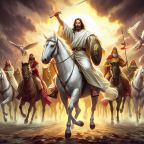 When Jesus returns to the earth after the time of the seven year Tribulation, He will establish His kingdom on earth.
 As Christians, when we think of salvation, it most often pertains to our spiritual deliverance from the lake of fire, which is the place of eternal suffering for those who reject Christ as Savior. John tells us, “if anyone’s name was not found written in the book of life, he was thrown into the lake of fire” (Rev 20:15). Spiritual salvation is the most important kind of salvation mentioned in the Bible, for it matters little if one is rescued a thousand times from physical danger, but ultimately fails to receive deliverance from the danger of hell. God loves everyone and is “not wishing for any to perish but for all to come to repentance” (2 Pet 3:9). And He has made a way for lost sinners to be saved from hell and brought to heaven, and this through His Son, Jesus, for “there is salvation in no one else; for there is no other name under heaven that has been given among men by which we must be saved” (Acts 4:12).
 Once, when I was working in jail ministry, I met a Christian man who told me about his older brother’s death. The incident, he said, had occurred several years earlier. He and his brother were drinking and arguing one afternoon when a fist fight erupted and the older brother fell backwards onto a metal pipe that pierced his heart. The man did all he could to save his brother, but the wound was fatal. His brother, whom he loved, was suddenly gone, and for years he carried the image of his brother’s lifeless body, held in his blood-soaked hands. Tears rolled down his face as he recalled the event. Over time he was able to resolve some of his grief, but while talking with me, he expressed a lingering concern about his brother’s eternal destiny. He was not sure if his brother would spend eternity in heaven or hell. Though his brother claimed to be a Christian, and family and friends spoke well of him at the funeral, the reality was that his brother’s life never reflected the virtues of Christ. Though I could not offer any assurance about his brother’s eternal destiny, I encouraged him to live his life in such a way that when he died, he would not leave his loved ones with any question about the place of Christ in his own life.
 All persons born into this world are physically alive, but spiritually dead, separated from God, because of Adam’s sin. The Bible reveals, “through one man sin entered into the world, and death through sin, and so death spread to all men, because all sinned [when Adam sinned]” (Rom 5:12), and “in Adam all die, so also in Christ all will be made alive” (1 Cor 15:22). Though we are all dead in Adam, God offers new life when we turn to Christ as Savior, reconciling us to Himself through the death of His Son (Rom 5:1-2). Adam’s sin brought death, and Christ’s death brings life. In Adam I am guilty, in Christ I am righteous. For the Christian, death is not the final victor in eternity. Every person, whether saved or unsaved, will receive a resurrection body that will live forever. Believers will enjoy eternal union with God, but unbelievers will suffer eternal separation from Him. Only those who are born again—by the Spirit of God—have eternal life and will spend forever in heaven (1 Pet 1:3, 23). Eternal life is received by grace alone, through faith alone, in Christ alone (John 3:16; 14:6; Acts 4:12; Gal 2:16; Eph 2:8-9; Tit 3:5). It’s a free gift from God, paid in full by the Lord Jesus (John 19:30), who died for us on the cross and paid the penalty for all our sins, so that we don’t have to pay for them ourselves.