Controversial Passages in First John

First John makes a consistent distinction between position and fellowship, eternal life and temporal life quality. John is not testing who is saved; he is diagnosing spiritual health among those already saved (1 John 5:13). His purpose is pastoral and corrective, calling believers to walk in the light so that their experience aligns with their secure standing in Christ (1 John 1:6–7). Below is a catalogue of the major controversial texts in First John, with explanations that remain internally consistent and exegetically defensible.

  1. Walking in the Light vs. Walking in Darkness (1 John 1:6–7). “Walking” (peripateō) refers to conduct and life direction, not entrance into salvation. Light is the sphere of God’s will, truth, and fellowship. Constable notes, “Walking in the light means walking in the sphere that the light of God’s will prescribes. Here light does not mean God Himself, as in 1 John 1:5, but the sphere in which God lives and operates.”[1] Darkness is the sphere of carnality, error, and self-rule. A believer can walk in darkness without forfeiting eternal life (cf. John 10:28; 1 Cor. 3:1–3). What is affected is fellowship, joy, and experiential cleansing, not justification, which is already settled (cf. John 15:4; Eph. 5:8; Gal. 5:16; 1 John 1:9).
  2. “If we say we have no sin” (1 John 1:8). John includes himself (“we”), showing this refers to believers, not unbelievers (cf. 1 John 1:10). The denial is experiential and doctrinal self-deception, specifically a refusal to acknowledge the continuing presence of the sin nature (Rom. 7:18, 21–23; Gal. 5:17; 1 Pet. 2:11). The issue is arrogance and rejection of biblical anthropology, which blocks fellowship and growth (Eccl. 7:20; 1 Kings 8:46; Prov. 20:9; Ps. 143:2; Jam. 3:2). This verse refutes perfectionism.
  3. “If we say that we have not sinned” (1 John 1:10). This refers to the denial of personal acts of sin, not the absence of salvation. John again includes believers (“we”). To deny one’s personal sins is to contradict God’s truthful assessment, which John describes as “making Him a liar.” Personal sin does not result in loss of eternal life but broken fellowship and doctrinal malfunction. The phrase “His word is not in us” means God’s Word is not operating or governing the believer’s thinking and conduct. Confession restores fellowship; denial entrenches carnality (cf. 1 John 1:9).
  4. “If anyone sins, we have an Advocate with the Father” (1 John 2:1b). This assumes believers will sin (Eccl. 7:20; Jam. 3:2; 1 John 1:8), not that they must sin (cf. Rom. 6:12–14; Gal. 5:16).[2] Radmacher notes, “According to Greek grammar, the if before anyone sins carries the added sense of ‘and it is assumed that we all do.’ This statement is not an encouragement to sin but a warning to all Christians to be on guard against sinful tendencies.”[3] Advocacy is for believers only, since it presupposes an existing family relationship with God as “the Father” (cf. John 1:12; Rom. 8:15–16; Gal. 4:6). Salvation was settled once for all at the moment of faith in Christ (Rom. 3:28; 5:1) and is not overturned by post-salvation failure (John 3:16; 10:28; 1 Cor. 1:30). 1 John 2:1 teaches that when a believer sins, Jesus Christ speaks on his behalf before the Father, maintaining fellowship on the basis of His finished work, not because the believer remains sinless.
  5. “Whoever keeps His word, in him the love of God has been perfected” (1 John 2:5). In this verse, the phrase “the love of God” (hē agapē tou Theou) is best understood as an objective genitive, referring to the believer’s love directed toward God, not God’s love toward the believer. This love reaches maturity through obedience (cf. John 14:21; 1 John 2:3). The verse teaches that obedience to God’s Word brings the believer’s love for God to maturity in experience as he walks by faith. The issue is spiritual growth and fellowship, not the believer’s eternal standing before God.
  6. “The one who says he abides in Him ought himself to walk” (1 John 2:6). Abiding (menō) means “to continue in an activity or state…to remain in, to keep on.”[4] This is fellowship language, referring to remaining in active, experiential dependence on Christ. It describes the believer’s moment-by-moment walk, not a fixed positional status. This usage is consistent throughout the New Testament, where believers are exhorted to abide, showing that it is not automatic but maintained through obedience and adherence to truth (John 15:4–10; 1 John 2:24; 3:24). All believers are “in Christ,” but not all abide.
  7. Loving the World (1 John 2:15–17). Believers are warned not to love the world. This presupposes the capacity of regenerate people to do so. Loving the world does not mean proof or loss of salvation, but loss of intimacy with the Father and loss of eternal reward (cf. 1 Cor. 3:12–15).
  8. “They went out from us” (1 John 2:19), where “us” most naturally refers to the apostolic circle and its authoritative witness rather than to the church at large. Hodges notes, “The special deceptiveness of the ‘many antichrists’ was that they had once been part of the same fellowship to which the apostles themselves belonged: they went out from us. No other meaning than this one is really suitable in this context.”[5] The false teachers had once aligned themselves with apostolic instruction but later departed when their doctrine deviated, exposing that they never truly shared the apostles’ teaching. John’s concern is not to establish perseverance as a test of salvation, but to explain the rise of antichrists who abandoned apostolic truth, making the issue fidelity to revealed doctrine rather than the loss or proof of eternal life.
  9. “Everyone who practices righteousness is born of Him” (1 John 2:29) describes the observable outworking of God’s life in the believer, not a test for determining who is saved. John uses present practice to show how divine influence expresses itself in conduct. Constable notes, “Practicing righteousness is normal, but not inevitable, for one who is truly born of God. Such behavior identifies one as a Christian. However, not everyone who practices righteous behavior is a Christian, because non-Christians can behave righteously, and Christians can walk in darkness. Therefore, we should not judge a person’s salvation by his or her behavior.”[6]
  10. “No one who abides in Him sins” (1 John 3:6) is durative, describing what is true while a believer is actively abiding in Christ. It does not teach sinless perfection, but that fellowship with Christ precludes sin at that moment; when fellowship is broken, sin resumes. This aligns with the command to “abide in Me” (John 15:4–6) and the promise that walking by the Spirit prevents the fulfillment of the flesh (Gal. 5:16).
  11. “No one who is born of God practices sin” (1 John 3:9). John is speaking of the new nature, not the whole person. The one “born of God” possesses God’s seed, the imparted life of regeneration, and that life cannot sin because sin never originates from the new nature. Sin arises from the flesh, which remains present in the believer until glorification, as Paul plainly states, “nothing good dwells in me, that is, in my flesh” (Rom. 7:18), and as John himself affirms, “If we say that we have no sin, we are deceiving ourselves” (1 John 1:8). John is not denying that believers commit sins; he is explaining that sin is inconsistent with the believer’s new nature in Christ. According to Constable, “The Christian becomes a partaker of God’s divine sinless nature when he or she experiences the new birth. The Christian sins because he also has a sinful human nature. However, in this verse, John was looking only at the sinless nature of the indwelling Christ that we possess.”[7]
  12. “By this the children of God and the children of the devil are obvious” (1 John 3:10). “Obvious” (phaneros) means “being evident so as to be readily known, visible, clear, plainly to be seen.”[8] It refers to observable conduct, not eternal destiny. John is contrasting patterns of influence, not redefining sonship. Baily notes, “Christians who are abiding in God will produce good works, and others can identify them as Christians by their godly behavior.”[9] A believer can act under satanic influence without becoming a child of the devil (cf. Matt. 16:23).
  13. “We know that we have passed out of death into life, because we love the brethren” (1 John 3:14). This is experiential death and life. John is speaking of vitality and fellowship, not justification. Love evidences spiritual health, not eternal security. Hodges notes, “It is a claim to a certain quality of experience. The apostles are able to recognize their experience of love as an experience of life rather than death.”[10]
  14. “No murderer has eternal life abiding in him” (1 John 3:15) means that a believer who lives in hatred is not experiencing the life he already possesses. John is not denying salvation, but the present enjoyment and expression of eternal life, just as Christ’s abiding presence is tied to fellowship (John 15:4). This is evident in believers such as David (2 Sam. 11:14–17; Ps. 32:1–5), Moses (Ex. 2:11–12; Matt. 17:3), and Paul (Acts 7:58; 8:1; 22:4), who committed murder yet remained saved. The issue is broken fellowship, not lost salvation.
  15. “Everyone who loves is born of God” (1 John 4:7). This verse teaches that love originates from God and is expressed when believers walk in fellowship with Him. John does not claim that all who are born of God will necessarily persevere in love, nor that the absence of love proves one was never saved. Love marks spiritual maturity and active fellowship, not the certainty or permanence of one’s walk, thereby undercutting the claim that perseverance in godliness is the necessary proof of regeneration.
  16. “Whoever does not love does not know God” (1 John 4:8). This continues the same line of thought as verse 7 by addressing experience, not entrance into salvation. The verb ginōskō points to personal, relational knowledge based on obedience, so a believer who fails to love is not enjoying intimate fellowship with God, even though his position as God’s child remains secure. John is describing the loss of experiential knowledge of God, not the absence of regeneration.
  17. “Perfect love casts out fear” (1 John 4:18). Fear is associated with divine discipline and accountability, not eternal condemnation. Mature love stabilizes the believer in fellowship and confidence. Hodges states, “The matured experience of God’s love is incompatible with fear and expels fear from the heart.”[11]
  18. “Whatever is born of God overcomes the world” (1 John 5:4). This verse teaches that victory belongs to every believer from the moment of faith in Christ. It does not promise a life of uninterrupted success over sin and the world. Overcoming is grounded in faith, which must continue to be exercised (cf. Rom. 8:37; 1 John 5:5). Scripture also makes clear that believers can live inconsistently with that victory when they set their minds on the flesh rather than on the things of the Spirit or drift into unbelief (cf. 1 Cor. 3:1–3; Heb. 3:12). Constable states, “Every Christian has overcome the world by his or her initial faith in Jesus Christ…To continue to overcome the world, the flesh, and the devil, all we need to do is continue to exercise faith in God (cf. Rom. 8:37; 1 Cor. 15:57).”[12]
  19. “The one who does not have the Son does not have the life” (1 John 5:12). John speaks positionally. Eternal life is secured solely by possessing the Son through faith, not by obedience, love, or perseverance (John 3:16; 5:24; 6:47; Rom. 3:28; 5:1; Eph. 2:8–9).
  20. Sin Leading to Death (1 John 5:16–17). John warns of extreme divine discipline for believers who persist in willful rebellion, which can culminate in physical death. This does not involve loss of salvation but removal from earthly life, as seen in the Corinthians who died under discipline (1 Cor. 11:30–32) and in Ananias and Sapphira (Acts 5:1–11).
  21. “We know that no one who is born of God sins” (1 John 5:18). This restates the principle of 1 John 3:9 and refers to the regenerate nature, which does not practice sin or live under its dominion (1 John 3:6, 9; Rom. 6:6–11). John does not deny acts of sin in the believer’s life (1 John 1:8–10; 2:1), but affirms God’s protecting work so that the evil one does not rule the believer who lives in dependence on Him (John 10:28–29; Jam. 4:7).


In summary, First John is not a salvation test. It is a fellowship manual. The epistle answers this question: How does eternal life function in daily experience? Eternal life is free and irrevocable. Fellowship is conditional, dynamic, and dependent on walking in truth.

Steven R. Cook, D.Min., M.Div.

If this article has enriched your understanding and walk with Christ, and you feel led to support my ministry, your generosity is greatly appreciated. Your gifts enable me to continue sharing the gospel of grace and providing in-depth biblical teachings. Thank you for partnering with me in this mission.

Related Articles:

[1] Tom Constable, Tom Constable’s Expository Notes on the Bible (Galaxie Software, 2003), 1 John 1:7.

[2] The “if” in 1 John 2:1 is a first-class condition, assuming the reality of the case: believers do sin. John’s point is not uncertainty or threat, but assurance that when sin occurs, Christ’s advocacy with the Father is already in place.

[3] Earl D. Radmacher, et al, The Nelson Study Bible: New King James Version (Nashville: T. Nelson Publishers, 1997), 1 John 2:1.

[4] Johannes P. Louw and Eugene Albert Nida, Greek-English Lexicon of the New Testament: Based on Semantic Domains (New York: United Bible Societies, 1996), 655.

[5] Zane C. Hodges, The Epistle of John: Walking in the Light of God’s Love (Irving, TX: Grace Evangelical Society, 1999), 108.

[6] Tom Constable, Tom Constable’s Expository Notes on the Bible, 1 John 2:29.

[7] Ibid., 1 John 3:9.

[8] William Arndt et al., A Greek-English Lexicon of the New Testament and Other Early Christian Literature (Chicago: University of Chicago Press, 2000), 1047.

[9] Mark Bailey et al., Nelson’s New Testament Survey: Discover the Background, Theology and Meaning of Every Book in the New Testament (Nashville: Word, 1999), 587.

[10] Zane C. Hodges, The Epistle of John, 156.

[11] Zane C. Hodges, “1 John,” in The Bible Knowledge Commentary: An Exposition of the Scriptures, ed. J. F. Walvoord and R. B. Zuck, vol. 2 (Wheaton, IL: Victor Books, 1985), 900.

[12] Tom Constable, Tom Constable’s Expository Notes on the Bible, 1 John 5:4.

When We Do Not Understand Scripture

To be honest, there is much in the Bible I do not fully understand, and even truths I once thought I had firmly grasped are sometimes clarified or refined with further study. Yet I take comfort in knowing that there are others in Scripture who received divine revelation that they did not fully understand at the time.

Scripture records numerous occasions in which genuine believers received divine revelation yet did not fully understand its meaning. Revelation and comprehension are not identical. God may disclose truth, yet the human recipient must still grow in understanding. Daniel illustrates this clearly. After receiving visions about future kingdoms and the end time, he confessed his lack of understanding: “As for me, Daniel, my spirit was distressed within me, and the visions in my mind kept alarming me” (Dan. 7:15). Later he admitted again, “I heard, but could not understand; so I said, ‘My lord, what will be the outcome of these events?’” (Dan. 12:8). Gabriel did not give him understanding, but said, “Go your way, Daniel, for these words are concealed and sealed up until the end time” (Dan. 12:9). Wiersbe states, “Daniel did what all of us must do: he humbly asked God for the wisdom that he needed. But He may not tell us! (Deut. 29:29) He knows how much we need to know and how much we can take (John 16:12).”[1]

The prophets sometimes wrote beyond their own understanding. Peter explains that they searched to understand the very prophecies they delivered: “As to this salvation, the prophets who prophesied of the grace that would come to you made careful searches and inquiries, seeking to know what person or time the Spirit of Christ within them was indicating as He predicted the sufferings of Christ and the glories to follow” (1 Pet. 1:10–11). They possessed revelation but sought fuller comprehension. According to Fruchtenbaum, “Peter points out that although the Holy Spirit indwelled the prophets, their knowledge was nevertheless still limited.”[2] MacDonald adds, “God’s ancient spokesmen prophesied the undeserved favor which we would receive. But they did not fully understand what they were writing (see Dan. 12:8).”[3]

The apostles occasionally misunderstood the Lord during His earthly ministry. After Jesus predicted His death and resurrection, Luke records, “But they did not understand this statement, and it was concealed from them so that they would not perceive it; and they were afraid to ask Him about this statement” (Luke 9:45). Even clearer is Luke’s statement after another prediction: “But the disciples understood none of these things, and the meaning of this statement was hidden from them” (Luke 18:34). Their understanding came later, after the resurrection and the illuminating work of the Spirit. Radmacher states, “The disciples did not understand the implications of Jesus’ suffering and death until it was explained to them in detail after Jesus was raised from the dead (Luke 24:25, 26, 44–47).”[4]

Peter acknowledged difficulty understanding some of Paul’s writings. Referring to Paul’s epistles, he wrote, “in which are some things hard to understand” (2 Pet. 3:16). Peter did not question their authority. He simply admitted that some portions were difficult. I find this somewhat ironic, since I find some of Peter’s writings difficult as well. Barbieri states, “Some of Paul’s writings were hard to understand (2 Pet. 3:16), a sentiment shared by every NT student and scholar today.”[5]

John the Baptist experienced uncertainty regarding the unfolding of the messianic program. From prison he sent messengers to ask Jesus, “Are You the Expected One, or shall we look for someone else?” (Matt. 11:3). His question arose because the expected messianic kingdom had not yet appeared. Because of his imprisonment, John experienced a temporary lapse of clarity and began to question his understanding of the Messiah and His kingdom. MacDonald states, “Like many great men of God, John suffered a temporary lapse of faith.”[6]

John 21:23 fits within this pattern of misunderstood revelation. After Jesus spoke privately to Peter about his future, He made a conditional statement concerning John: “If I want him to remain until I come, what is that to you?” (John 21:22). The statement was not a prediction but a hypothetical contrast designed to redirect Peter’s focus. However, the early believers drew an incorrect conclusion: “Therefore this saying went out among the brethren that that disciple would not die; yet Jesus did not say to him that he would not die, but only, ‘If I want him to remain until I come, what is that to you?’” (John 21:23). This passage shows how easily divine words can be misinterpreted when listeners supply assumptions not stated in the text. According to Blum, “The false rumor about Jesus’ words to Peter show the possibility of misunderstanding God’s promises. Christians must seek to understand God’s Word accurately.”[7]

Even after Christ’s resurrection, the disciples still misunderstood aspects of God’s plan for Israel and the kingdom. Just before the ascension they asked, “Lord, is it at this time You are restoring the kingdom to Israel?” (Acts 1:6). They had correct expectation about the kingdom but lacked clarity concerning the timing. Their question reveals that while they rightly anticipated a literal restoration, they had not yet distinguished between the present age and the future fulfillment of God’s kingdom program.

These passages demonstrate an important doctrinal principle. Revelation is perfect because it originates with God, but human understanding grows progressively. Spiritual perception increases as God discloses truth and as believers mature in it. Proverbs summarizes the process: “The path of the righteous is like the light of dawn, that shines brighter and brighter until the full day” (Prov. 4:18). Therefore, the believer presses on in the study of God’s Word, even when understanding is incomplete. Growth comes through repeated exposure to Scripture, humility before the text, and dependence on the illuminating ministry of the Spirit (John 16:13). We advance line upon line, precept upon precept (Isa. 28:10), trusting that God will give insight in His time (2 Tim. 2:7). The challenge of Scripture is not a barrier but an invitation to deeper fellowship with the Lord, for “the unfolding of Your words gives light; it gives understanding to the simple” (Ps. 119:130).

Steven R. Cook, D.Min., M.Div.

If this article has enriched your understanding and walk with Christ, and you feel led to support my ministry, your generosity is greatly appreciated. Your gifts enable me to continue sharing the gospel of grace and providing in-depth biblical teachings. Thank you for partnering with me in this mission.

Related Articles:


[1] Warren W. Wiersbe, Be Resolute, “Be” Commentary Series (Colorado Springs, CO: Victor, 2000), 147.

[2] Arnold G. Fruchtenbaum, The Messianic Jewish Epistles: Hebrews, James, First Peter, Second Peter, Jude, 1st ed. (Tustin, CA: Ariel Ministries, 2005), 329.

[3] William MacDonald, Believer’s Bible Commentary: Old and New Testaments, ed. Arthur Farstad (Nashville: Thomas Nelson, 1995), 2253.

[4] Earl D. Radmacher, Ronald Barclay Allen, and H. Wayne House, Nelson’s New Illustrated Bible Commentary (Nashville: T. Nelson Publishers, 1999), 1290.

[5] Louis A. Barbieri, “2 Peter,” in The Moody Bible Commentary, ed. Michael A. Rydelnik and Michael Vanlaningham (Chicago, IL: Moody Publishers, 2014), 1972.

[6] William MacDonald, Believer’s Bible Commentary, 1243.

[7] Edwin A. Blum, “John,” in The Bible Knowledge Commentary: An Exposition of the Scriptures, ed. J. F. Walvoord and R. B. Zuck, vol. 2 (Wheaton, IL: Victor Books, 1985), 346.

The Sufficiency of Scripture

The doctrine of the sufficiency of Scripture affirms that the written Word of God is entirely adequate for all matters of faith and practice, providing the divine information necessary for salvation (2 Tim 3:15; John 3:16), spiritual growth (1 Pet 2:2), and righteous living (2 Tim 3:16-17; 2 Pet 1:3). Paul wrote, “all Scripture is inspired by God and profitable for teaching, for reproof, for correction, for training in righteousness, so that the man of God may be adequate, equipped for every good work” (2 Tim 3:16-17). To say that all Scripture is inspired by God affirms its divine origin and authority. It is profitable for teaching truth, exposing error, correcting wrong, and training in righteousness (2 Tim 3:16), with the goal of making the child of God spiritually competent, fully equipped for every good work that honors the Lord (2 Tim 3:17). No other source of revelation is needed to meet the believer’s spiritual needs, for God has already disclosed His will sufficiently in the sixty-six canonical books. This sufficiency does not imply that Scripture answers every curiosity of human inquiry, but rather that it provides the full counsel of God necessary for knowing Him, serving Him, and walking faithfully in the world. Robert Saucy states, “the Bible contains all truth that is necessary for salvation and the spiritual life.”[1] Geisler adds, “The Bible is sufficient for faith and practice; nothing more is needed; the spiritual guide to life needs no new chapters. The Author inspired a complete manual from the beginning and has preserved all of it, intact.”[2]

The sufficiency of Scripture is grounded in its divine origin. Because it proceeds from the God who is true and unchanging (Num 23:19; Psa 119:89), the Bible bears an authority and completeness that no human tradition, philosophy, or experience can rival. Peter affirms that God’s “divine power has granted to us everything pertaining to life and godliness” through the knowledge of Him (2 Pet 1:3). This comprehensive provision comes through God’s directives and promises in His Word, which secure the believer’s participation in His divine purposes. In contrast, reliance upon extra-biblical traditions, mystical impressions, or emotions, introduces subjectivity and undermines confidence in the written Word. When Jesus resisted Satan’s temptations in the wilderness, He consistently appealed to what “is written” (Matt 4:4, 7, 10), demonstrating that Scripture alone was sufficient to meet the assaults of the adversary.

The practical implications of this doctrine are weighty. Scripture is not only sufficient for salvation but also for sanctification, as it renews the mind and transforms conduct. Believers are commanded, “Like newborn babies, long for the pure milk of the word, so that by it you may grow in respect to salvation” (1 Pet 2:2). According to Radmacher, “The purpose of studying God’s truth is not only to learn more, but to become mature in the faith.”[3] Growth in grace is fueled by the steady intake and application of Scripture. Jesus Himself prayed for His disciples, saying, “Sanctify them in the truth; Your word is truth” (John 17:17). The Word is sufficient to set believers apart unto God, shaping both their thinking and their living. Tenney notes, “Since the Word of God is truth, it provides the unchanging standard for the course and character of life.”[4] Whenever churches or individuals supplement the Word with pragmatic schemes, mystical experiences, emotional theatrics, or human philosophies, they tacitly deny its sufficiency. Instead, the proper posture is one of humble submission, recognizing that Scripture alone supplies the wisdom that leads to salvation and equips believers for faithful service. MacDonald states, “The Holy Scriptures are spoken of as being continually able to make men wise for salvation. This means, first of all, that men learn the way of salvation through the Bible.”[5] Of course, Scripture points us to Jesus as our Savior, for “these have been written so that you may believe that Jesus is the Christ, the Son of God; and that believing you may have life in His name” (John 20:31).

A Good Hermeneutical Approach

For the growing Christian, Bible study demands a consistent approach that honors both the divine inspiration and the human authorship of Scripture. The literal-grammatical-historical method of interpretation provides the proper framework, recognizing that God communicated in real languages, through real authors, to real audiences situated in real historical contexts. By taking words in their ordinary sense, attending to grammar, and situating passages within their historical setting, this interpretive approach safeguards against subjective readings that obscure the author’s intended meaning. Jesus and the apostles modeled this method, treating the Old Testament as a reliable record whose very words carried precise significance (Matt 22:31-32; Gal 3:16). According to Ryrie, “It might also be designated plain interpretation so that no one receives the mistaken notion that the literal principle rules out figures of speech. Symbols, figures of speech, and types are all interpreted plainly in this method, and they are in no way contrary to literal interpretation.”[6] He further states, “If one does not use the plain, normal, or literal method of interpretation, all objectivity is lost.”[7] This hermeneutic, consistently applied, recognizes the sufficiency and clarity of Scripture by allowing the text to speak for itself rather than being reshaped by tradition, philosophy, or personal opinion. In this way, believers honor the God who chose to reveal Himself in human words and can rightly handle the Word of truth (2 Tim 2:15), ensuring that doctrine and practice remain tethered to the divine message as originally given.

Conclusion

In summary, the sufficiency of Scripture affirms that God’s Word is complete, authoritative, and adequate for every aspect of faith and practice. Because it proceeds from the God who is true, it remains the final standard against which all claims of truth must be measured. It alone provides the wisdom that leads to salvation, the nourishment that produces spiritual growth, and the guidance that equips believers for righteous living. As the psalmist declared, “The law of the LORD is perfect, restoring the soul” (Psa 19:7), and Peter confirmed that God has granted to us “everything pertaining to life and godliness” through His promises (2 Pet 1:3). The task of God’s people, therefore, is not to seek additional revelations or rely upon human philosophies but to humbly receive, carefully interpret, and faithfully apply the written Word. By doing so, the church stands firmly anchored in divine truth, equipped to glorify God until the day when His Word gives way to sight in the presence of Christ.

Steven R. Cook, D.Min., M.Div.

If this article has enriched your understanding and walk with Christ, and you feel led to support my ministry, your generosity is greatly appreciated. Your gifts enable me to continue sharing the gospel of grace and providing in-depth biblical teachings. Thank you for partnering with me in this mission.

Related Articles:

[1] Robert L. Saucy, “Scripture”, in Understanding Christian Theology (Nashville, TN: Thomas Nelson Publishers, 2003), 125.

[2] Norman L. Geisler, Systematic Theology, Volume One: Introduction, Bible (Minneapolis, MN: Bethany House Publishers, 2002), 539.

[3] Earl D. Radmacher, Nelson’s New Illustrated Bible Commentary (Nashville: T. Nelson Publishers, 1999), 1680.

[4] Merrill C. Tenney, “John,” in The Expositor’s Bible Commentary: John and Acts, ed. Frank E. Gaebelein, vol. 9 (Grand Rapids, MI: Zondervan Publishing House, 1981), 165.

[5] William MacDonald, Believer’s Bible Commentary: Old and New Testaments, ed. Arthur Farstad (Nashville: Thomas Nelson, 1995), 2123.

[6] Charles Caldwell Ryrie, Dispensationalism, Rev. and expanded. (Chicago: Moody Publishers, 1995), 91.

[7] Ibid., 92.

What Jesus Suffered in the Hours Prior to His Crucifixion

Jesus Before the SanhedrinJesus loved the Father (John 14:31) and submitted Himself to do the Father’s will (Matt 26:39-44; cf. Rom 5:19; Phil 2:5-8), which included enduring the illegal trials of His accusers, as well as the eventual mockings, beatings, and crucifixion. All that Jesus suffered was prophesied in Scripture (Gen 3:15; Psa 22:16-18; Isa 50:4-7; 52:14; 53:3-12; Matt 26:67-68; Mark 10:32-34). God the Father was in complete control of the circumstances surrounding the trials and crucifixion of Jesus (Acts 2:23; 4:27-28). Though unjustly attacked, Jesus knew He was doing the Father’s will (John 6:38; 10:14-18; 12:27; 18:11) and did not retaliate against His attackers. Peter wrote, “while being reviled, He did not revile in return; while suffering, He uttered no threats, but kept entrusting Himself to Him who judges righteously” (1 Pet 2:23).

The four Gospels record the arrest, trials, mocking, crucifixion, death, burial and resurrection of Jesus. Matthew, Mark and Luke refer to events taking place according to Jewish time in which the day ends at sunset; whereas John relies on Gentile time in which the day ends at midnight. A brief chronology of Jesus’ trials, mockings, beatings, crucifixion and burial is as follows:

  1. Jesus was arrested during the night—perhaps around midnight—and faced six illegal trials, three religious and three civil.[1] The trials must have happened relatively early, as they concluded “about six in the morning” (John 19:14 CSB).[2]
  2. During the religious trials, the chief priest and Sanhedrin tried to secure false testimony about Jesus so they might have grounds to crucify Him (Matt 26:59).
  3. Jesus was beaten in the face and mocked during His Jewish trial (Matt 26:67-68).
  4. After Pilate agreed to the demands of the mob (Matt 27:17-25), he had Jesus scourged (Matt 27:26a), and then “handed Him over to be crucified” (Matt 27:26b).
  5. Jesus was mocked and beaten by Roman soldiers (Matt 27:27-30), and then was led away to be crucified (Matt 27:31).
  6. Jesus was crucified by 9:00 AM (Mark 15:25).
  7. Jesus was judged by the Father and bore our sins on the cross from 12:00 to 3:00 PM (Matt 27:45; Mark 15:33; Luke 23:44).
  8. Jesus died about 3:00 PM (Matt 27:46-50; Mark 15:34-37).
  9. Jesus’ body was placed in the grave before 6:00 PM (i.e. sunset) because the Jews did not want His body on the cross for the Sabbath (John 19:31, 38-42).[3]

The Jewish trials declared Jesus guilty, whereas the Gentile trials found Him innocent. Jesus was crucified by Gentiles because of the pressure of the Jewish leadership. The crucifixion of Jesus was physically horrendous and involved not only great physical pain, but also psychological anguish and social humiliation. According to William Hendriksen, crucifixion included “severe inflammation, the swelling of the wounds in the region of the nails, unbearable pain from torn tendons, fearful discomfort from the strained position of the body, throbbing headache, and burning thirst (John 19:28).”[4]

Dr. Steven R. Cook

Related Articles:

[1] Jesus’ religious trials: 1) Annas (John 18:12-24), 2) Caiaphas (Matt 26:57-66), and 3) the Sanhedrin (Matt 27:1-2). Jesus’ civil trials: 1) Pilate (John 18:28-40), 2) Herod Antipas (Luke 23:6-12), and 3) Pilate (Luke 23:11; John 19:1-16).

[2] This CSB assumes John calculates events using Roman time (where the day begins after midnight) rather than Jewish time (where the day starts at sunrise). The ESV and NAU translate the Greek literally, “about the sixth hour,” whereas the NET and NIV translate it, “about noon.” If the sixth hour is calculated by Roman time, then it would be about 6:00 AM, and if calculated by Jewish time, it would be about 12:00 PM. This author favors the CSB translation.

[3] After His death, Jesus was resurrected on the third day and appeared to numerous persons over a period of forty days (Matt 28:1-10; John 20:10-29; 1 Cor 15:5-7). Afterwards, Jesus ascended bodily into heaven (Acts 1:9-12). It is recorded that God the Father “raised Him from the dead and seated Him at His right hand in the heavenly places” (Eph 1:20).

[4] William Hendriksen and Simon J. Kistemaker, Exposition of the Gospel According to John, vol. 2, New Testament Commentary (Grand Rapids: Baker Book House, 1953–2001), 427.

The Suffering of Jesus Christ

Jesus' Sorrow as He Faces the CrossWhen God the Son added perfect humanity to Himself, this enabled Him to experience suffering and death with, and on behalf of, humanity. The suffering of Christ may be viewed in at least two ways: 1) His suffering during His time on earth prior to the cross, and 2) the suffering of the cross. As the God-Man, Jesus was perfectly holy in all His thoughts, words, and actions. Such perfect holiness brought with it a special form of suffering in this world that the rest of us could never know, since we are capable of yielding to the pressures of sinful temptation. When the time of His death was nearing, Jesus told His disciples “that He must go to Jerusalem, and suffer many things from the elders and chief priests and scribes, and be killed, and be raised up on the third day” (Matt 16:21; cf., Mark 8:31; Luke 9:22). It’s noteworthy that Jesus said His suffering, dying, and resurrection were things that “must” happen to Him. The use of the Greek verb dei (δεῖ) here denotes divine necessity, which meant it was the will of God the Father that these things happen to Christ. Thomas Constable notes, “Jesus said that it was necessary (Gr. dei) for Him to go to Jerusalem. He had to do this because it was God’s will for Messiah to suffer, die, and rise from the dead. He had to do these things to fulfill prophecy (Isa 53; cf. Acts 2:22–36).”[1] The absolute necessity of Jesus’ death on the cross further emphasizes our helplessness to save ourselves, for if our salvation could have been secured by any other means, then the death of Christ would have been unnecessary.

While in the Garden of Gethsemane, Jesus prayed to God the Father, saying, “My Father, if it is possible, let this cup pass from Me; yet not as I will, but as You will” (Matt 26:39). In His humanity, Jesus struggled to face the cross, understanding the scope of what it meant and the agony associated with it. Jesus prayed a second time, saying, “My Father, if this cannot pass away unless I drink it, Your will be done” (Matt 26:42). The reference to the “cup” speaks of the suffering of the cross. John A. Witmer states, “In the Old Testament a ‘cup’ sometimes symbolized wrath (Jer 25:15), and so Jesus was aware that His coming death meant He would bear the wrath of God the Father against sin. Though Christ had no sin (2 Cor 5:21), He bore the sins of the world on Himself (1 Pet 2:24). Thus He was made ‘a curse for us’ because of His being hanged on a tree (Gal 3:13).”[2]

While on the cross, Jesus cried out, “My God, My God, why have You forsaken Me?” (Matt 27:46). This was the cry of Jesus from His humanity. Peter tells us that Jesus “Himself bore our sins in His body on the cross” (1 Pet 2:24). Peter’s reference to Jesus’ “body” indicates humanity, not deity. Sin cannot be imputed to deity. Humanity can bear sin. It was while Jesus was on the cross that He bore the wrath of the Father as He died in our place and bore the punishment that rightfully belongs to us. And the Spirit sustained Jesus’ humanity while He bore our sins. Robert G. Gromacki states, “God the Son incarnate suffered and died. The Father did not suffer and die. Nor did the Holy Spirit suffer and die, even though He filled Christ when the Savior suffered and died.”[3] The suffering and death of Jesus on the cross was salvific, as Jesus was made “sin on our behalf” (2 Cor 5:21). Mark wrote, “When the sixth hour came, darkness fell over the whole land until the ninth hour. At the ninth hour Jesus cried out with a loud voice, ‘Eloi, Eloi, lama sabachthani?’ which is translated, ‘My God, My God, why have You forsaken Me?’” (Mark 15:33-34; cf., Matt 27:45-46; Luke 23:44-46). Concerning this moment on the cross, Witmer states, “It was at this point, as Jesus bore the sin of the world, that God, the Judge of sin, turned away from Jesus Christ, His incarnate Son, the Sin-bearer, as far as the personal consciousness of Jesus was concerned.”[4] But there is some mystery at work here, for God the Father could not forsake God the Son, as a separation within the Trinity is not possible. Yet, somehow, the humanity of Christ—not His deity—was forsaken at the time of the judgment on the cross, otherwise the words of Jesus would be meaningless. But Jesus’ suffering and death did happen, and it was His time on the cross that brought about our salvation; a salvation that is applied to us at the moment we trust in Christ as our Savior.

Even after Jesus’ resurrection, Jesus said to the two disciples on the road to Emmaus, “Was it not necessary for the Christ to suffer these things and to enter into His glory?” (Luke 24:26). In the book of Acts, Luke records that Jesus “presented Himself alive after His suffering” (Acts 1:3). Peter said, “the things which God announced beforehand by the mouth of all the prophets, that His Christ would suffer, He has thus fulfilled” (Acts 3:18). And Paul reasoned “from the Scriptures, explaining and giving evidence that the Christ had to suffer and rise again from the dead” (Acts 17:2b-3; cf., Acts 26:23). Jesus’ suffering and death were necessary for salvation to be available to humanity.

Dr. Steven R. Cook

Related Articles:

[1] Tom Constable, Tom Constable’s Expository Notes on the Bible (Galaxie Software, 2003), Mt 16:21.

[2] John A. Witmer, “Jesus Christ”, Understanding Christian Theology (Nashville, TN: Thomas Nelson Publishers, 2003), 352.

[3] Robert G. Gromacki, “The Holy Spirit”, Understanding Christian Theology (Nashville, TN: Thomas Nelson Publishers, 2003), 468–469.

[4] John A. Witmer, “Jesus Christ”, Understanding Christian Theology, 352.

The Spirit’s Convicting Ministry to the World

Holy Spirit as a DoveThere is a special work that God the Holy Spirit is doing in the hearts of unbelievers to help prepare them to turn to Christ as Savior.[1] Concerning this special work, Jesus said, “And He, when He comes, will convict the world concerning sin and righteousness and judgment” (John 16:8). Jesus’ statement about the Holy Spirit is in the future tense (He will convict), which implies the Spirit’s special ministry was not active at the time Jesus uttered His statement. This special convicting ministry would be inaugurated on the day of Pentecost. The word convict translates the Greek word elegcho (ἐλέγχω), which means, “to bring a person to the point of recognizing wrongdoing, convict, [or] convince someone of something.”[2] Jesus said the Spirit’s convincing work would fall into three areas: 1) “concerning sin, because they do not believe in Me” (John 16:9), 2) “concerning righteousness, because I go to the Father and you no longer see Me” (John 16:10), and 3) “concerning judgment, because the ruler of this world has been judged” (John 16:11). Let’s look at these in order.

The Sin of Unbelief

The sin mentioned by Jesus in John 16:8 does not refer to a catalogue of sins one might be guilty of (i.e., lust, greed, worry, gossip, stealing, etc.), but rather, one specific sin, which is unbelief, as Jesus said, “because they do not believe in Me” (John 16:9). The word for sin is hamartia (ἁμαρτία), which in Jesus’ statement is a singular noun that refers to a specific crime; namely, unbelief. Sylva notes, “Here sin is unbelief. Jesus faces people with a decision for or against himself: by belief or unbelief a person decides either for life or for death (John 8:24; 9:41; 16:8–9).”[3] There is only one sin that keeps a person out of heaven, and that’s the sin of unbelief. Wiersbe states:

The Holy Spirit convicts the world of one particular sin, the sin of unbelief. The law of God and the conscience of man will convict the sinner of his sins (plural) specifically; but it is the work of the Spirit, through the witness of the believers, to expose the unbelief of the lost world. After all, it is unbelief that condemns the lost sinner (John 3:18–21), not the committing of individual sins. A person could “clean up his life” and quit his or her bad habits and still be lost and go to hell.[4]

The Spirit always performs His work perfectly in the hearts of the lost, but because people have volition, and their hearts are corrupt, the vast majority of people suppress His message (Matt 7:13-14; John 5:39-40; Rom 1:18-32). Only the Holy Spirit can reveal to the human heart the truth about Jesus, as well as the truth about their sin of unbelief. To suppress the Spirit’s work about Jesus as the Son of God and Savior is the greatest of sins possible, as well as the most fatal sin that forever condemns a person to hell. Robert Lightner states:

Apart from God the Father there would have been no plan of salvation. Without God the Son there would have been no provision for salvation. Apart from the work of God the Spirit there would be no application of this great salvation to man’s needs. It is the third member of the Godhead who procures salvation for all who believe.[5]

The Righteousness of Jesus

God alone sets the standard for righteousness, not people. Divine righteousness may be defined as the intrinsic, immutable, moral perfection of God, from which He commands all things, in heaven and earth, and declares as just that which conforms to His righteousness and as sinful that which deviates. Borchert is correct when he states, “Humanity is not in control either of the future or of setting the standards for life. That is the work of God.”[6] And Merrill C. Tenney states, “Apart from a standard of righteousness, there can be no sin; and there must be an awareness of the holiness of God before a person will realize his own deficiency.”[7] Though Jesus was rejected and treated as a criminal, God the Father declared Him righteous and welcomed Him to heaven, His natural home. Jesus is “the Holy and Righteous One” (Acts 3:14), and throughout His life “knew no sin” (2 Cor 5:21), was “without sin” (Heb 4:15), “committed no sin” (1 Pet 2:22), and in whom “there is no sin” (1 John 3:5). The rejection and crucifixion of Jesus was the greatest miscarriage of justice in the history of the human race. Jesus said those who rejected and crucified Him would “rejoice” (John 16:20), but as Borchert notes, “their rejoicing at being finished with Jesus turned out to be the rejoicing of the damned.”[8] William Hendriksen offers the following insights:

The world, represented by the Jews, was about to crucify Jesus. It was going to say, “He ought to die” (John 19:7); hence, in the name of righteousness it was going to put him to death. It proclaimed aloud that he was anything but righteous. It treated him as an evil-doer (John 18:30). But the exact opposite was the truth. Though rejected by the world, he was welcomed by the Father, welcomed home via the cross, the cross which led to the crown…By means of the resurrection the Father would place the stamp of His approval upon His life and work (Acts 2:22, 23, 33; Rom 1:4). He, the very One whom the world had branded as unrighteous, would by means of His victorious going to the Father be marked as the Righteous One (8:46; Acts 3:14; 7:52; 2 Cor 5:21; 1 Pet 3:18; 1 John 2:1; and cf., Luke 23:47). Thus, the world would be convicted with respect to righteousness.[9]

Christians do not need to struggle to convince people about the perfect righteousness of Christ, nor of the sinner’s failed righteousness before a holy God. They need only to communicate the biblical truth about Christ and fallen humanity, and leave the Spirit to do what only He can do, to convince them of the truth about Christ as the only Savior of mankind. If unbelievers suppresses the work of the Holy Spirit in their hearts, then no amount of reasoning or argumentation on the part of Christians will advance the gospel even one inch.

The Judgment of the Ruler of this World

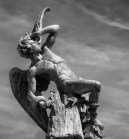
Fallen angelA third area where the Holy Spirit is working in the hearts of unbelievers concerns judgment, “because the ruler of this world has been judged” (John 16:11). Satan has been judged and found guilty before God. This means that Satan and his world-system is condemned. Being the ruler of this world, Satan naturally rules in the hearts of all unbelievers. Three times Jesus referred to Satan as “the ruler of this world” (John 12:31; 14:30; 16:11). Other passages of Scripture call Satan “the god of this world” (2 Cor 4:4), and “the prince of the power of the air” (Eph 2:2), informing us “that the whole world lies in the power of the evil one” (1 John 5:19). Satan rules as a tyrant who has “weakened the nations” (Isa 14:12), and currently “deceives the whole world” (Rev 12:9). Satan continues to attack God’s people today (1 Pet 5:8), practices deception (2 Cor 11:13-15), and has well developed strategies of warfare (Eph 6:10-12). Furthermore, humanity is living in an “evil age” (Gal 1:4), under “the dominion of Satan” (Acts 26:18), whose sphere of influence is called “the domain of darkness” (Col 1:13). But Satan has been judged and his punishment is pending execution. Furthermore, those who side with Satan in this life will be judged with him in eternity. According to Ryrie, “At the cross, Christ triumphed over Satan, serving notice on unbelievers of their judgment to come.”[10] Radmacher notes, “Satan was judged at the Cross, and the Holy Spirit would convince people of the judgment to come. Satan has been judged, so all who side with him will be judged with him. There is no room for neutrality. A person is either a child of God or a child of the devil.”[11] Merrill Tenney states:

To convince any unbeliever of sin, righteousness, and judgment is beyond human ability. It may be possible to fix upon him the guilt of some specific sin if there is sufficient evidence to bring him before a jury; but to make him acknowledge the deeper fact, that he is a sinner, evil at heart, and deserving of punishment because he has not believed in Christ, is quite another matter. To bring a man to some standard of ethics is not too difficult; for almost every person has ideals that coincide with the moral law at some point. To create in him the humiliating consciousness that his self-righteousness is as filthy rags in comparison with the spotless linen of the righteousness of God cannot be effected by ordinary persuasion. Many believe in a general law of retribution; but it is almost impossible to convince them that they already stand condemned. Only the power of the Holy Spirit, working from within, can bring about that profound conviction which leads to repentance. The Spirit anticipates and makes effective the ministry of the disciples in carrying the message to unbelievers.[12]

Satan has been judged and will spend eternity in the lake of fire. Those who reject Christ as Savior naturally default to an alliance with Satan, and these will spend eternity in the lake of fire with him, “the eternal fire which has been prepared for the devil and his angels” (Matt 25:41). The lake of fire is avoidable. If the lost simply trust in Christ as their Savior, they will have eternal life and spend eternity with God in heaven. However, if they reject Christ as Savior, then they will spend eternity in hell, for “if anyone’s name was not found written in the book of life, he was thrown into the lake of fire” (Rev 20:15).

Dr. Steven R. Cook

Related Articles:

[1] In the NT, God the Holy Spirit took on a new ministry after Jesus returned to heaven (John 16:7-15; cf., Acts 1:6-8; 2:1-4; 15:7-9). Part of His ministry is to believers, and part is to unbelievers. Concerning the Spirit’s ministry to believers, Jesus said, “I tell you the truth, it is to your advantage that I go away; for if I do not go away, the Helper will not come to you; but if I go, I will send Him to you” (John 16:7). The Helper is the Holy Spirit, whom Jesus will send (future tense of the Greek verb pempo) to believers. The Spirit’s work in Christians would be multifaceted and would relate to their sanctification and godly influence in a fallen world. After Pentecost (Acts 2), God the Holy Spirit would work in and through His church to other Christians, to help with their sanctification, and to unbelievers, to share the gospel of grace that they might be saved.

[2] William Arndt et al., A Greek-English Lexicon of the New Testament and Other Early Christian Literature (Chicago: University of Chicago Press, 2000), 315.

[3] Moisés Silva, ed., New International Dictionary of New Testament Theology and Exegesis (Grand Rapids, MI: Zondervan, 2014), 260.

[4] Warren W. Wiersbe, The Bible Exposition Commentary, vol. 1, 362.

[5] Robert P. Lightner, Handbook of Evangelical Theology: A Historical, Biblical, and Contemporary Survey and Review (Grand Rapids, MI: Kregel Publications, 1995), 196.

[6] Gerald L. Borchert, John 12–21, vol. 25B, The New American Commentary (Nashville: Broadman & Holman Publishers, 2002), 167.

[7] Merrill C. Tenney, “John,” in The Expositor’s Bible Commentary: John and Acts, ed. Frank E. Gaebelein, vol. 9 (Grand Rapids, MI: Zondervan Publishing House, 1981), 157.

[8] Gerald L. Borchert, John 12–21, vol. 25B, The New American Commentary (Nashville: Broadman & Holman Publishers, 2002), 167.

[9] William Hendriksen and Simon J. Kistemaker, Exposition of the Gospel According to John, vol. 2, New Testament Commentary (Grand Rapids: Baker Book House, 1953–2001), 326.

[10] Charles Caldwell Ryrie, Ryrie Study Bible: New American Standard Bible, 1995 Update, Expanded ed. (Chicago: Moody Press, 1995), 1712.

[11] Earl D. Radmacher, Ronald Barclay Allen, and H. Wayne House, Nelson’s New Illustrated Bible Commentary (Nashville: T. Nelson Publishers, 1999), 1350.

[12] Merrill C. Tenney, John: The Gospel of Belief, The New International Commentary on the Old and New Testament (Grand Rapids, MI; Cambridge, U.K.: Wm. B. Eerdmans Publishing Co., 1976), 237.

Theological Implications of Jesus’ Resurrection for Salvation

I am the resurrection and the life - squareJesus’ resurrection is an essential element in soteriology. In fact, every writer of the NT assumes that Jesus was resurrected from the grave and treat it as an event that took place in time and space. Paul wrote that Jesus “was raised on the third day according to the Scriptures” (1 Cor 15:4), that He was “the first fruits of those who are asleep” (1 Cor 15:20), and that “having been raised from the dead, is never to die again” (Rom 6:9). After His resurrection, Jesus appeared to numerous persons over a period of forty days (Acts 1:3), namely, Mary Magdalene and other women (Matt 28:1-10; John 20:10-18), two disciples on the road to Emmaus (Luke 24:13-32), the disciples without Thomas (John 20:19-25), the disciples with Thomas (John 20:26-29), the disciples by the Sea of Galilee (John 21:1-23), Peter, James, and more than 500 brethren at one time (1 Cor 15:5-7). After these appearances, Jesus ascended bodily into heaven (Luke 24:50-51; Acts 1:9-11). It is recorded that God the Father “raised Him from the dead and seated Him at His right hand in the heavenly places” (Eph 1:20). Ralph Earle notes the importance of Jesus’ resurrection as follows:

Without the Resurrection the Crucifixion would have been in vain. It was the Resurrection which validated the atoning death of Jesus and gave it value. Paul describes it strikingly this way: “Who was delivered for our offences, and was raised again for our justification” (Rom 4:25). The resurrection of Jesus proved that his sacrifice for sins had been accepted. The whole redemptive scheme would have fallen apart without it. For by his resurrection Jesus Christ became the first fruits of a new race, a new humanity.[1]

Charles Ryrie adds:

In the classic passage, 1 Corinthians 15:3–8, Christ’s death and resurrection are said to be “of first importance.” The Gospel is based on two essential facts: a Savior died and He lives. The burial proves the reality of His death. He did not merely faint only to be revived later. He died. The list of witnesses proves the reality of His resurrection. He died and was buried; He rose and was seen. Paul wrote of that same twofold emphasis in Romans 4:25: He was delivered for our offenses and raised for our justification. Without the Resurrection there is no Gospel…If Christ did not rise then our witness is false, our faith is without meaningful content, and our prospects for the future are hopeless (1 Cor 15:13–19). If Christ is not risen then believers who have died would be dead in the absolute sense without any hope of resurrection. And we who live could only be pitied for being deluded into thinking there is a future resurrection for them.[2]

The resurrection of Jesus is an essential element of the Christian gospel. Paul wrote, “Now I make known to you, brethren, the gospel which I preached to you” (1 Cor 15:1). And the content of the gospel Paul preached was “that Christ died for our sins according to the Scriptures, and that He was buried, and that He was raised on the third day according to the Scriptures” (1 Cor 15:3-4). Believing the gospel message means accepting this information as true, and then trusting in Christ as one’s Savior. According to R.B. Thieme Jr., “First Corinthians 15:3-4 defines the boundaries of the Gospel, beginning with the work of Christ and ending with His resurrection…Any Gospel message that strays from the cross or denies Jesus Christ’s resurrection from physical death is inaccurate and out of bounds.”[3]

Amazingly, there were some at the church in Corinth who taught “that there is no resurrection of the dead” (1 Cor 15:12). Paul addressed this issue head on, saying, “if there is no resurrection of the dead, not even Christ has been raised; and if Christ has not been raised, then our preaching is vain, your faith also is useless…For if Christ has not been raised, your faith is worthless; you are still in your sins.” (1 Cor 15:13-14, 17). The clear teaching of Scripture is that “Christ has been raised from the dead, the first fruits of those who are asleep” (1 Cor 15:20), and being “raised from the dead, is never to die again” (Rom 6:9). By His resurrection, Jesus proved that He overcame sin and death. Robert Mounce states:

Having been raised from the dead, Christ cannot die again. His resurrection was unlike that of Lazarus, who had to meet death once again. But Christ’s resurrection broke forever the tyranny of death. That cruel master can no longer exercise any power over him. The cross was sin’s final move; the resurrection was God’s checkmate. The game is over. Sin is forever in defeat. Christ the victor died to sin “once for all” and lives now in unbroken fellowship with God.[4]

Dr. Steven R. Cook

Related Articles:

[1] Ralph Earle, “The Person of Christ: Death, Resurrection, Ascension,” in Basics of the Faith: An Evangelical Introduction to Christian Doctrine, ed. Carl F. H. Henry, Best of Christianity Today (Bellingham, WA: Lexham Press, 2019), 184.

[2] Charles Caldwell Ryrie, Basic Theology, 308.

[3] Robert B. Thieme, Jr. “Gospel”, Thieme’s Bible Doctrine Dictionary, (Houston, TX., R. B. Thieme, Jr., Bible Ministries, 2022), 113

[4] Robert H. Mounce, Romans, vol. 27, The New American Commentary (Nashville: Broadman & Holman Publishers, 1995), 152.

Jesus’ Substitutionary Atonement in Salvation

Atonement is a very important concept in the Bible. In the OT, the word atonement translates the Hebrew verb kaphar (כָּפַר) which means to “cover over, pacify, propitiate, [or] atone for sin.”[1] Theologically, it means “to bring together in mutual agreement, with the added idea, in theology, of reconciliation through the vicarious suffering of one on behalf of another.”[2] The animal sacrificial system—which was part of the Mosaic Law—taught that sin must be atoned for. The idea of substitution was clearly taught as the sinner laid his hands on the animal that died in his place (Lev 4:15, 24; 16:21). The innocent animal paid the price of death on behalf of the guilty sinner.

Sacrificial LambThe animal sacrificial system under the Mosaic Law taught that God is holy, man is sinful, and that God was willing to judge an innocent creature as a substitute in place of the sinner. The animal that shed its blood gave up its life in place of the one who had offended God, and it was only through the shed blood that atonement was made. A life for a life. The animal sacrificial system under the Mosaic Law was highly symbolic, temporary, and pointed forward to the work of Jesus Christ on the cross. The Levitical priests would regularly perform their temple sacrifices on behalf of the people to God, but being a symbolic system, the animal sacrifices could never “make perfect those who draw near” to Him, for the simple reason that “it is impossible for the blood of bulls and goats to take away sins” (Heb 10:1, 4). For nearly fourteen centuries the temple priests kept “offering time after time the same sacrifices, which can never take away sins” (Heb 10:11), until finally Christ “offered one sacrifice for sins for all time” (Heb 10:12), and through that one offering “perfected for all time those who are sanctified” by it (Heb 10:14). What the Mosaic Law could never accomplish through the sacrifice of symbols, Christ did once and for all time through His substitutionary death on the cross when he died in the place of sinners.

Christ our Hope in Life and DeathJesus’ death on the cross was a satisfactory sacrifice to God which completely paid the price for our sin. We owed a debt to God that we could never pay, and Jesus paid that debt in full when He died on the cross and bore the punishment that rightfully belonged to us. In Romans 3:25 Paul used the Greek word hilasterion (ἱλαστήριον)—translated propitiation—to show that Jesus’ shed blood completely satisfied God’s righteous demands toward our sin, with the result that there is nothing more for the sinner to pay to God. Jesus paid our sin-debt in full. The Apostle John tells us “He Himself is the propitiation for our sins; and not for ours only, but also for those of the whole world” (1 John 2:2; cf., 1 John 4:10). Jesus’ death on the cross forever satisfied God’s righteous demands toward the sins of everyone for all time! God has “canceled out the certificate of debt consisting of decrees against us, which was hostile to us; and He has taken it out of the way, having nailed it to the cross” (Col 2:14). Regarding Christ’s death, J. Dwight Pentecost states:

You can be adjusted to God’s standard, because God made Christ to become sin for us. The One who knew no sin, the One in whose lips had never been found guile, took upon Himself our sin in order that He might bear our sins to the cross and offer Himself as an acceptable substitute to God for us—on our behalf, in our place. And when Jesus Christ identified Himself with sinners and went to the cross on their behalf and in their place, He was making possible the doctrine of reconciliation. He was making it possible for God to conform the world to Himself, to adjust the world to His standard so that sinners in the world might find salvation because “Jesus paid it all.” You can be adjusted to God, to God’s standard, through Christ, by His death, by His cross, by His blood, and by His identification with sinners.[3]

In the NT, the idea of substitution is observed in the use of two Greek prepositions. The first is the preposition huper (ὑπὲρ), translated “for,” which means “in behalf of, for the sake of someone.”[4] The idea of Jesus dying as a substitute in the place of sinners is seen in Romans 5:8 where Paul wrote, “God demonstrates His own love toward us, in that while we were yet sinners, Christ died for us.” The second preposition that denotes substitution is anti (ἀντὶ), also translated “for,” which expresses the idea “that one person or thing is, or is to be, replaced by another, instead of, in place of.”[5] The preposition anti (ἀντὶ) is seen in Jesus’ statement, “the Son of Man did not come to be served, but to serve, and to give His life a ransom for many” (Matt 20:28). According to Robert Lightner:

The biblical view of the Savior’s death is that he died to satisfy the demands of the offended righteousness of God. The Savior died in the sinner’s place. This is an essential, indispensable truth in evangelicalism. It is true that Christ died for the sinner’s benefit, but that does not fully describe the nature and purpose of his finished work. He gave his life in the sinner’s place. He died as the sinner’s substitute. The strongest expression of Christ’s substitutionary death is given with the Greek preposition anti, translated “for.” Christ himself used this word when he said, “even as the Son of man came not to be ministered unto, but to minister, and to give his life a ransom for many” (Matt 20:28; cf. Matt 26:28; 1 Tim 2:6). Christ died in the sinner’s place. He died instead of the condemned.[6]

Jesus’ atonement for sins is the basis for reconciliation, because God has judged our sins in the Person of Christ who died on the cross in our place. The death of Christ has forever satisfied God’s righteous demands for our sin and it is on this basis that He can accept sinners into heaven. The blood of Christ is the only coin in the heavenly realm that God accepts as payment for our sin-debt, and Christ paid our sin debt in full. That’s good news!

Because Jesus’ death satisfied God’s righteousness demands for sin, the sinner can approach God who welcomes him without reservation. God has cleared the way for sinners to come to Him for a new relationship, and this is based completely on the substitutionary work of Christ. God has done everything to reconcile humanity to Himself. The debt that was owed to God was paid in full by the blood of Christ.

Dr. Steven R. Cook

Related Articles:

[1] Francis Brown, S.R. Driver and Charles A. Briggs, The New Brown-Driver-Briggs-Gesenius Hebrew-English Lexicon (Peabody, Mass.: Hendrickson Publishers 1979), 497.

[2] G. W. Bromiley, “Atone; Atonement,” ed. Geoffrey W. Bromiley, The International Standard Bible Encyclopedia, Revised (Wm. B. Eerdmans, 1979–1988), 352.

[3] J. Dwight Pentecost, Things Which Become Sound Doctrine (Grand Rapids, Mi., Kregel Publications, 1965), 89.

[4] William Arndt et al., A Greek-English Lexicon of the New Testament and Other Early Christian Literature (Chicago: University of Chicago Press, 2000), 1030.

[5] Ibid., 87.

[6] Robert P. Lightner, Handbook of Evangelical Theology: A Historical, Biblical, and Contemporary Survey and Review (Grand Rapids, MI: Kregel Publications, 1995), 194.

The Purposeful Suffering of Christ: A Look at Isaiah 53

Christ-on-the-crossIt is in the understanding of the suffering and death of Christ that the sinner appreciates God’s great love and the price that was paid for our salvation. Christ suffered in our place, bearing the penalty that rightfully belongs to us. Scripture tells us that “Christ also died for sins once for all, the just for the unjust, so that He might bring us to God” (1 Pet 3:18a). Perhaps no section of Scripture in the Old Testament bears greater testimony to this truth than Isaiah 52:13 through 53:12, in which the prophet reveals the Messiah as the Suffering Servant. Isaiah 53 is mentioned several times in the New Testament as specifically referring to Christ (Matt 8:17; John 12:38; Acts 8:30-35; Rom 10:16; 1 Pet 2:22-25), so that there is no mistake in the minds of the New Testament writers that the passage points to Jesus. According to John Stott, “The New Testament writers quote eight specific verses as having been fulfilled in Jesus…eight verses out of the chapter’s twelve are all quite specifically referred to Jesus.”[1] And Arnold Fruchtenbaum notes:

“It was Isaiah the Prophet who first provided the hope that the day would come when the burden will be lifted. In Isaiah 53, God declared that the Suffering Servant, the Messiah, would be the sacrifice for sin…The point of Isaiah 53 is basically this: The animal sacrifices under the Mosaic Law were intended to be of temporary duration, a temporary measure only. God’s intent was for there to be one final blood sacrifice, and that would be the sacrifice of the Messiah Himself.”[2]

In Isaiah 53:10 we observe the Father’s judgment on Christ for our sin, and Christ’s willingness to be judged in our place. Isaiah, wrote, “But the LORD was pleased to crush Him, putting Him to grief; if He would render Himself as a guilt offering, He will see His offspring, He will prolong His days, and the good pleasure of the LORD will prosper in His hand” (Isa 53:10). It was the Father’s will for the Son to go to the cross to die for sinners, but we must also realize that Christ willingly went to His death and bore the Father’s wrath in our place. It is simultaneously true that God sent and Christ went. Jesus was not forced upon the cross, but willingly, in love, surrendered His life and died in our place. Jesus said, “I lay down My life for the sheep” (John 10:15), and “no one has taken it away from Me, but I lay it down on My own initiative” (John 10:18). Paul wrote, “Christ also loved you and gave Himself up for us, an offering and a sacrifice to God as a fragrant aroma” (Eph 5:2), and “Christ also loved the church and gave Himself up for her” (Eph 5:25), and “the Son of God, who loved me and gave Himself up for me” (Gal 2:20). The writer to the Hebrews tells us that Christ “offered up Himself” (Heb 7:27), and “offered Himself without blemish to God” (Heb 9:14).

As a result of Jesus bearing the sin of many, Isaiah wrote, “He will see His offspring, He will prolong His days, and the good pleasure of the LORD will prosper in His hand” (Isa 53:10b). When Isaiah said, “He will see His offspring”, it meant that Christ’s death would bear the fruit of spiritual offspring as people turn to Him as Savior and are born again (cf. John 3:3; 1 Pet 1:3, 23). Fruchtenbaum notes, “The Servant’s seed would be those who benefit from His death by spiritual rebirth. The moment they accept for themselves His substitutionary death for their sins, they are born again spiritually by the Holy Spirit. By this spiritual rebirth, they become the Servant’s seed.”[3] And the phrase, “He will prolong His days” refers to Jesus’ bodily resurrection, never to die again. And the phrase, “the good pleasure of the LORD” most likely speaks of heaven’s wealth that will be known to those whom Christ will justify and who will share in His riches and heavenly estate (John 14:1-3; 1 Pet 1:3-4).

Though Jesus suffered greatly on the cross, His death was infinitely purposeful, as it satisfied the Father’s demands toward our sin, and also justified the many who would trust in Christ as Savior. Isaiah wrote, “As a result of the anguish of His soul, He will see it and be satisfied; by His knowledge the Righteous One, My Servant, will justify the many, as He will bear their iniquities” (Isa 53:11). Here is a picture of substitutionary atonement, as the Suffering Servant will “justify the many, as He will bear their iniquities” (Isa 53:11b). Peter also reveals the doctrine of substitution when he states, “Christ also died for sins once for all, the just for the unjust, so that He might bring us to God” (1 Pet 3:18). It is important to grasp that Christ bore our sin, but this did not make Him a sinner in conduct. On the other hand, we are declared righteous in God’s sight because of the righteousness of Christ imputed to us at the moment of salvation, but this does not make us righteous in conduct. God gives us “the gift of righteousness” (Rom 5:17) at the moment we trust Christ as our Savior. This is what Paul meant when he stated, “He made Him who knew no sin to be sin on our behalf, so that we might become the righteousness of God in Him” (2 Cor 5:21). Paul understood the doctrine of substitution, that Christ died in the place of sinners and that sinners are declared righteous because of the work of Christ credited to their account. This explains Paul’s desire to “be found in Him, not having a righteousness of my own derived from the Law, but that which is through faith in Christ, the righteousness which comes from God on the basis of faith” (Phil 3:9). Concerning Isaiah 53:11, Edward Young states:

“When the servant bears the iniquities of the many and has been punished for the guilt of these iniquities, the act of bearing the iniquities in itself has not changed the character of those whose iniquities are borne. When the iniquities are borne, i.e. when the guilt those iniquities involved has been punished, the servant may declare that the many stand in right relationship with God. Their iniquities will no longer be able to rise up and accuse them, for the guilt of those iniquities has been punished. Thus, they are justified. They are declared to be righteous, for they have received the righteousness of the servant and they are received and accepted by God Himself. Of them God says that they no longer have iniquities, but they do have the righteousness of the servant. This can only be a forensic justification.”[4]

If we had stood at the trials of Jesus, seen His beatings, seen His crucifixion and sat at the foot of the cross, surely we would have wept at the injustice and brutal cruelty of it all. However, the Scripture reveals that it was the will of God that Christ go to the cross and die for sinners (Acts 2:23; 4:28), that His death would be an atoning sacrifice that satisfied every righteous demand of the Father (Rom 3:25; 1 John 2:2). In the willing death of Christ, we have the Father’s righteousness displayed toward our sin as well as His love toward us, the sinner, whom He seeks to save.

There is a purpose to the suffering of Christ. He suffered that we might have forgiveness of sins and eternal life. His substitutionary death propitiated the Father’s righteous demand for justice concerning our sin and now we can come to God with the empty hands of faith and receive the free gift of eternal life and be clothed in perfect righteousness. This was accomplished while were helpless, ungodly, sinners and enemies of God (Rom 5:6-10). God graciously acted toward us to reconcile us to Himself, and this was accomplished through the suffering of Christ.

Dr. Steven R. Cook

Related Articles:

[1] John R. W. Stott, The Cross of Christ (Downers Grove, Ill. Intervarsity Press, 1986), 145.

[2] Arnold G. Fruchtenbaum, Messianic Christology: A Study of Old Testament Prophecy Concerning the First Coming of the Messiah (Tustin, CA: Ariel Ministries, 1998), 130.

[3] Arnold Fruchtenbaum, The Book of Isaiah: Exposition from a Messianic Jewish Perspective (San Antonio, TX. Ariel Ministries, 2021), 577-578.

[4] Edward Young, The Book of Isaiah, Chapters 40–66, vol. 3 (Grand Rapids, MI: Wm. B. Eerdmans Publishing Co., 1972), 358.

Who is the One Who Saves?

There are four basic views concerning who saves. First is autosoterism (auto = self + soter = savior) which is a belief that entrance into heaven is entirely by good works. Autosoterists don’t feel they need salvation from an outside source. Their good works are enough. Second is syntheosoterism (syn = with + theo = God + soter = savior) which is a belief that people partner with God and contribute to their initial salvation by good works, or a promise to perform them. These frontload the gospel with some human requirement in addition to faith in Jesus (i.e., turn from all their sin, keep the Sabbath, water baptism, etc.). Third is posttheosoterism (post – after + theo = God + soter = savior) which is the belief that salvation is by grace alone, through faith alone, in Christ alone, but later, after being saved, the Christians are persuaded they must perform good works to keep themselves saved (like the Christians in Galatia). Last is solatheosoterism (sola = alone + theo = God + soter = savior), which is the belief that salvation is entirely a work of God through Christ and is provided by grace alone, though faith alone, in Christ alone, plus nothing more. In this view, salvation is a gift from God, freely given and freely received with no requirement of good works before, during, or after receiving salvation. These understand that good works should follow salvation (Eph 2:10), but they are never the condition of it. These four views are unpacked in the rest of this article.

Autosoterism

The autosoterists believe that, from beginning to end, they save themselves by adhering to a moral code that will secure their entrance into heaven. In this system of thought, the Bible becomes a moral guide to one’s path to heaven (perhaps among other guides). I’ve personally heard people say, “I’ll keep the Ten Commandments and hope God lets me into heaven”, or “I’ll love God and my neighbor and trust that He will let me into His kingdom when I die.” Historically, this would be similar to Pelagianism, a teaching derived from a British monk named Pelagius who lived and preached in Rome circa A.D. 400. According to Ryrie, Pelagius “believed that since God would not command anything that was not possible, and that since He has commanded men to be holy, everyone therefore can live a life that is free from sin.”[1] In this teaching, a person needs only follow God’s laws to be saved from hell and accepted into heaven. From beginning to end, this is a works-salvation.

The problem with autosoterism—among several—is that those who think they can save themselves by works fail to grasp God’s absolute standard of righteousness to gain entrance into heaven. The Bible reveals God is holy (Psa 99:9; Isa 6:3), which means He is perfectly righteous and completely set apart from sin (Psa 99:9; 1 Pet 1:14-16). Because God is holy, He cannot have anything to do with sin except to condemn it. The Scripture states, “Your eyes are too pure to approve evil, and You cannot look on wickedness with favor” (Hab 1:13), and “This is the message we have heard from Him and announce to you, that God is Light, and in Him there is no darkness at all” (1 John 1:5). Autosoterists also fail to understand the biblical teaching about sin and total depravity, in which sin permeates every aspect of our being—intellect, body, will, and sensibilities—and that we are helpless to correct our fallen position. The biblical teaching is that all mankind is sinful and separated from God (Rom 3:10-23). We are sinners in Adam (Rom 5:12; 1 Cor 15:21-22), sinners by nature (Rom 7:14-25; 13:12-14), sinners by choice (Isa 59:2; Jam 1:14-15), and completely helpless to solve the sin problem and save ourselves (Rom 5:6-10; Eph 2:1-3). Good works have no saving merit before God (Isa 64:6; Rom 4:4-5; Eph 2:8-9; Tit 3:5). Paul wrote, “we maintain that a man is justified by faith apart from works of the Law” (Rom 3:28), and “a man is not justified by the works of the Law but through faith in Christ Jesus, even we have believed in Christ Jesus, so that we may be justified by faith in Christ and not by the works of the Law; since by the works of the Law no flesh will be justified” (Gal 2:16).

Furthermore, autosoterists are trapped in a vague system of rules-for-salvation that can never provide assurance of their salvation. No matter how much good they do, there is always that nagging question, “have I done enough?” The reason they can never have assurance of their salvation is because the Bible does not teach that salvation is by human works, either in total or in part. Those who approach God by their works are in want of any passage of Scripture that can provide them assurance they’ve done enough to secure their place in heaven. For if one performs a hundred good works during a lifetime, how do  they know that God doesn’t require a hundred and one, or a hundred and two? They don’t, because the Bible does not teach salvation by works. Autosoterists are not saved, as they trust entirely in their good works to save them.

Syntheosoterism

The syntheosoterists are those who think good works are required in addition to their initial act of faith in Jesus. These teach faith in Christ, but then muddy the gospel by adding something we do, such as turning from sins, keeping the Sabbath, water baptism, promising to live a moral life, joining a church, receiving sacraments, etc. I don’t believe these persons are saved, as human activity is added to the gospel message from the beginning. We observe an example of this in the early church in which “Some men came down from Judea and began teaching the brethren, ‘Unless you are circumcised according to the custom of Moses, you cannot be saved’” (Acts 15:1). This teaching caused a huge reaction in Paul and Barnabas, who had “great dissension and debate with them” (Acts 15:2). The simple gospel message was: “we are saved through the grace of the Lord Jesus” (Acts 15:11). But some Judaizers from Judea were presenting a false gospel which frontloaded the message with a requirement to follow to the Law of Moses; specifically, circumcision. Concerning Acts 15:1, Arnold Fruchtenbaum states:

“Verse 1 describes the issue that led to the debate: Gentile circumcision. After their first missionary journey, Paul and Barnabas gave a report to the church of Antioch and spent some time with the Believers there. Eventually, certain men came down from Judea. They were members of the “circumcision party,” mentioned earlier, in Acts 11:2, who had challenged Peter about going into the home of an uncircumcised Gentile. Acts 15:24 makes it clear that these men had not been sent by the church of Jerusalem, but that they simply came down to Antioch of their own accord. In Galatians 2:4, Paul made reference to this same Jerusalem Council and describe these men as false brethren. They came to Antioch to teach. The Greek tense of the verb “teach” means they began to teach, and they kept at it with determination. The false teachers picked on the brethren, meaning the Gentile believers, because they were not circumcised. To these Gentile believers, they said: except ye be circumcised after the manner of Moses, ye cannot be saved. This was the Judaizers dictum: Believing Gentiles are not saved until they are circumcised. Today certain groups teach another heresy, namely, that believers are not saved until they have been baptized. Both statements are equally wrong. Both involve salvation by works and salvation through ritual.”[2]

If any human works or religious rituals are added to the simple gospel message, it is rendered null and void. A gospel message that includes human works is no gospel at all. Such a message saves no one. Warren Wiersbe states:

“God pronounces a solemn anathema on anyone who preaches any other Gospel than the Gospel of the grace of God found in Jesus Christ His Son (Gal 1:1–9). When any religious leader says, “Unless you belong to our group, you cannot be saved!” or, “Unless you participate in our ceremonies and keep our rules, you cannot be saved!” he is adding to the Gospel and denying the finished work of Jesus Christ. Paul wrote his Epistle to the Galatians to make it clear that salvation is wholly by God’s grace, through faith in Christ, plus nothing!”[3]

Posttheosoterism

The posttheosoterists are those who believe they are saved initially by grace alone, through faith alone, in Christ alone, but then later adopt a works-system to continue to be saved. I think many in this camp were saved when they heard and responded positively to the simple gospel message (perhaps as a child), placing their faith in Christ alone for salvation, but then later were persuaded to accept a system of legalistic teaching that told them they must do good works to continue to be saved. These would be similar to the Christians Paul wrote to in Galatia, who said, “I am amazed that you are so quickly deserting Him who called you by the grace of Christ, for a different gospel” (Gal 1:6). These were believers whom Paul called brethren (Gal 1:11; 3:15; 4:12, 28, 31; 5:11, 13; 6:1, 18), declaring they were “sons of God through faith in Christ Jesus” (Gal 3:26). The Christians in Galatia had trusted in Christ as their Savior; however, some “false brethren” (Gal 2:4) came among them and taught they must adhere to the Law of Moses to be saved. These were false teachers. According to Fruchtenbaum, “The problem that Paul was dealing with in his epistle to the Galatians concerns a group that has come to be known as ‘the Judaizers.’ These people felt that the Gentiles must obey the Law of Moses in order to be saved (Acts 15:1 and 5).”[4] Paul, in an effort to correct the false teaching, posed a few simple questions to the Galatian Christians, saying, “This is the only thing I want to find out from you: did you receive the Spirit by the works of the Law, or by hearing with faith? Are you so foolish? Having begun by the Spirit, are you now being perfected by the flesh?” (Gal 3:2-3). The Christians in Galatia had trusted in Christ as their Savior and had received the Holy Spirit. They were saved. Yet, the legalism of the Judaizers had corrupted the concept of faith alone in Christ alone. Fruchtenbaum notes, “Too many believers think they can and need to add to their salvation. By grace through faith alone does not seem to satisfy. People add the keeping of some of the laws of Moses to their salvation. Others believe their baptism plays a role in it. Again others throw what is commonly known as Lordship salvation into the mix.”[5] I think posttheosoterism describes many Christians today, who truly trusted Christ as their Savior, but then later were led to believe they needed good works to keep themselves saved. Chafer states, “True salvation is wholly a work of God. It is said to be both a finished work and a gift, and, therefore, it lays no obligation upon the saved one to complete it himself, or to make after payments of service for it.”[6]

I personally trusted Christ as my Savior at age eight; however, shortly afterwards I was taught I needed to keep myself saved by ceasing to sin and also by doing good works. Though I did not lose my salvation (which is impossible), the joy I had when I trusted Christ as my Savior was lost, as I became trapped in a vicious system of trying to keep my salvation by good works. Subsequently, I believed I lost my salvation every time I sinned (which  was daily), and felt I needed to come groveling back to God as a failure, and trusting Christ over and over again in order to be saved. Eventually, exhaustion took its toll, and after several years I walked away from God, thinking the Christian life was impossible. It was not until roughly fifteen years later that my assurance of salvation rested in Christ alone, and the joy of my salvation was restored.

Because pride is the default setting of the human heart; it’s our natural proclivity to think we can fix the problem of sin and righteousness and either earn God’s approval by our own efforts, or at least participate in the effort. Pride must die for salvation to occur, as we come to God with the empty hands of faith, offering nothing, but only receiving the salvation which He offers to us by grace alone, through faith alone, in Christ alone. Human efforts to save are useless. Lewis Chafer notes, “No one under any circumstances could forgive his own sin, impart eternal life to himself, clothe himself in the righteousness of God, or write his name in heaven.”[7]

Solatheosoterism

Gift from God 2Solatheosoterism is the correct biblical view. This teaches that our spiritual salvation is by grace alone, through faith alone, in Christ alone, plus nothing more. No good works are required for our salvation before, during, or after we trust in Christ. As stated before, good works should follow salvation (Eph 2:10), but they are never the condition of it. This is the record of Scripture in the OT, as “Salvation belongs to the LORD” (Psa 3:8), and “Our God is a God of salvation” (Psa 68:20 CSB), and “Salvation is from the LORD” (Jon 2:9). In the NT we read about Jesus, and that “He will save His people from their sins” (Matt 1:21), and “He rescued us from the domain of darkness, and transferred us to the kingdom of His beloved Son” (Col 1:13a), and “He saved us, not on the basis of deeds which we have done in righteousness, but according to His mercy, by the washing of regeneration and renewing by the Holy Spirit” (Tit 3:5), and it is “God who has saved us and called us with a holy calling, not according to our works, but according to His own purpose and grace which was granted us in Christ Jesus from all eternity” (2 Tim 1:8b-9). In these verses, salvation is always in one direction, from God to us.

Scripture reveals we are helpless, ungodly, sinners, and enemies of God (Rom 5:6-10), and prior to our salvation, we were dead in our trespasses and sins (Eph 2:1). Salvation is never what we do for God; rather, it’s what He’s done for us through the death of His Son, who paid the full penalty for all our sins on the cross at Calvary. Having paid the full price for our sins, there is nothing that remains for us to pay. Christ paid it all, and our spiritual salvation was completed at the cross, where Jesus said, “It is finished” (John 19:30). According to Francis Schaeffer, “Salvation is the whole process that results from the finished work of Jesus Christ as He died in space and time upon the cross.”[8] And Lewis Chafer notes, “As for revelation, it is the testimony of the Scriptures, without exception, that every feature of man’s salvation from its inception to the final perfection in heaven is a work of God for man and not a work of man for God.”[9]

No one has the means to redeem his own soul, nor the soul of another. Jesus asked, “what will a man give in exchange for his soul?” (Matt 16:26). The answer is nothing! If Jesus had not paid our sin-debt to God, there would be no hope of ever being liberated from spiritual slavery, for “no man can by any means redeem his brother or give to God a ransom for him—for the redemption of his soul is costly, and he should cease trying forever” (Psa 49:7-8). However, Paul writes of the “redemption which is in Christ Jesus” (Rom 3:24b), and this speaks to the payment He made on behalf of sinners. The word redemption translates the Greek apolutrosis (ἀπολύτρωσις) which means to “release from a captive condition.”[10] Redemption refers to the payment of a debt that one gives in order to liberate another from slavery. Jesus declared “the Son of Man did not come to be served, but to serve, and to give His life a ransom for many” (Mark 10:45), and the apostle Paul tells us that Jesus “gave Himself as a ransom for all” (1 Tim 2:6). When we turn to Christ as our only Savior “we have redemption through His blood, the forgiveness of our trespasses” (Eph 1:7; cf. Col 1:13-14). Because Jesus died in our place, He is able to set us free from our spiritual bondage and give us eternal life, but it is only because of His shed blood on the cross that He can do this, for we “were not redeemed with perishable things like silver or gold…but with precious blood, as of a lamb unblemished and spotless, the blood of Christ” (1 Pet 1:18-19). The blood of Christ is necessary, for “without shedding of blood there is no forgiveness” (Heb 9:22). And the blood of Christ is the coin of the heavenly realm that paid our sin debt. He paid it all, and there’s nothing more for us to pay. Salvation is a gift from God. If we have to pay for it, it ceases to be a gift.

Dr. Steven R. Cook

Related Articles:

[1] Charles Caldwell Ryrie, Basic Theology: A Popular Systematic Guide to Understanding Biblical Truth (Chicago, IL: Moody Press, 1999), 254.

[2] Arnold G. Fruchtenbaum, The Book of Acts (San Antonio, TX, Published by Ariel Ministries, 2022), 316.

[3] Warren W. Wiersbe, The Bible Exposition Commentary, vol. 1 (Wheaton, IL: Victor Books, 1996), 461.

[4] Arnold G. Fruchtenbaum, Faith Alone: The Condition of Our Salvation: An Exposition of the Book of Galatians and Other Relevant Topics, ed. Christiane Jurik, Second Edition. (San Antonio, TX: Ariel Ministries, 2016), 9.

[5] Ibid., 1.

[6] Lewis Sperry Chafer, Satan (New York: Gospel Publishing House, 1909), 111.

[7] Lewis Sperry Chafer, Systematic Theology, vol. 3 (Grand Rapids, MI: Kregel Publications, 1993), 7.

[8] Francis A. Schaeffer, Death in the City (Wheaton, IL: Crossway, 2002), 100.

[9] Lewis Sperry Chafer, Systematic Theology, vol. 3, p. 6.

[10] Walter Bauer, A Greek-English Lexicon of the New Testament and Other Early Christian Literature, rev. and ed. Frederick W. Danker, 3rd ed. (Chicago: University of Chicago Press, 2000), 117.

The Plain Interpretation of Scripture

     We live our lives on the assumption that language—whether written or spoken—serves as a reliable vehicle for the expression of ideas.  Our survival and success depends on the plain use of language whether we’re reading the words on highway signs, food packages, or work documents.  A nonliteral reading of the instructions on a medicine bottle could be fatal and we could suffer greatly if we failed to take plainly the words on tax documents, legal papers, or instructions on how to use a chain saw. 

     The Bible is a collection of sixty six books written by nearly forty human authors spanning approximately sixteen hundred years.  The authors originally wrote in Hebrew and Koine Greek (some chapters in Daniel were written in Aramaic).  Behind each human author was the divine Author who communicated His thoughts through them and superintended their writings (2 Pet. 1:20-21) so that what they wrote reveals His mind, His work in creation, His will for mankind, His plan for history, and His provision of salvation through His Son, Jesus Christ.  The Bible is written in propositional terms and understood and accepted by those whom the Holy Spirit illumines (1 Cor. 2:14-16; 2 Cor. 3:14-16; 4:3-4).  

     The Bible is divinely inspired.  Though there are different views of inspiration, verbal plenary inspiration best fits what Scripture says about itself.  Verbal plenary inspiration teaches that Scripture originates with God (inspired – 1 Cor. 2:12-13; 2 Pet. 1:21), pertains to the very words themselves (verbal – Matt. 5:17-18; cf. Gal. 3:16), and extends to all of Scripture (plenary – 2 Tim. 3:16).  The apostle Paul regarded his letters as divinely inspired when he wrote to the Christians at Thessalonica, saying, “when you received the word of God which you heard from us, you accepted it not as the word of men, but for what it really is, the word of God, which also performs its work in you who believe” (1 Thess. 2:13). 

     Several English translations accurately communicate the original meaning of the biblical author (such as the ESV, HCSB, KJV, NKJV, NET, NAS, RSV), and most people read the Bible plainly as they would any other book, understanding the words and phrases according to their contextual usage.  There are some passages in the Bible that are difficult to comprehend, but most of it is simple to understand.  The Bible consists mostly of historical narrative which reveals how God acted in the lives of people.  Other biblical genres include law, prophecy, psalms, proverbs, poetry, parables, and epistles.  These literary genres require a literal reading in order to identify how the author is communicating so we can know what he is saying.  Liberal teachers advocate a nonliteral, non-grammatical, non-historical reading of the Bible, which opens the floodgates of speculation and allows the imagination of the reader to make the Bible say whatever he/she wants it to say.  Ironically, those who advocate a nonliteral reading of the Bible expect their words to be taken literally.  A plain reading of Scripture protects the reader from fanciful interpretations.  “If one does not use the plain, normal, or literal method of interpretation, all objectivity is lost.”[1]  

When the plain sense of Scripture makes common sense, seek no other sense; therefore, take every word at its primary, ordinary, usual, and literal meaning unless the facts of the immediate context, studied in the light of related passages and axiomatic and fundamental truths, clearly indicate otherwise.[2]

    A normal reading of the Bible is commonly called the grammatical-historical method of interpretation.  The grammatical-historical method of interpretation means the Christian reads the Bible in a plain manner, paying attention to the normal rules of grammar and the meaning of words as they were commonly used in their historical setting.[3]  A normal reading also considers each word and verse in the light of its immediate context, as well as the larger context of the book, and the whole Bible.  

     In summary, the Bible is God’s inerrant and enduring written revelation that tells us who He is and what He’s accomplished in time and space.  It was written by approximately forty human authors spanning nearly sixteen hundred years.  The human authors—without forfeiting their personal literary style—wrote under the direction (Ex. 17:14; 34:27; Isa. 30:8; Jer. 30:2; 1 Cor. 14:37; Rev. 1:11) and superintending care of God the Holy Spirit (2 Pet. 1:20-21), so that what is written is the inerrant and infallible “word of God” (1 Thess. 2:13; cf. Ps. 12:6-7; Rom. 15:4; 1 Cor. 2:13-14; 2 Tim. 3:16).  Some of the various literary styles include historical narrative, law, poetry, psalms, proverbs, parables, epistles, and apocalypse.  It is best to read the Bible plainly, literally, according to the grammatical-historical approach in which the reader pays attention to the normal meaning of words as they were commonly used in their historical setting.  

Steven R. Cook, D.Min.

Related Articles:


[1] Charles C. Ryrie, Dispensationalism (Chicago, Ill. Moody Press, 1995), 82.

[2] David L. Cooper, The God of Israel (Los Angeles: Biblical Research Society, 1945), iii.

[3] For further reading on the subject of hermeneutics, I recommend Basic Biblical Interpretation by Roy B. Zuck, and Protestant Biblical Interpretation by Bernard Ramm.